Author Ellery Adams Stays Busy Plotting the Next Kill

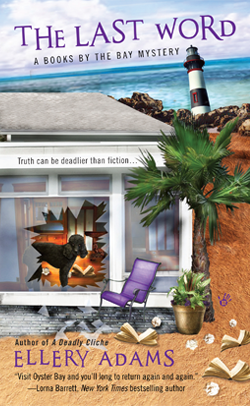
Ellery Adams, who also writes as J.B. Stanley and Lucy Arlington, told a group of mystery writers and readers, that having worked at a bookstore, she was convinced she could write a mystery better than most that were on the shelves. “I was feeling very snobby about it.”

She also was a school teacher for eight years so “you can see why I wanted to kill people,” she said with a friendly laugh.

She chose the name Ellery Adams because she loved the works of Ellery Queen and because she wanted to be in the front of the bookshelves.  The name Lucy Arlington originated when she was in Arlington, Va.

The different nom de plumes are helpful, Ellery says. “You can completely fail and come back as a different author. You start with a clean slate.”

She does, however, get confused when she attends writer conferences. “I’m never sure who I am.”

Ellery follows a strict schedule, writing 1,000 words a day. Then she revises those words. She aims for 4,000-4,500 words each week and edits on the weekend. She writes blog posts while she watches TV.

She blogs, even though it takes away from time on her books, because “people getting to know me sells books.” Editors also are requiring authors to blog and post to Facebook and Twitter.

Because she has three separate series, Ellery works in chunks and marks her calendar with the topics of her series: Pies, Agency, Beach.

“I’ve got so many people to kill,” she said, before dashing off to another appointment and then home to write.

Author’s Eavesdropping Leads to Imperfect Characters Modeling Grace

On an evening kissed with rain and just a hint of light in the night sky, a group gathered in a large beautifully decorated auditorium at the historic Boling-Haxell House in Richmond. The group sat raptly listening to the vibrant voice of a Southern author.

The author was Joshilyn Jackson, who was in town – thanks to Fountain Bookstore – to talk about her newest book, A Grown-Up Kind of Pretty.

Joshilyn Jackson

Joshilyn Jackson discusses where she finds her ideas. (Photo by Cynthia Price)

She tells the audience, “Y’all are a dying breed. You take a night and sit around and discuss literature.”

Audience members had lots of questions for the author, too.

When asked where she gets her ideas, Joshilyn first offers a facile answer. “Take a mentally ill person and a ream of paper and have them love each other very much,” she tells the audience, which erupts in laughter.

Then she turns serious – for a moment – and explains that her characters come from both the landscape and from eavesdropping.

“I find Southern landscapes evocative,” she says. She grew up on the Florida Gulf Coast, which she describes as “white, sugary and pristine.” She later moved to the Mississippi Gulf Coast, which she describes as a deep, rich green. “It is a verdant landscape,” she says repeatedly, noting that she has been chastised for using the word “verdant” too often. She even catches herself during her talk and stops using the word.

Joshilyn admits to being a “terrible inveterate eavesdropper.” She warns her audience, ““If I’m ever sitting next to you reading, you better watch your mouth.”

An airport is a favorite place for eavesdropping. “Everyone is going somewhere, and you only get two or three sentences” of the conversation, she says. Then she simply imagines.

One such overhead conversation at an airport became the basis for the character Mosy Slocumb in her newest book, which she originally intended to be her funny book.

However her friend Lydia Netzer – author of Shine, Shine, Shine – told Joshilyn that she needed to rework the book and find a way to let Liza speak. At first, Joshilyn says with a chuckle, “I simply hated Lydia.”

She took the advice, though, and reworked the book. “It took off when I let Liza go and let her infest the book,” Joshilyn admits.

The premise of most of her books is straightforward. “How can imperfect people model the best version of grace that they can?” Joshilyn explains.

Most of her books, she says, take her between 18 months and two years to write. “I’m really blessed that I don’t sleep,” she says. “Really, I don’t.” She often is up at 4 a.m. and will write until it’s time to send her children to school. Then she heads to a coffee shop to write until her children return. Joshilyn, while supportive of her children’s activities, says she’s not above “stealing an hour” at soccer practice, track meets or ballet rehearsals to write.

She also speaks highly of her editor. Joshilyn describes an editor as “a person who shows you where your map has failed.”

So far, Joshilyn’s map has not failed.
Advice to Get Your Book Published

If you think writing your book, is the hard, part, think again.

Ellery Adams, Meredith Cole and Mary Burton offer advice on how to get your book published. (Photo by Cynthia Price)

That’s the advice of a trio of mystery authors who spoke to the Central District Sisters in Crime group earlier this year.

Mary Burton, who has written eleven historical romances for Harlequin Historicals and four short romantic suspenses for Silhouette Romantic Suspense, says writing is a business.

Meredith Cole, who lives and writes in Charlottesville, Va., advises, “Be an editor and agent’s dream.”

Her mystery series with St. Martin’s Minotaur is set in the art community in Williamsburg, Brooklyn, and was nominated for an Agatha Award. “You want to produce a very well written book in a genre they can sell,” she says.

A key step to getting published is securing an agent. The way to do that is through a query letter, which are not easy to write. “It’s easier to write the book,” Mary says.

Their advice:

  1. Be as brief as possible
  2. Be as relevant as possible
  3. Write it professionally
  4. Reference relevant details

For example, Mary says, if you attend a writer’s conference and met the agent – even briefly – you should note the meeting in the letter. Or if you know the agent succeeded in publishing a book, note that. “It shows you’ve done your research,” Mary says.

They also suggest making an extensive list of agents within the appropriate genre. One site to help with that is agentquery.com, says Ellery Adams, who has written several mystery series. Another useful site, she says, is BookEnds Literacy Agency, which includes helpful posts about word count and sample queries.

When querying an agent, they recommend emailing 20 and then waiting about six weeks for the responses. “If you get 20 rejections, the query is probably poor,” Mary says. They suggest using the rejections to rewrite and try again.

When you do get to meet with an agent, they recommend having three good questions to ask and also having a paragraph about your book ready to share.

When it comes to getting published, Mary says, “Persistence is just as important as talent.”

Reading for Success

I recently reordered my one bookcase so that all of the business, leadership and self-help books that I’ve purchased and have not read were shelved together. I figured it would be a small section. Wrong!

(Photo by Cynthia Price)

Then I looked back on my blogs for the past year and discovered I had only read four such books – and that included the ones I read for the business book club to which I belong.

The ones I read this year had some great points. Here’s a quick recap:

Drive: The Surprising Truth About What Motivates Us by Daniel H. Pink describes the secret to high performance. It’s about autonomy, mastery and purpose.

Start Something That Matters by Blake Mycoskie tells the story of TOMS shoes but also offers lessons from innovative companies.  The section on “Keep it simple” particularly resonated with me.

TouchPoints by Douglas Conant and Mette Norgaard describes interruptions as “opportunities to touch someone and improve the situation.” The interactions are framed using the TouchPoint Triad: Listen, Frame, Advance.

What Got You Here Won’t Get You There by Marshall Goldsmith forces you to look at various habits that may hold you back. Fortunately, Goldsmith also provides ways to change for the better, whether it’s through feedback, listening, thanking or following up.

Business and leadership books are a great way to keep your skills and thinking fresh. One of the subjects I want to learn more about is change management. To make sure I schedule time for reading about the topic, I recently agreed to present a short session on the subject at work. Now I have no excuse.

What books would you recommend I add to my list?

Start Something That Matters

I’d been hearing about TOMS shoes and how cool they are. Plus, they give back.

(Photo: TOMS website)

Fortunately, the founder, or Chief Shoe Giver of TOMS, published a book called Start Something that Matters. In it Blake Mycoskie tells the story of TOMS. The business model is simple: “With every pair you purchase, TOMS will give a pair of new shoes to a child in need. One for One.”

The book isn’t all about TOMS, though. Blake also shares lessons learned from other organizations, such as FEED projects, chartity: water and TerraCycle. Some I had read in other books but it’s always good to hear them again.

I read this as part of my business book club. TOMS built a business based on social innovation, and we wondered if it’s possible to build pockets of social innovation within an organization, especially if a company is already large and established. Trying to change an entire culture might be difficult, but we decided if you create a pocket you might have success, and it could spread. That’s actually one of the reasons for the book club – to bring different functions of the organization together for discussion.

Blake talks about the need to “find your story.” The TOMS story resonates and is easy to tell. Is your organization’s story easily told? What about your personal story? If not, how can you make it so it is?

Stories must be specific and you must know your audience. Blake writes, “Make sure your story is crafted to appeal to the people you really want to become your supporters and that it draws from your core strength.”

One section that resonated with me and of which I need constant reminding was the chapter, “Keep it Simple.” He shared simple ideas that became great companies, including Chipotle and Craigslist.

He also talked about the need to create a simple environment in which to live and work. I confess that after reading that chapter, which stressed uncluttering your workspace, I cleaned out an entire file cabinet. I didn’t need the materials and even though they were out of site, they were weighing me down. Now I can focus on my priorities.

Although I’ve not met Blake, I suspect the book is a lot like he is – filled with energy. If you want a quick read that shares innovation, good life lessons and the story of TOMS, this is the book for you. Plus, if you purchase a book, a new book will be provided to a child in need.

Note: I didn’t purchase my book. I received it when I was selected for the Books for Bloggers Program. I’ve shared my copies (I received two) with others because the book is an easy read with wisdom worth sharing.