Touch Points Provide Leadership Opportunities

In the preface of TouchPoints author Douglas Conant, president and CEO of Campbell Soup Company, explains that he doesn’t get tired of “ceaseless interruptions” because he doesn’t see them as that. Instead, he says, “They’re opportunities to touch someone and improve the situation.”

That really resonated with me. I have many interruptions in my day, and I often viewed them as disruptive. But after reading this book, I have a new perspective on each of these interactions.

Conant and his co-author Mette Norgaard argue that through these interactions leaders are able to increase their impact and promote their organization’s strategy and values.

In the book the authors discuss the TouchPoint Triad: Listen, Frame, Advance. A good starting point is to ask the question, “How can I help?” Framing the issue ensures that we have the same understanding of the issue. Advancing means deciding what steps to take next. A final point, they make is to follow up to see how things worked out.

This isn’t a weighty book, but it definitely changed my approach to the opportunities I have to interact each day.

How do you spend your day? Do you have interruptions or opportunities?


Literary Awards Are a Night to Remember

One day my book will be finished and it will be archived at the Library of Virginia. Until that day, I live vicariously through my author friends (author, as in published book; not writer, as in still working on one).
Literary Awards 2011

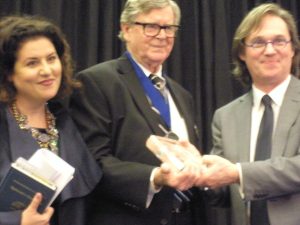
Adriana Trigiani, Earl Hamner and Richard Thomas celebrate Hamner's Literary LIfetime Achievement Award. (photo by Cynthia Price)

The best way for me to do that is at the annual Library of Virginia Literary Awards. As in years past, Adriana Trigiani hosted the evening. Herself a gifted and prolific writer, she always provides plenty of laughter and nuggets throughout the evening. This year was no exception. She related a story about writers.

“You’re a very dangerous person,” she said of writers. “Nothing is sacred.”

She talked about eavesdropping on some women on her flight to Richmond. All of us writers, scribbled the story down thinking, “This could work in my book.”

What did they say? They were talking about attending a wedding, and one of the women, in her best Southern drawl said, “First we’re going to socialize, then we’re going to scrutinize.”

Seriously, I couldn’t write it better than that.

While I try to be professional – after all, it is a black tie evening – I couldn’t help but introduce myself to Jan Karon, whose books I devoured during a few weeks after discovering them. Her Mitford Series, Adriana said, changed lives. And as Jan told me, “I try to give you a bit of peace from today’s crazy world.”

I can’t wait to read In the Company of Others, which won the People Choice Award for Fiction this year. She said of her win,” I am shaken, thrilled and delighted.” And she shared what almost everyone in the audience thinks about libraries, “It makes my heart beat faster to be in a library.”

And the evening is about being seen. Even Adriana admits to falling prey to it, describing David Baldacci, who presented the Emyl Jenkins Sexton Fiction Award, as “eye candy.” In talking with him about it later, he just laughed and rolled his eyes. I’ve always enjoyed his books, but as an aspiring author, I appreciate the time he has always given to writers.

The award he presented is always bittersweet as I remember my dear friend Emyl Jenkins. She continues to sprinkle fairy dust on me from afar, and for that I always will be grateful.

The highlight this year for me was watching my friend Julie Campbell win the People’s Choice Award for Nonfiction for her book The Horse in Virginia.

For many in the audience, the highlight was watching Earl Hamner receive the Literary Lifetime Achievement Award, which was presented by John-Boy Walton himself, Richard Thomas. As Hamner spoke, I was taken back to my childhood days, watching The Waltons with my family. At the beginning and ending of each episode, we heard Hamner speak and wrap up the episode, usually with a philosophical thought.

Thomas described each episode as “an American short story” and said of Hamner, “He wrote these wonderful words for us to say.”

Hamner told the audience, “Virginia has given me fine gifts,” including “the wellspring of everything I have written.”

Until next year’s Library of Virginia event, good night John-Boy.

Campbell Wins People’s Choice Award

Julie Campbell

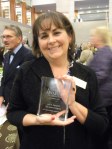
Julie Campbell proudly displays her People's Choice Award. (Photo by Cynthia Price)

Many years ago, Julie Campbell attended her first literary awards at the Library of Virginia. Never did she dream she would be up on stage accepting an award for a book that she had written, but that’s exactly what happened during the 14th annual Literary Awards yesterday.

Julie won the People’s Choice Award for Nonfiction for her book, The Horse in Virginia: An Illustrated History. It explores the history of horses in Virginia during four centuries, including how the horse fit into society at any given time.  The University of Virginia Press developed the concept and hired Julie to write it and find the illustrations.

In her acceptance, Julie thanked many people, including those from Virginia Press Women, who had encouraged her through her years of writing the book and were there to celebrate her win. And she said, “Thank you for the stars that aligned tonight.”

The evening was all the more special because she had always been an admirer of Earl Hamner, who was the force behind the semiautobiographical television series The Waltons. During the Literary Awards Hamner was honored with the literary lifetime achievement.

Congratulations Julie!

Write It, Publish It!

Rainbow Rowell, author of the romantic comedy Attachments, one of Entertainment weekly’s top 10 “Best of Summer” reads, told an NFPW audience that she had been a journalist for so long it was hard for her to write beyond a few inches. Rowell is a lifestyle and pop culture columnist at The Omaha World-Herald.

"Attachments" by Rainbow Rowell“Writing something like a book is like wading into the ocean when you can’t see the bottom,” she said of her novel, which came in at 87,000 words.

But she waded in, cramming in writing whenever she could. She wrote on holidays and usually one day during the week (often Sundays). Rowell said she couldn’t simply write for an hour each day as many authors do.

“I can’t just dive in and out. I have to have blocks of time to write it. I have to get to a place where it can just come out of me.”

After completing the manuscript, she found an agent and two years after the book sold it was published.

Rowell says that finding an agent is the most difficult part of getting published. “Publishers don’t look at anything unless a literary agent gives it to them,” Rowell said. “They trust the literary agents to weed through the manuscripts.”

Rainbow Rowell

Rainbow Rowell shares publishing tips.

To find a literary agent, Rowell suggested looking through books that list agents. She also said that going to writers’ forums is a good way to learn about  others’ experiences with an agent.

Agents all have different rules for submissions, and Rowell said you need to follow them. “You have to give them exactly what they want,” she said. “They want to make it hard for you.” The agents receive so many submissions, this is a means to weed out the crap.

The best is when the agent asks you to send your manuscript. “Then you are in,” the author said.

A few additional tips she shared include:

  • Write only a one-page query letter.
  • Never call it a book. It’s a manuscript. “The publisher gives you a book,” Rowell said.
  • Start with your bottom choice for literary agent, saving your favorite agent for your final query. “Let other people reject you first so you can learn from them,” she said.
  • Don’t do any pitching to agents in the summertime. Rowell said, “They kick into gear after Labor Day.”

Mystery Novelist Shares What She Loves

Alex Kava, who has written 11 novels, including nine in the critically acclaimed Maggie O’Dell series, grew up in the small town of Silver Creek, Neb. As an aspiring writer she was always told to write about what she knows.

As she told an audience at the 2011 NFPW conference that didn’t work for her. “I write about murder,” she said as the audience laughed. “I can assure you, I am not writing about what I know.”

She shared some of what she has learned.

Cover of Alex Kava's book, HotwirePersistence is just as important as talent. Alex said she received 116 rejections from literary agents. Her first novel still sits in the bottom of a drawer, although she is thinking about turning it into an e-book. Today her novels are published in 24 countries.

When you bump your head against the glass ceiling, you look for any crack you can find and you improvise. Alex, whose real name is Sharon, said when she submitted her novel agents would tell her to tone it down, that it was too violent and that she should add some romance. “They were really telling me they had no idea how to sell something that wasn’t romantic suspense,” she said.

Recognizing that her name was an obstacle, she changed it to one that could be misconstrued. She wasn’t mad that she had to do it  because she figured if agents couldn’t tell if a man or a woman had written the book, it was a compliment to her writing.

The same holds true for her character Maggie O’Dell. The character, Alex said, can’t have as many one night stands as a male protagonist. And she can’t cry, drink excessively or swear.

Truth is stranger than fiction. “If my readers can’t tell what’s fact and what’s fiction, then I’ve done my job,” Alex said. If she doesn’t know something, she researches it, and as she noted, “I learned all kinds of information that you can’t use at cocktail parties.” She knows the difference between a floater (body in the water) and a flyer (someone who is pushed or jumps to their death). She knows how a taser works. And she knows when a body starts to decompose.

If you are going to be a writer, you have to have very thick skin. “Your success will depend more on how you respond to what they say then on what they say,” the author said.

Eleven novels into her career, Alex Kava doesn’t write what she knows, but rather what she loves.