Innovating, Succeeding Thanks to Books

Books provide inspiration about innovating and leading. (Photo by Cynthia Price)

The leadership book club I belong to at work just finished a great read about innovating. Next up is one about introverts succeeding in an extroverted world and then one on leadership. I always have found inspiration in leadership, management and self-improvement books, but the impact is even greater when I’m able to discuss the books with others.

If you’re looking for ways to innovate and succeed, here are three books to read:

The Future of Nonprofits: Innovate and Thrive in the Digital Age by David J. Neff and Randal C. Moss: The book jacket notes this “comprehensive playbook demonstrates how to create and launch a new, more flexible, innovative organization that is better equipped to embrace and leverage today’s digital technologies.”

Quiet: The Power of Introverts in a World That Can’t Stop Talking by Susan Cain: “This extraordinary book has the power to permanently change how we see introverts and, equally important, how introverts see themselves,” notes the book jacket.

The Leadership Challenge by James Kouzes: The preface notes this is about “how leaders mobilize others to want to get extraordinary things done in organizations. It’s about the practices leaders use to transform values into actions, visions into realities, obstacles into innovations, separateness into solidarity and risks into rewards.”

What other books would you add to this list?

Media Tips from Gillian Flynn’s ‘Gone Girl’

Gone Girl coverI just finished reading a riveting suspense book called Gone Girl by Gillian Flynn. One of the characters has to be prepped for a media interview. The section resonated with me because of all of the media interviews I had to give as a spokesperson. In my current role, I do the same, just not as frequently, so I thought I’d brush up some on how to give a successful interview.

Practice: Don’t think you can meet with a reporter (either print or video/digital) and expect to easily answer questions and succeed in the interview. In advance, develop a list of questions you expect will be asked. Then find someone to ask those questions of you and answer them out loud. That way you can determine how far off the mark you are and what you might not have an answer to. Don’t over practice, though, as you don’t want to come across as too polished.

Answer the question and stop: A common mistake is for an interviewee to keep speaking to fill silence or gaps. Answer the question the reporter asked and then stop. If there is silence, don’t fill it. The reporter will quickly ask another question, especially if it’s for television, because the reporter won’t want silence. If you keep talking, you are likely to say more than you had planned to share.

Be truthful: If the topic is difficult, you need to answer honestly. If you don’t, the reporter – and subsequently the audience – will know it. You will continue to be hounded until the truth comes out. If you don’t want to talk about a situation, then don’t agree to the interview. But be aware that a reporter will find someone else to discuss it, and that person’s version may be even less flattering.

The character in Gone Girl prepped for the interviews and did well. If you follow these tips, you will, too.

Authors’ Words Provide Inspiration

Most people have an office in their home. I have a library. It’s a matter of word choice, but for me, it also sends a message. One day I will publish a mystery and my book will grace the library shelves.

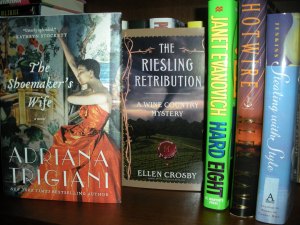
In the meantime, I write in my library surrounded by signed copies from some of my favorite authors, whom I have been fortunate to meet.

Books on a shelf

Books signed by favorite authors provide inspiration. (Photo by Cynthia Price)

There is Janet Evanovich, who at her book signing, spent a few moments giving me advice and suggested writing critique groups for me to seek out.

There is Adriana Trigiani, whose advice is simple and direct, “Just write!”

There is Emyl Jenkins, who provided me with fairy dust, to keep my writing inspiration alive.

Another favorite is Michael Connelly, whom I met at a mystery writers’ conference. I passed him in the foyer and said hello as if I knew him. Of course, I didn’t, I just felt like I did because I was familiar with his photograph on the back of his book jacket. It didn’t matter. He found a sitting area and spent a few minutes with me, also giving me solid advice.

David Baldacci is another favorite. He always makes time for his fans, signing books and answering questions. Like the other authors mentioned, it doesn’t matter how many times he makes the best-seller list, he still is approachable and pleased to talk about his craft.

So while I continue to write and re-write, I surround myself with the words – both on paper and in person – of other authors.  And I leave space on the shelf for what I hope will be the first of many books I publish.

What helps you write and where do you write?

Tough Cop Writes About Teddy Bears

As a cop, John Lamb admits he had a reputation for being “the coldest human being on the planet.”

Then he met his future wife Joyce, who said to him, “You’re nothing but a big teddy bear.”

John Lamb is a tough cop who writes a teddy bear mystery series. (Photo by Cynthia Price)

Teddy bears would become a key character in a series of mysteries he would write. Lamb is the author of the “Bear Collector” mystery series. He also is a retired cop with 22 years of service with a Southern California police department. During his career he served as a patrol officer, hostage negotiator, homicide investigator and patrol sergeant.

The first gift he gave his future wife, naturally, was a teddy bear. The two started collecting handmade bears. “They are original, and they’re amazing,” Lamb said.

As a cop, Lamb said he often held a dim view of the human race. The beauty of teddy bear collecting is “There aren’t any teddy bear jerks.”

After retiring to the Shenandoah Valley in Virginia, Lamb’s publisher told him they were looking for a new line of cozies – mysteries in which there is no blood and no guts. Lamb realized, “I’m living a cozy” as he sat on his front porch and thought about the hundreds of teddy bears he and his wife had collected and their comfortable home with six cats and two golden retrievers.

He wrote the first few chapters of the first book, The Mournful Teddy, and within 24 hours had a three-book deal.

He would go on to write four more books in the series, all with the word “teddy” in the title. “You have to have a word you can hang your series on,” Lamb said.

His most recent work is a suspense thriller, which he is working to get published. The publishing world is much more challenging today, Lamb said. “We no longer build or grow an audience,” Lamb said. “If it’s not a homerun, they don’t sell them.”

Despite such obstacles, Lamb said, “I love writing. I’m going to keep writing.”

Celebrate National Library Week

How do you read? Perhaps, I should be asking whether you still read.

It’s an interesting question and one I wanted to pose given that this week is National Library Week. One of my favorite authors, Ellen Crosby, posted a survey on her Facebook page asking people how they read. The choices were – they buy the book, they read on an e-reader or they go to the library. The winner was real books that are owned, followed by library books.

Of course, this was a small survey and is not scientific, but I started thinking about how I consume books. I’ve moved a lot in my adult years so I’ve always tried to keep my collection of books manageable. Despite that, if I moved today I would easily fill 15 to 20 boxes with books – and those are only my favorites that I’ve kept. And then there are all the business and leadership books that I have at work.

To cut down on books, though, I’ve become a huge fan of my library. I can walk to it and pick up a few books. I also volunteer with the Friends group of my library. We hold two books sales each year. This is great because I can buy books, read them and then contribute to the sale. I also coordinate our Writer Wednesday series where authors come in and speak about their books. Topics have included mysteries, remodeling, history and anything else that will interest our patrons. The wonderful part is that the topic almost doesn’t matter because readers love to meet authors.

Books and more books

E-readers, library books and purchased books -- I read them all! (Photo by Cynthia Price)

I also have succumbed to the e-reader. Last fall I traveled to Indonesia, which is a 30+-hour journey. I needed some variety in my reading choices and not much weight in the suitcase. So I bought a Nook. I love it for traveling and enjoy reading on it. I have some friends who even have abandoned a physical book for their e-readers. Apparently, we’re not alone. A Pew Research Center survey showed that one in five American adults read an electronic book in the last year.

For me, though, at the end of the day, I still want to hold a book, preferably new, so I can sniff the ink on the page and hear the sound of the pages crinkling and the spine slightly cracking as I open it to explore.

Would you take the time to share how you consume books by posting a comment this week as part of National Library Week?