Check Your Facts Before Publishing

Have you read something on social media and immediately shared? Did you stop to think about whether it was accurate?

It’s a question, I honestly hadn’t given much thought to on my personal Facebook page, but now I’m pausing before I hit share.

At a recent media conference, Bill Schackner of the Pittsburgh Post-Gazette questioned, “Just because you can send it quickly, should you?”
(Source: ING)

(Source: ING)

Unfortunately, it seems as if that is exactly what many reporters are doing.

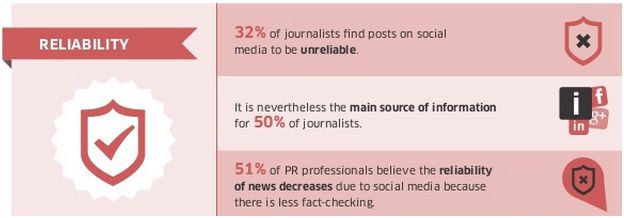
A new survey from Dutch company ING found that 45 percent of international journalists “publish as soon as possible and correct later,” while only 20 percent always do their due diligence before publishing.

Additionally, the 2014 Study Impact of Social Media on News report, created for PR professionals and journalists, reported that one-third of journalists don’t consider social media posts a reliable source of information.

That doesn’t mean they don’t see the value of social media posts. Fifty percent said the majority of their news tips and facts come from social.

Scott Jaschick, editor and founder of Insider Higher Ed, said at the same media conference, “We now have unofficial sources of information. That really helps.”

I was encouraged, though, when he told the audience to lots of applause, “We’re old school journalists. We actually like to confirm facts.”

Maybe more journalists will return to the days of fact checking.

Finding Time to Write a Book in the Digital Era

The surprising thing about being a writer says novelist Ellen Crosby is “how hard you have to fight to find the time to write.”

Ellen Crosby

Ellen Crosby spoke about her latest book, Multiple Exposure, at the Library of Virginia.

Crosby shared her thoughts on the topic during a talk at the Library of Virginia.

Her editor told her she had to be on Facebook. The publishers “Really believe that’s the future,” she said.

Publishers are less likely to send the authors to a bookstore. “They want the magic of the internet,” Crosby said.

That means she needs to be on Facebook, Twitter and Pinterest. She also writes a blog and maintains a website, although she said, “I have eight visitors on a good day.”

“It’s a very big part of my day,” Crosby said. “I try to do it cheerfully, although I’d rather be writing.”

On her social sites Crosby shares about upcoming book appearances and signings. She also shares tidbits related to her books. She’s currently doing a photo blog, which ties directly to her latest book, Multiple Exposure.

(Courtesy of Ellen Crosby.com)

(Courtesy of Ellen Crosby.com)

Engaging on social does require time and effort. A few tips gleaned from numerous talks include:

  1. Align your social media profile picture with your brand. Use a photo of you that appears on your book jacket or use the cover of your book.
  2. Include a short description of your books and links to purchase books.
  3. Respond to replies and comments. You want to engage with your community.
  4. Plan your posts and tweets so you have fodder and aren’t spending all of your time writing for your social sites instead of writing your book. It’s acceptable to share information related to your subject matter. For example, Crosby can share about photojournalism or wine country.
  5. Cross pollinate. Not everyone will visit your website or follow you on Facebook. It’s okay to use content more than once.
  6. Post photos because they help your posts stand out and they create an emotional connection with your fans.
  7. Ask your fans to retweet and repost or to write mini reviews.

My Blog Stats — Thanks Readers

Writing Cynthia’s Communique is a labor of love.

fireworksI’m now in my fourth year and expect to continue the blog through the end of the year. Then I’m going to decide whether to continue it.

In the meantime, I wanted to say thank you to everyone who subscribes, reads it and/or passes it on to others. WordPress recently shared individual reports with bloggers. In 2012, I posted 105 new posts. The busiest day of the year was April 18th with 52 views. The most popular post that day was National Columnists Day.

Most people find my blog via Facebook, LinkedIn or NFPW’s website.

Occasionally someone will tell me face to face that they enjoy reading my blog. It’s something any author loves to hear. I also have several faithful readers, who also regularly comments on my blog, and I’d like to give them a shout out. I’m only going to use their first names, and I hope they know who they are. I greatly appreciate the feedback. It keeps me going. So thank you…

  • Mary Lou
  • Nancy
  • Roger
  • Louise
  • Bonnie

I don’t know where 2013 will take the blog. A friend suggested I publish some of my blogs so I am considering putting together an e-book based on the blog. In the spring I’m taking a class, which may help me decide whether to do so or not. At the least, it will be the basis for another blog.

Thank you for another great year. And if I may be so bold, would you share my blog with a colleague or friend whom you think would benefit from reading it?

Thanks!

LinkedIn Celebrates 200 Million Members

LinkedIn InfographicAre you on LinkedIn?

If you’re not, then you may be missing out. LinkedIn announced that it has reached 200 million members and noted that about two members per second join LinkedIn.

It also put together a cool infographic about who has the most LinkedIn members (United States) and the fastest growing countries on LinkedIn (Turkey).

The most followed on LinkedIn are Richard Branson, Barack Obama, Deepak Chopra, Tony Robbins and Jeff Weiner.

I’m not on the site each day the way I am with Facebook. I do get on at least weekly, and more so when I’m recruiting to fill a position. I also appreciate updates from those in my network. I want to know who has a new job or who recommends a book or article to read.

How are you using LinkedIn?

Pinterest Attracts New Audience

Last week Pinterest revealed it was offering secret boards. As the email said, “Secret boards give you a place for things you’re not quite ready to share yet, like a surprise party, special gift ideas, or even planning for a new baby.”

Pinterest boardPinterest is testing the feature. For many, though, Pinterest itself is a secret. Pinterest is a virtual pinboard to organize and share the things you love. At a recent meeting focused on Pinterest many in the audience were only vaguely familiar with the social media platform. Others weren’t sure how to fit it into their communication strategy.

One way to measure the success of Pinterest is by how much traffic it drives to an organization’s website. Wendy Scherer, who oversees social media efforts for Cabot Cheese, a cooperative of 1,200 family-owned farms in New England, said huge volumes of website traffic come from Pinterest.

For Cabot, “The boards aren’t just about us. We wanted to be inclusive,” Scherer said. “We talk about Vermont. We talk about farms. We talk about cows.”

That leads more people to find Cabot Cheese because they are coming to the site, not for the company, but because of things they are interested in. “They find us through our content, like a recipe, rather than our brand.”

For the National Wildlife Federation, Pinterest is ideal for fun and inspiring messages, said Danielle Brigida, digital marketing manager for the NWF. “We’re trying to be fun about it.”

Loren Pritchett, who is a colleague of mine at ChildFund International, also served on the panel. She talked about how Pinterest targets other audiences. “We see this as a place where we are reaching out to the next generation of ChildFund supporters.”

She added, “Many are sharing because of social interest.”

As with all social media, determining the platform’s return on investment is tricky. Most are measuring through repins and which boards are most active. Referring traffic also is studied.

“Everyone is trying to track,” said Danielle. “It’s crazy, though. Pin shares often go farther than a Facebook share.”