Osmond Hears With His Heart

Justin Osmond was born with a 90 percent hearing loss.

Imagine that, especially if you were born the son of Merrill Osmond, the lead singer of the world-renowned Osmonds.

Justin, who spoke to the NFPW 2013 conference, said “Imagine life without sound.” As he continued to “speak” the audience could see his lips moving but could hear nothing but the sound of silence.

“That’s what my life was like without hearing aids,” he said as he raised his voice.

Today one in five teenagers has a documented hearing loss, in part, because of the prevalent use of ear buds and playing music on mp3 players too loudly, Justin said.

His hearing lost presented challenges for him, but he chose to challenge his limits. He recognizes his hearing loss and said, “It’s okay. It’s who I am.”

He added, “I have a hearing loss, but that hearing loss does not have me. “
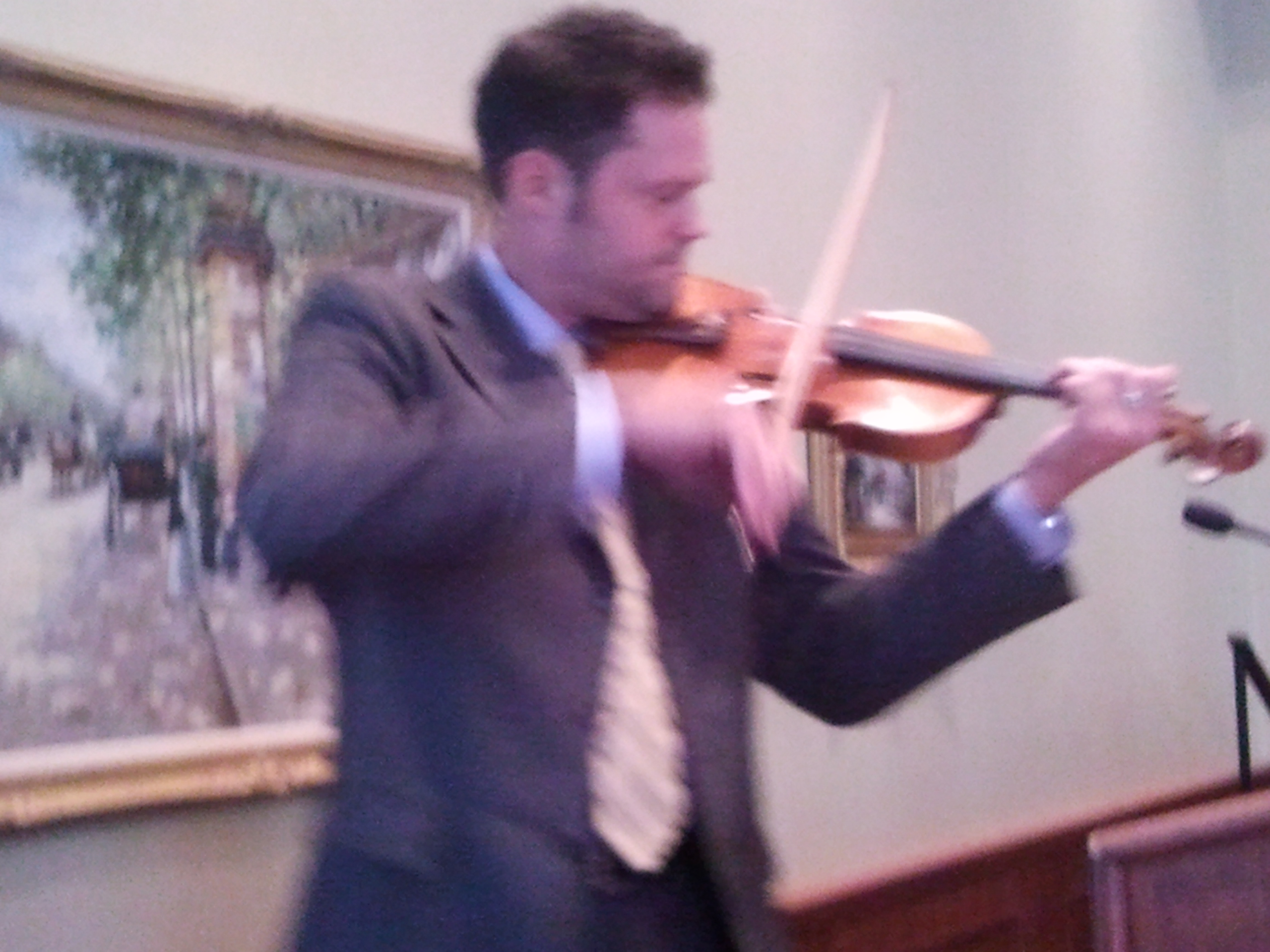
Justin Osmond learned to keep the beat by watching his brother's bow.

Justin Osmond learned to keep the beat by watching his brother’s bow. (Photo by Cynthia Price)

As he smiled and joked with the audience, he shared other popular sayings that contribute to his positive outlook. For example, “If there are no ups and downs in life, it means you are dead.”

He spoke of becoming more assertive and also of service. “Whatever your profession, always make time to help others, to serve one another.” Because of his hearing loss, he established the Olive Osmond Hearing Fund, in honor of his late grandmother.

A video he shared showed the many faces of the children the fund has helped. Dry eyes were few in the audience as it watched children receive the gift of being able to hear for the first time. Their faces beamed and they laughed as they came to hear sound.

Justin encouraged the audience to never give up. “You may have a challenge but don’t let those challenges have you.”

As a young boy, Justin learned to play the violin. He could feel the vibrations along his jaw line. However, when he performed with his brothers, he wasn’t sure if he was keeping the beat. Then he struck on the idea to watch his brother’s bow – and he kept the beat.

Justin recently wrote a book, Hearing with My Heart, in which he shares his story with the world in order to help everyone understand the struggles of living with a hearing loss and how to overcome it.

Summer Reading List Keeps Me Sharp

Growing up, summers meant library time and signing up for the book club. Whatever the minimum level, it was never a problem to reach as I read voraciously. I still do.

In the summer, though, I tend toward less weighty subjects that are best read poolside. I do, however, create a summer reading list to keep me sharp.

This summer is no different, and I’ve selected five books, which is a bit ambitious.

The Marketing Agency Blueprint by Paul Roetzer. This one was recommended to me by Brian Forester of Dynamic Web Solutions. The book presents 10 rules for building tech-savvy, hybrid agencies that will disrupt and transform the marketing services industry. One caveat, several reviews criticized it for its heavy focus on HubSpot. I still think I’ll benefit from it as the communications world now has such a heavy focus on digital.

Katie Paine shared her books at a workshop. (Photo by Cynthia Price)

Katie Paine shared her books at a workshop. (Photo by Cynthia Price)

Measuring the Networked Nonprofit by Beth Kanter and Katie Delahaye Paine. The premise is simple, “If you want to change the world, be networked, use measurement and make sense of your data.” I’ve heard both authors speak, and I follow Beth’s blog. When Katie spoke to my local PRSA chapter, I finally bought the book. She also signed it for me and provided some great inspiration, “May all your results be great by any measure and may you change children’s lives with data.”

Engage by Brian Solis. This one’s been out for awhile, and I have the version that includes a forward by Ashton Kutcher. Brian has been at the forefront of social media and this book is often touted as a must-read. The reason it’s languished on my shelf for so long unread is that every time I pick it up, I turn to a sentence that is unwieldy, and I don’t think I can read further. This past week, though, I turned to a section that did pull me in so I’m going to read it and skip over the poorly written sentences.

Authentic Leadership by Bill George. The book club I belong to at work has selected this book for our September discussion. I didn’t read the last book, so I’m determined to read this one. The Amazon site notes that George has become the unofficial spokesperson for responsible leadership—in business, the media and academia. He shows how to develop the five essential dimensions of authentic leaders—purpose, values, heart, relationships and self-discipline.

Words That Mean Success by Jeffrey D. Porro. I’ve worked with Jeff Porro and have learned much from him. In this book he tells you how to take your speeches and presentations from good to great.

Once I finish a book, I plan to write a blog on it. It’s a way to keep myself accountable. Plus, if you are interested in the book and haven’t committed to reading the book, maybe the post will encourage you.

What books do you recommend?

Professional Development Books Keep Me on Track

One of the ways I know if I’m on track is by checking the number of books I read each year, both for pleasure and for my profession. I don’t have a set number that I have to read, but I do know that if I’ve gone months without reading then I need to realign my priorities.

River

Professional development books help with one’s career journey. (Photo by Cynthia Price)

I decided to review the books I had read for my professional development, in part, because the stack that still needs to be read remains quite high. I did finish several and thought I’d pull them together in a list in case you have anyone you’re still shopping for. I included links to the original posts.

Most of try to do too many things at once. All that multi-tasking makes it difficult to focus. A great book about getting yourself set for the day is 18 Minutes. Written by Peter Bregman, it is based upon his weekly Harvard Business Review columns. Step 1 takes 5 minutes and is about setting the plan for the day. Bregman says that before turning on your computer, we should sit with a blank piece of paper and decide what will make this day highly successful. In Step 2, we refocus for one minute every hour. At the end of the day, we review for five minutes. It sounds simple. I’m fairly consistent with Steps 1 and 2. Step 3, not so much.

I’m an introvert, althoughI’ve learned to function in many settings as an extrovert. I even enjoy it. However, at the end of the day, I need to allow for quiet time, which is why at conferences I prefer to room alone and why I build time into the day for a peaceful walk in between meetings. These become my “restorative niches” as described in Quiet: The Power of Introverts in a World That Can’t Stop Talking by Susan Cain. It’s a great book for understanding the value of introverts.

In Marshall Goldsmith’s book, What Got You Here Won’t Get You There, he recommends making a list of the 25 people most responsible for your career. But he doesn’t stop there. He then wants us to write a thank you note “to confront the humbling fact that you have not achieved your success alone.”

Most of us need routines and order in our lives. If you’re like me, though, you struggle to do so. It’s about finding “the power of rhythm and routine” at work. That phrase comes from Cheryl Richardson in her book, The Art of Extreme Self Care. Creating routines “creates a sense of order that gives the mind a much-needed rest,” she writes. One of the best routines I’ve developed is printing my daily calendar for the next day before I leave the office at the end of the day. That way I already know if I have to pack a lunch or if I have an early meeting for which I must prepare. If that’s the case, I know to schedule my training session for a different day or only plan on a 30-minute morning workout. I also know what healthy snacks to pack.

Jason Womak, author of Your Best Just Got Better, warns that we are often forced to sacrifice quality for quantity. Because there is so much information to take in, he says, we’ve become a nation of skimmers. The downside of that, Womak says, is we miss essential details that could “help us improve our productivity, build better relationships and live more gratifying lives.” His book offers several suggestions, several of which I’ve implemented, including carrying a camera.

What books did you read this year that you would add to the list?

The Power of Introverts

I’m an introvert. Those who have seen me in action at work or at the NFPW conference always challenge me when I say that. But it’s true. I’ve learned to function in many settings as an extrovert. I even enjoy it.

However, at the end of the day, I need to allow for quiet time, which is why at conferences I prefer to room alone and why I build time into the day for a peaceful walk in between meetings. These become my “restorative niches” as described in Quiet: The Power of Introverts in a World That Can’t Stop Talking by Susan Cain.

It’s a great book for understanding the value of introverts. For introverts, it offers ways to function successfully in a society that emphasizes group work.

Cain describes the difference between introverts and extroverts.

“Introverts focus on the meaning they make of the events swirling around them; extroverts plunge into the events themselves. Introverts recharge their batteries by being alone; extroverts need to recharge when they don’t socialize enough.”

In her book she describes how our culture emphasizes group work – from elementary school into the business world. My book club talked about how so many of our meetings are designed for leaders to think and work as a team, leaving no time for introverts to process. While I function in those settings, that point really resonated with me.

I’m making a conscious effort with my team to give the introverts time to think and to process big ideas before we come together to discuss. That means I have to be a bit more organized providing background materials in advance. At the end of the day, though, we arrive at a better product.

Ultimately, the book, which is filled with research and insights about introversion, makes a strong case for paying attention to the listeners and thinkers.

Celebrate National Author’s Day Tomorrow

During the Library of Virginia Literary Awards Oct. 20, guests dined with the nominated authors. Host Adriana Trigiani, a best-selling author beloved by millions of readers around the world for her hilarious and heartwarming novels, asked, “You’re actually eating with writers. How is that working out?”

For most guests, it was a privilege to do so and a great way to celebrate the nominees. Tomorrow is another day for celebrating authors as it is National Author’s Day, which was created by Nellie Verne Burt McPherson, a teacher and avid reader.  She submitted the idea for such a day, and in 1949 the day was recognized by the U.S. Department of Commerce.

After attending the Literary Awards, I’m inspired to celebrate several new authors, including David Wojahn, who won for his collection of poetry, World Tree. In accepting he said of the award, “It looks like the Olympics, but it’s for brain works.”

At the event, I picked up David Huddle’s book Nothing Can Make Me Do This, which won the Emyl Jenkins Sexton Literary Award for Fiction. He grew up listening to his parents read books to him. “The sound of the human reading voice is the presence of love,” he told the audience.

David Baldacci won the People’s Choice Award for Fiction for The Sixth Man. I’m planning to read it on my next flight and asked him if I was going to jump in my seat from the suspense. He chuckled and said, “Don’t be surprised.”

Authors

Adriana Trigiani and David Baldacci are two authors worth celebrating. (Photo by Cynthia Price)

Both David and Adriana are two authors I greatly admire because despite their millions of books sold, they are both approachable and willing to sign books and talk with fans and would-be writers. They are authors to be celebrated.

In celebrating authors by reading their books, we also are achieving another success, according to Jodi Moore, who won the Whitney & Scott Cardozo Award for Children’s Literature. “In order for a book to be happy, it must be read,” Moore said in accepting her award.

Tomorrow, why not make a book and an author happy?