‘Uninteresting Life’ Leads to Many Novels for Owen

Author Howard Owen does not live an interesting life given that he’s about to publish his 10th book.

He cited a comment by writer Alice Munro, “If you live an interesting life you don’t have time to write.”
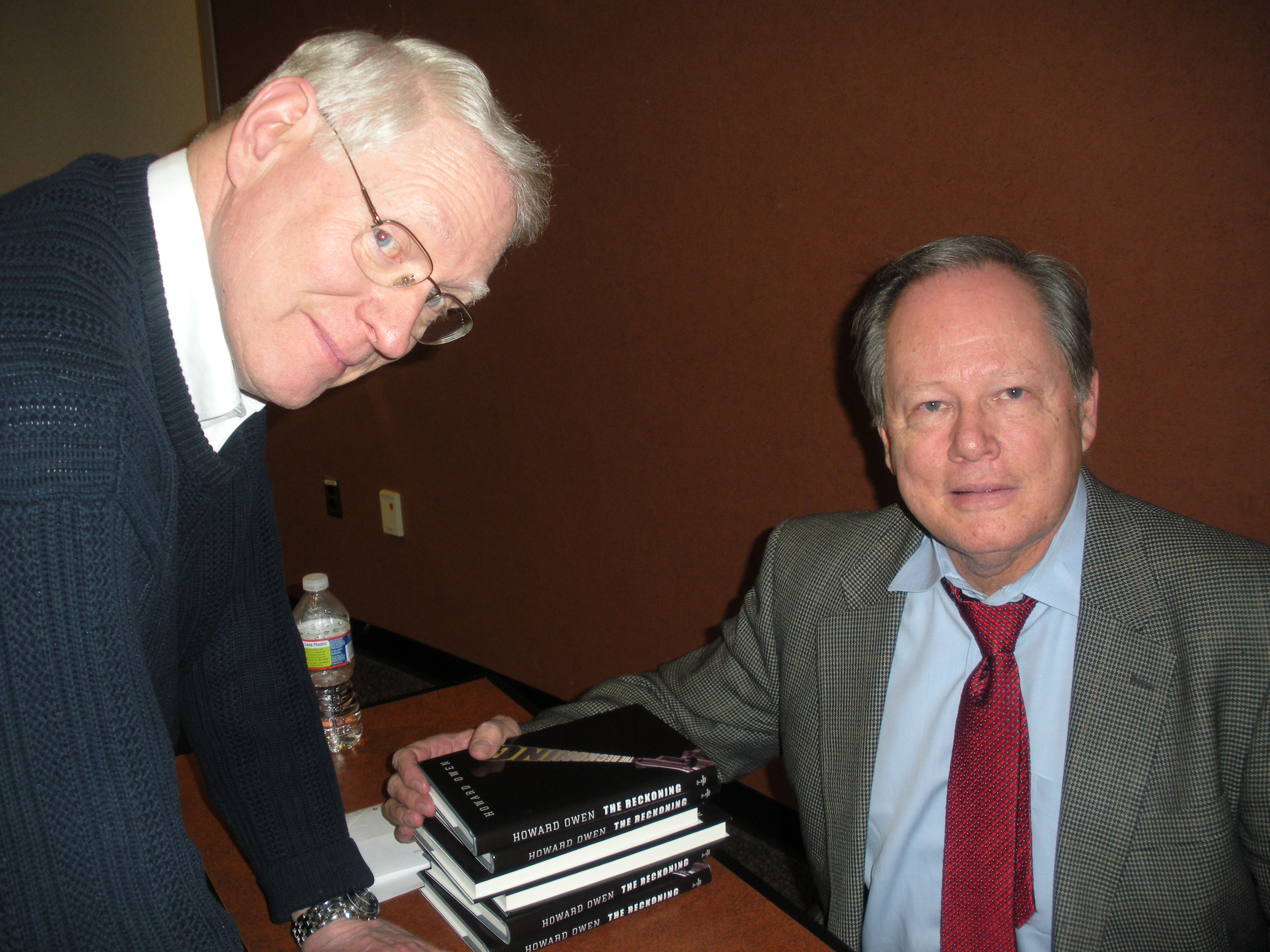
Howard Owen

Howard Owen signs a book for John Ward.

He chuckled as he shared the quote and said he draws the details of his characters from others in real life. “There’s always someone out there I can draw from,” he said during a recent book talk. “There are psychopaths, thwarted lovers, ex-baseball players and guilty baby boomers.”

Although he was 13 when he said he would first be a writer, it wasn’t until he was 40 that Owen published his first book, Littlejohn. He cited laziness, fear and not having lived an interesting life as his excuses.

Writing, he said, takes discipline to do it every day. He also feared failing. “It’s much easier to have a pipe dream,” he said. “But at 40 I realized the worst thing would be to not try at all.”

So Owen began making up characters, settings and finally stories. He found, “You pick things up like a suit picks up lint.”

He doesn’t have a difficult time starting a book, but he said everything takes planning. He’s currently reading and signing his ninth book. His 10th is with his editor, and he’s writing the 11th.

When he’s not writing novels, Owen is business editor at the Freelance-Star in Fredericksburg, Va. He writes a daily blog and quipped, “Every day I floss and blog!”

He confessed that he’s “old school” having more respect for what shows up in print and is still adjusting to social media. “I think I’m the last write in America without a website.”

He acknowledged that he has to be present on social media platforms. “You have to be on Facebook or LinkedIn whether you want to write a book or overthrow a country.”

Ultimately for Owen it comes down to one thing: “All I want to do is write.”

Drive: What Really Motivates Us

What’s the best way to reward a great employee?

If you suggest a bonus or a day off, you may need to rethink your approach to motivating yourself and others – at least according to Daniel H. Pink, author of Drive: The Surprising Truth About What Motivates Us.

He describes external rewards as the carrot-and-stick approach. Such an approach may once have worked, but it won’t in today’s ever evolving landscape. Instead, he says the secret to high performance has three essentials:

1)       Autonomy: the desire to direct our own lives

2)      Mastery: the urge to get better and better at something that matters

3)      Purpose: the yearning to do what we do in the service of something larger than ourselves.

My blog is a perfect example of the essentials at work. There is no paycheck for publishing this blog. There is no carrot waiting for me. So why do it?

For one, I am mastering a new tool (or at least learning it). I can work on it when it suits me. I choose my topics. And it has a purpose – I’m able to share information with NFPW members who may not have the time or desire to research and distill on the topics that I cover. It’s part of my service to NFPW.

The book also includes a tool kit for taking the ideas in the book and putting them into action – in your professional life, in your child’s education, in your personal life.  

If you are intrigued, but just don’t think you can fit another book into your life, check out this video that neatly depicts it.

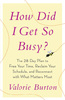
How Did I Get So Busy?

I noticed a reoccurring theme playing out during my weekends. I was always trying to catch up. And even at the end of the weekend, my “To Do” list never seemed shorter.

So this weekend I stopped and read “How Did I Get So Busy?” by Valorie Burton. It’s a 28-day program that promised to help me “rediscover my true priorities, shift out of overdrive and reclaim my life and schedule.”

Of course, I read the book in one weekend instead of during 28 days. And I read a large chunk of it while riding a stationary bicycle so clearly I needed the advice contained in the book.

As the author notes, “The problem with being too busy is that you lose your sense of self. In the race to get it all done, you give up the experience of being fully engaged in anything.”

Fortunately, I am not that far gone. I still enjoy meaningful conversations over a cup of coffee or cooking a meal from scratch for my book club. But I also knew there were areas of my life where I was not being intentional with my actions.

And so I’m now focused on being productive by accomplishing that which matters most. And I’m not going to wear busyness as a badge of honor.

I am going to exercise regularly, as I’ve already shared. In fact, I’ve hired a personal trainer to keep me on track. I’m now cooking meals on Sunday so I have lunches for the work week. I’m not eating at my desk but rather in the break room. Lunch might be finished in 15 or 20 minutes, but at least it is a break. And some days, I take an entire hour. I also have all of my vacation days scheduled.

I’m also focusing more on the journey and not the destination. I’m working on not letting technology intrude. I can be sitting right by the phone and not answer it. I’m still working on ignoring e-mail except during set times.

I’ve changed my approach to my To Do List. At the top I now list my goals for the week, listing no more than three. Then I put on the list those items that will help me achieve those goals. Anything else is not urgent and is not needed on the list. Of course, some of those items may become urgent if they don’t ever get finished so I track them using the Task List in Outlook.

I’m saying “no” more frequently. Before accepting a meeting invitation, I must know the purpose. Otherwise, I don’t accept the request.

I’m also spending quiet time each day. It’s the one I struggle with the most. I started with a minute. I’m working up to 10 minutes each day. No music, no television. Just me sitting quietly being present and not busy.

Are you too busy? How do you get unbusy?

Wanted: Book Recommendations

One of my professional goals is to read books related to my field and to leadership.

I try to read five to six such books a year, but this year I only managed to finish three. Fortunately, I read so many blogs and articles, I think I still managed to keep up somewhat with what is occurring in the world of communications and leadership.

I finished –

                Made to Stick 

                The Five Dysfunctions of a Team

                The Power of Self-Coaching

I’ve started a list for next year, including “Switch,” by the authors of “Made to Stick” and “Managing Transititons” by William Bridges. What do you recommend?

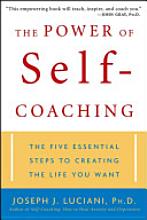
The Power of Self-Coaching

For the past year, I’ve been working with a coach. It’s been an incredible opportunity to strengthen my leadership and management skills. It’s also a lot of work. I tend to over think at the moment because I want to be sure I’m implementing what we’ve been discussing.

Along the way, I also read a book my coach recommended called “The Power of Self-Coaching” by Joseph J. Luciani. I was relieved when most of the quizzes indicated I wasn’t dysfunctional but that self coaching could enhance areas.

My biggest ah-ha moment came when I read this sentence, “A big part of why you struggle is because you’ve become attached to your problems.”

What?! Are you crazy? Do you think I like working long hours?  

Taking it a step further, the author wrote, “You can choose to create the life you want by training yourself to be a complete and successful person.”

I took it to heart. So for the month of December, I have consciously been doing a better job of prioritizing and completing the most important item (s) each day and when it’s time to go home if that item is finished, I go home. The other items can wait.  I’ve also set my alarm to go off later, thus preventing me from simply going in to work earlier.

I require deadlines when people ask me to do something for them. Without a deadline, I don’t make a commitment and I get bogged down. I also don’t hesitate to say no, especially when someone is trying to schedule another meeting on an otherwise already meeting packed day. If I’m in meetings all day, I don’t have time to do the work that I need to do or I don’t have time for strategic thinking and planning.

I also have scheduled more unscheduled time. Yep, I’ve had a few weekends of total spontaneity. It’s freed my thinking and has allowed me to feel more sane and relaxed. Who knew? The whole time I was trying to control everything, I was only making it worse.

Coaching isn’t for everyone because ultimately it’s the person being coached who has to do the work. And it is work – make no mistake. But the benefits I’m seeing are worth it. I know I’ll have to make some self-corrections as I continue to self-coach, but because I’m seeing the benefits, I’m going to keep doing the work.  

Are you ready for some coaching?