8 Conference Survival Tips

Conferences are a great way to enhance or learn new skills and to network. Ensuring a productive conference requires some planning and survival tips. As a conference veteran, here are some tips I employ.

Set Expectations. Even if you plan to respond to emails while you are at the conference, it’s a good idea to set your out-of-office response to manage expectations. I also discuss with my team in advance when I’m likely to respond to queries and how to best reach me in an emergency.

20180404_165917Bring Tools. Whether you write in a notebook or type on a laptop, you don’t want to forget to bring them. I always bring pens and at least one highlighter, which helps me note important names, points in my notes or workshops in the program that I don’t want to forget or miss. I like to bring an envelope or pouch, which I find handy for storing receipts, business cards and other relevant materials. Of course, you can also take a photo of the receipts with your phone.

Don’t forget your power cords. I keep a second cord for each device in a small tote bag that I keep with my luggage. That way I’m not scrambling to find the cords. While more hotels are now offering mini docking stations with USB ports, too many still don’t so I bring a mini multi-prong adapter for the hotel room. I can plug in two devices and two USB cables and keep my mobiles, Fitbit and laptop charged. And, of course, don’t forget your business cards.

Choose Wisely. At most conferences, there are competing sessions. Take the time to review not only the topic, but also the presenter’s bio to ensure it aligns with what you want to hear. Look at all the sessions and events to make sure you’re attending sessions on a range of topics and skills. And if you are in a session that isn’t what you expected, it’s okay to pop out and go to a different one.

Make Connections (Ahead of Time). Conferences are a time to meet new people and to build on the relationships you already have. Don’t arrive at the conference and run around trying to meet as many people as you can and don’t stalk a speaker. Instead, reach out in advance and schedule a time to meet. I do this frequently when there is a speaker whom I’d like to interview. I email them in advance and we schedule a time and location for a brief conversation. It reduces stress and allows for a meaningful interaction. During conferences I try to never eat a meal with the same group of people. I want to reconnect with as many colleagues as possible.

Digitally Engage. Follow the conference hashtag and make sure you’re tagging your tweets and Instagrams properly. You can monitor the hashtag throughout the conference to learn what others think about the speakers and topics. If a speaker mentions a resource, someone likely will tweet the resource and how to find it, which is always helpful. Social media also is a way to acknowledge great speakers, conference staff and hotel staff. Everyone enjoys a “Job well done!”

Digitally Disengage. I’ve already noted ways to digitally engage, but it’s also okay to disengage. You don’t need to stay on top of every email. Make time to put your smartphone away and introduce yourself to other attendees while you are waiting for a session to begin or during lunch. Sometimes we gain just as much from striking up a face-to-face conversation as we do from the workshops.

Stay Healthy. Conferences run on their own schedule, which may not coincide with your internal clock. Keep your energy level high by staying hydrated (always carry your own bottle of water) and snacking on items such as nuts, a protein bar or a piece of fruit. While it’s fun to socialize in the evenings, if you are feeling run down, skip a night of networking and get some zzz’s so you are ready for the next day. And don’t feel guilty if you skip a session for a power nap.

Pay It Forward. You will learn new information and be inspired at conferences. Why not share what you learned with your colleagues? That’s what my colleagues did when they returned from a conference. They created a brief PowerPoint presentation with their key takeaways from the conference. Each one also provided their key learnings, which was invaluable since they are at different points in their careers. I learned a few new things and was reminded of a few other points.

One of the things I’ve been doing when I return is designing a document that includes information, inspiration and random facts. I display it on my bulletin board where it provides inspiration and reminders throughout the year.  


4 Steps To a Productive Meeting

I have a fairly new team, and we quickly established ground rules for our meetings. I only wish all meetings followed them.

20180223_160842Agenda

We agreed to always have an agenda for our meetings. If we don’t have items for the agenda, we don’t meet. I try to follow that with all meetings that I am invited to attend.  If there is no agenda or a clear purpose, then I don’t go. That’s not always in my control, but most often it is. If someone requests a meeting with no clear agenda, I decline. Usually, the person follows up with a quick email, and no meeting is required. My boss and I meet bi-weekly, and we both add items to the agenda.

Start on time

Another frustration is meetings that don’t start or end on time. One place I worked, we basically joked that all meetings started 10 minutes late, and we referred to it as [insert name of company] time.”

End on time

Meetings that run long are equally problematic because then individuals are invariably running late to the next meeting. If you can’t get through the agenda in the allotted time, ask the participants if it’s okay to extend the length of the meeting. If it’s not possible, schedule a second meeting.

Develop an action plan

Before the meeting ends, everyone should agree on the action items, due dates and who is assigned to them. One person should be responsible for following up with individuals to ensure assignments are completed on time and shared as needed.

The Muse recently wrote about fixing the meeting overload problem. You can read more here.

Get Out Your Crayons!

Coloring has been an integral part of my life since I first began coloring outside the lines. Even as I outgrew coloring, I found I still enjoyed it. Perhaps I was inspired to keep coloring because of my mum, who often sat with my sister and me as we colored. She didn’t simply fill in the spaces, she shaded and created patterns, inspiring me to do more with my pictures.

In later years, I have found coloring cathartic. No real skills are needed and the supplies are simple. I buy my coloring books at a dollar store based on theme and begin to color away. Nothing makes me happier than a fresh box of crayons.

Clearly my penchant for coloring is well known as I have been gifted several coloring books for adults. While I appreciate the intricacies of the design, I admit to also being a bit overwhelmed. I tend to only color about 50 percent of any page, but the results are the same. I relax as I color.

If you need a reason to break out a coloring book and crayons, then Aug. 2 is your day as it is National Coloring Book Day.

I am especially excited about it because a month later, I’ll be immersed in coloring – at least for a few hours.

Crayola

(Photo courtesy of the Crayola Experience)

At the NFPW conference in Bethlehem, Pennsylvania, Mimi Dixon manager of brand equity, strategy and activation at Crayola will present “The Power of Storytelling: Crayola’s 2017 Color Promotion.” I followed the campaign closely and am excited to learn how the company took a simple idea and turned it into the biggest promotion in Crayola’s 115-year history using the power of creative thinking, disruption and storytelling.

I’ll also get to play at being a kid again when we tour Crayola Experience, where I can discover the “Magic of Color” with 28 attractions, including making my own crayon. That sounds like a great way to relax and unwind.  And you can be sure, a fresh box of Crayolas will be coming home with me!

Sleuthing to Secure Speakers

For the past several months, I’ve worked to identify and secure speakers for this year’s NFPW conference in Bethlehem, Pennsylvania

sherlock_holmes_movie_slice

Like a good detective, I turned to sleuthing to find speakers for a conference.

At first, the thought of identifying and securing 20 speakers was daunting. As I began sleuthing to identify speakers, I realized I had my ways to find them.

Here’s how I did it.

About nine months ago I reached out to fellow university media communicators in Pennsylvania. I introduced myself and shared how I was seeking experts on a variety of communications topics. Because I spend my days pitching experts on a variety of topics, I was confident these individuals would have some suggestions. And they did.

I also asked friends in the communications field if they had suggestions. I stressed that their recommendations needed to be of experts who lived and worked in the Lehigh Valley, where Bethlehem is located because we did not have a budget for travel or speaker fees. Fortunately, I received a few recommendations that way.

In my profession, I receive numerous invites to attend communications conferences on a variety of topics. I became a sleuth, digging through conference programs to identify topics of interest and speakers who might be from Pennsylvania. Once I found them, if their topic was appropriate, I reached out and filled a few more speaker slots.

Another source was individuals whom I had heard speak or with whom I had participated in one of their online trainings. I asked these individuals for speaker suggestions knowing that their calendars were likely full. Surprisingly, a few said they would be willing and were available to speak at the conference.

Facebook was an obvious source. I posted once for recommendations. Although I only received one response, the suggestion was exactly what I was seeking – and another spot was filled.

A few NFPW members also committed to speaking. It’s always nice to have first-hand knowledge of a speaker to ensure that the person’s presentation will be on point and will be geared toward the audience.

Finally, my family proved helpful. My sister told me about a speaker she heard on the topic of productivity. She found him inspiring and noted she gained numerous tips. I reached out to that person, and he agreed to speak.

My mum became a secret weapon for me. I shared with her how I was struggling to find appropriate reporters and editors from the region. Unbeknownst to me, she began to read the local newspapers with an eye toward potential speakers and then mailed me a list of suggestions with their email addresses. I should note that my mum is not on social media and does not have a computer so she went above and beyond.

With everyone’s assistance and plenty of networking, the speaker slots are filled. You can learn about our speakers here, https://www.nfpw.org/conference-speakers.php and about the topics here, https://www.nfpw.org/conference-sessions.php.

Personally, I can’t wait to learn from them.

7 Reasons to Attend a Conference

As part of my responsibilities as co-chair of the 2018 NFPW Conference, I wrote several articles promoting the conference. One of them was a list of 10 reasons to come to Bethlehem, Pennsylvania, where the conference is being held.

I should have also made a list of why it’s a good reason to attend a conference in person. Here’s my list:

Meet experts face-to-face. If the conference isn’t too large, there usually is time following a presentation to engage in conversation with the speaker and ask additional questions. Sometimes it’s about taking a photo with someone who has influenced or inspired you.

20170908_133730

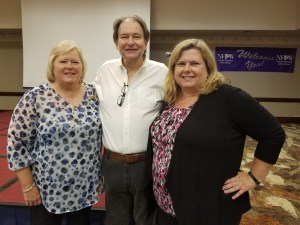
I’m hanging out with NFPW member Donna Penticuff and Rick Bragg!

Last year, at the NFPW conference in Alabama, we heard from Rick Bragg. I have been reading his works for decades, first his articles in Southern Living and later his books. I was delighted to be photographed with him. At this year’s conference in Bethlehem, I’ll meet Shonali Burke. I’ve participated in her on-line trainings and have conversed with her several times digitally, but I’ve yet to meet her in person.

Discover new tools. I still remember the first time I heard the term, “blogging.” It was at a national communications conference, and I could not wrap my head around it. But an idea was planted, and I have now been blogging for a decade. This year, I’ll be learning about podcasting. I also enjoy vendor booths because I often discover tools that can simplify my life. Best of all, I can test them.

Be inspired in a new space. Sometimes at work I leave my desk and work for an hour or two in a conference room. I simply need a new perspective. Conferences provide an opportunity to learn in a new space and encourage fresh thinking and new ideas.

Cut through the clutter. I confess I am an information junkie. Sometimes it’s a challenge to find the time to sit through a webinar or listen to a podcast. And sifting through dozens of helpful links to find the most helpful is time-consuming. At conferences, speakers deliver the content I need to hear and share ideas that are often new to me. They also often remind me of the basics.

Hang out with your tribe. One of the benefits of a conference is being with like-minded individuals. These are people who want to learn and grow their skills. They also are people who understand the challenges you face. Not only can they commiserate, they can offer solutions from their first-hand experiences.

Network outside your comfort zone. As an introvert, I struggle with networking. Through the years, though, I’ve developed some tricks to increase my comfort. I don’t try to meet everyone at a conference. I do make a point to get to know the people sitting next to me or at my table. I learn about their profession and what we might have in common. I try to follow-up with the individuals once the conference has ended. I may share a book suggestion or provide them with notes from a session that I attended but they weren’t able to. I also try to chat with at least one vendor, too. Invariably I learn about a new product or service.

Invest in yourself. I almost didn’t include this one because it seems obvious. And yet, in many ways, it’s the most important reason to attend a conference. We all have things we can still learn, and we can continue to grow our skills. Attending a conference is an investment in yourself and your career.