Digital Journalism Requires Curiosity, Good Writing

Today Lois Lane is going to be carrying her trusty smartphone when she heads out to try to interview Superman.

During a mock interview, a journalist uses a smartphone to conduct the interview.

During a mock interview, a journalist uses a smartphone to conduct the interview.

She may still have a notebook and pen to scratch a few notes down, but she’s going to want to capture video of Superman flying through the sky to save the day and upload to the Daily Planet’s website.

“The smartphone is becoming the journalist’s tool,” Danny Finnegan, editor of the Richmond Times-Dispatch, told a group of communicators during a workshop.

For one thing, a smartphone makes it easier for reporters to transmit their stories. And because a  smartphone takes photos and videos, Finnegan said, “It makes enhancing stories so much easier.”

Some things about journalism haven’t changed, though, Finnegan said. Newspapers continue to hire curious reporters who have an understanding of a good story and can write well.


5 Tips for Pitching the Media

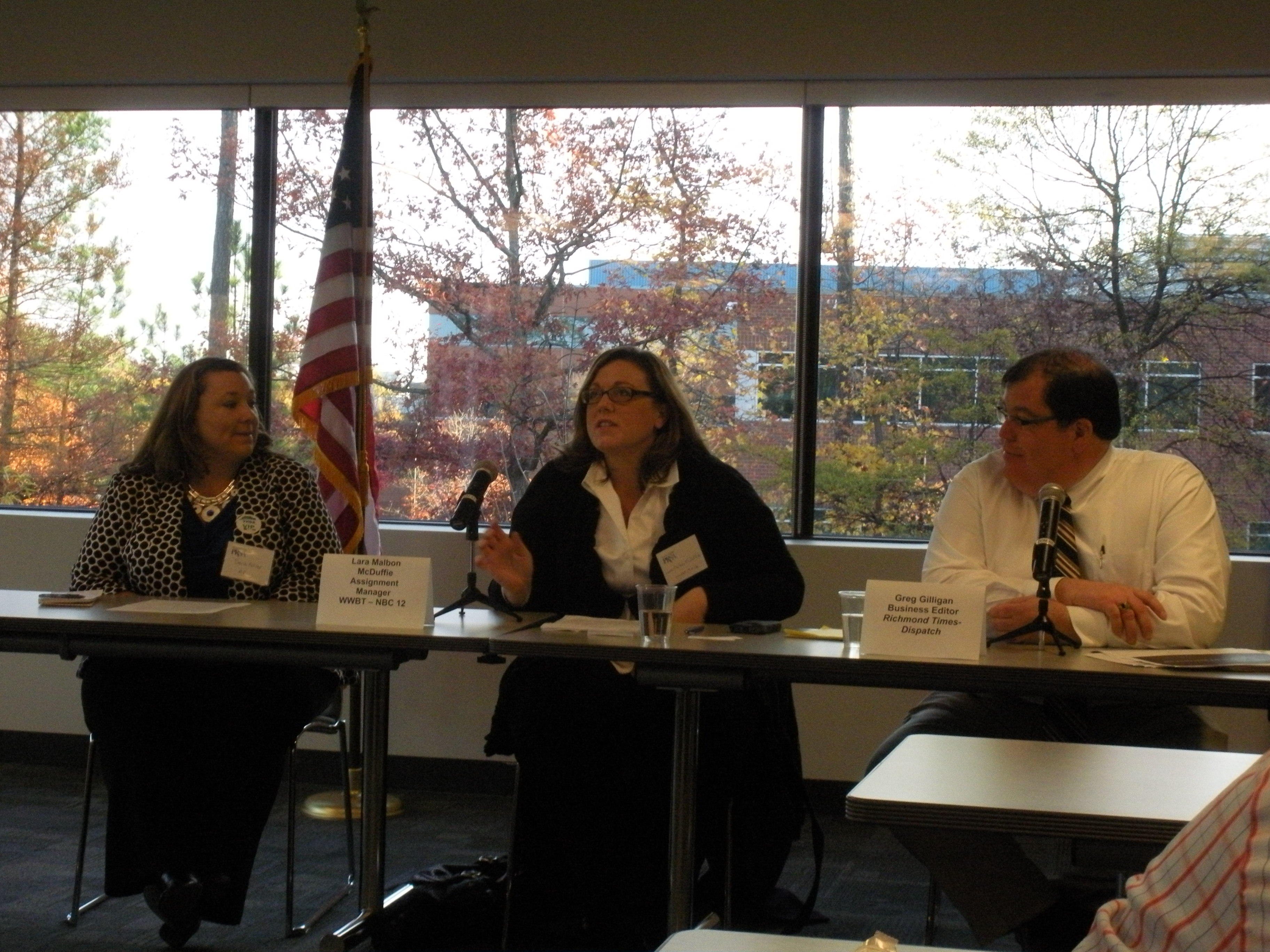
If you’re pitching a story that you wouldn’t read, don’t bother pitching it. That was the advice from a panel of reporters speaking to an audience of PR practitioners.

The panelists shared their tips for pitching them. Their advice was spot on, and, at times discouraging. Today, there are fewer reporters so it’s more challenging as PR practitioners to get our stories covered. But that doesn’t mean it can’t happen. Here are five tips to help you.  

A panel of reporters share tips on how to successfully pitch them. (Photo by Cynthia Price)

1. Perfect the pitch.Reporters are busy, too. “If I can’t read your pitch and understand it in 60 seconds, I’m deleting it,” said Dena Potter, news editor with The  Associated Press in Richmond, Va.

2. Don’t bury the news. Potter has a related piece of advice. “Don’t bury the news under a bunch of prose just to show me how well you can write.”

3. Know what’s going on. In other words, don’t pitch your feature story in the middle of a hurricane or election night coverage.

4. Use Email. Greg Gilligan, business editor of the Richmond Times-Dispatch, advocated for a strong subject line that “gets to the point.” He also said to paste the release or pitch in the body of the email. If he’s reading a release on his mobile, it takes too long to download and he’s likely to give up.

5. Identify contacts and spokespersons. Lara Malbon McDuffie, assignment manager of WWBT-NBC12 in Richmond, cautioned having a backup spokesperson if the primary spokesperson is unavailable. She also likes easy-to-find contacts on the website and – even better – after hour phone numbers.

What successes have you had in pitching the media?

The Power of Introverts

I’m an introvert. Those who have seen me in action at work or at the NFPW conference always challenge me when I say that. But it’s true. I’ve learned to function in many settings as an extrovert. I even enjoy it.

However, at the end of the day, I need to allow for quiet time, which is why at conferences I prefer to room alone and why I build time into the day for a peaceful walk in between meetings. These become my “restorative niches” as described in Quiet: The Power of Introverts in a World That Can’t Stop Talking by Susan Cain.

It’s a great book for understanding the value of introverts. For introverts, it offers ways to function successfully in a society that emphasizes group work.

Cain describes the difference between introverts and extroverts.

“Introverts focus on the meaning they make of the events swirling around them; extroverts plunge into the events themselves. Introverts recharge their batteries by being alone; extroverts need to recharge when they don’t socialize enough.”

In her book she describes how our culture emphasizes group work – from elementary school into the business world. My book club talked about how so many of our meetings are designed for leaders to think and work as a team, leaving no time for introverts to process. While I function in those settings, that point really resonated with me.

I’m making a conscious effort with my team to give the introverts time to think and to process big ideas before we come together to discuss. That means I have to be a bit more organized providing background materials in advance. At the end of the day, though, we arrive at a better product.

Ultimately, the book, which is filled with research and insights about introversion, makes a strong case for paying attention to the listeners and thinkers.

Thanksgiving Blessings

This year has been one in which I have made a conscious effort to acknowledge the good in my life and to be thankful for all that goodness. One way I’ve done that is through my photo a day, where I capture an image that either makes me smile or reminds me of my blessings. It’s good to look back and reflect.

Another way I express my gratitude is by giving of my time, talents and riches. I contribute to several organizations by writing a check. In the past year I’ve been involved with the Education Fund of the National Federation of Press Women. Through the fund, we are able to provide opportunities for members to learn and grow as communicators. It feels good to be able to do that.

As someone who has taught – and continues to serve as a guest lecturer – at my local university, I realize how important education is to a young mind, which is why this Thanksgiving I decided to pledge $500 to the Virginia Press Women Foundation’s capital campaign. I’ve already sent the first installment.

I’m also walking to raise money for the Foundation. Each time Louise Seals, who is the president of the Foundation, and I meet to walk, we record the miles. We have pledged $1/mile. Unfortunately, our schedules haven’t allowed for the distances we want, but I suspect we’ll keep walking and pledging more funds.

Louise also gives of her time and talent. She’s quite active with the Richmond Tree Stewards. Not only does she get more exercise and fresh air, but she is helping to care for and advocate for street and park trees. Most weekends she is pruning so people can walk in their neighborhood without dodging branches or so drivers can see stop signs clearly. You’ll also find her watering newly planted trees and planting trees.

It’s a joy to do something for others. This holiday season I put together a gift bag for a resident of a senior home. Her wishes were simple and, I couldn’t resist putting some extras in the bag. I hope it brightens her holiday. I know it brightened mine.

It’s easy to get frustrated by long work days and too many errands and chores. Taking time to be thankful for what I have is always something I welcome at the holidays. Giving back is even better.

Happy Thanksgiving!

Pinterest Attracts New Audience

Last week Pinterest revealed it was offering secret boards. As the email said, “Secret boards give you a place for things you’re not quite ready to share yet, like a surprise party, special gift ideas, or even planning for a new baby.”

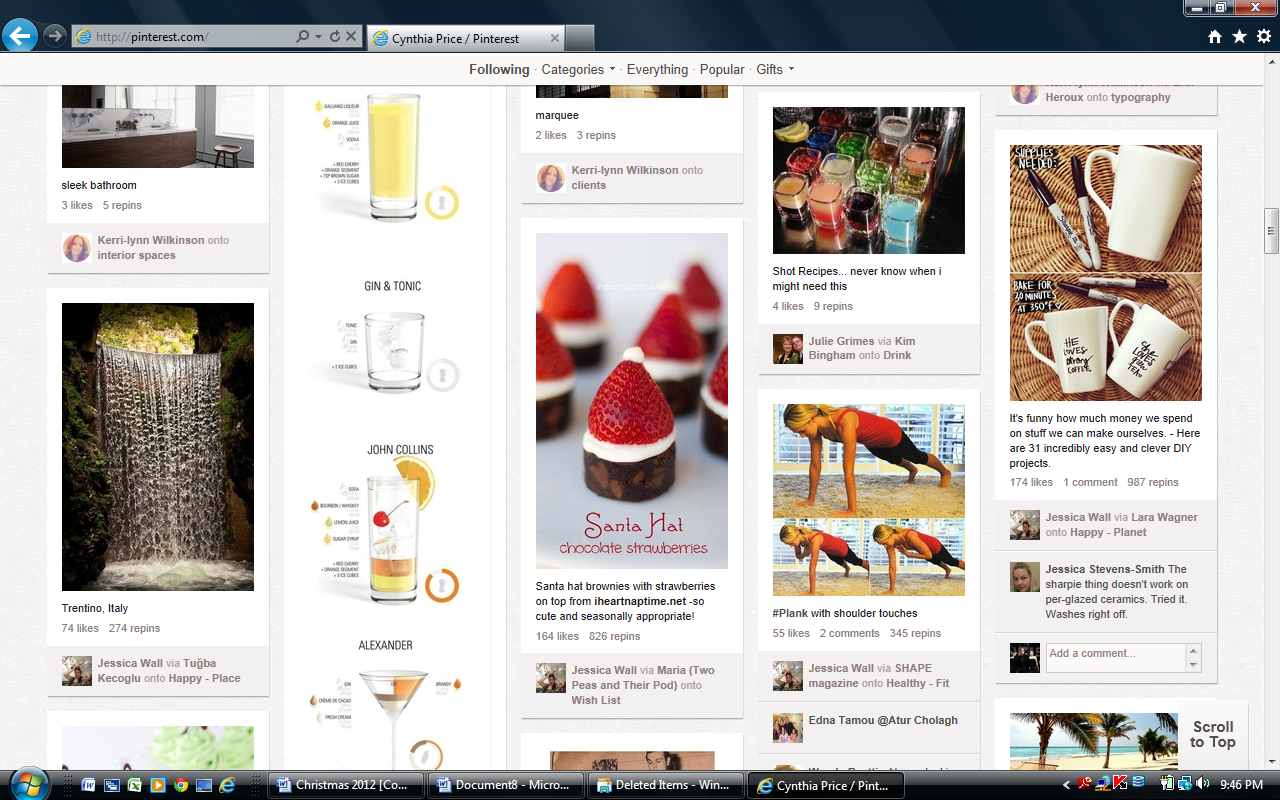
Pinterest boardPinterest is testing the feature. For many, though, Pinterest itself is a secret. Pinterest is a virtual pinboard to organize and share the things you love. At a recent meeting focused on Pinterest many in the audience were only vaguely familiar with the social media platform. Others weren’t sure how to fit it into their communication strategy.

One way to measure the success of Pinterest is by how much traffic it drives to an organization’s website. Wendy Scherer, who oversees social media efforts for Cabot Cheese, a cooperative of 1,200 family-owned farms in New England, said huge volumes of website traffic come from Pinterest.

For Cabot, “The boards aren’t just about us. We wanted to be inclusive,” Scherer said. “We talk about Vermont. We talk about farms. We talk about cows.”

That leads more people to find Cabot Cheese because they are coming to the site, not for the company, but because of things they are interested in. “They find us through our content, like a recipe, rather than our brand.”

For the National Wildlife Federation, Pinterest is ideal for fun and inspiring messages, said Danielle Brigida, digital marketing manager for the NWF. “We’re trying to be fun about it.”

Loren Pritchett, who is a colleague of mine at ChildFund International, also served on the panel. She talked about how Pinterest targets other audiences. “We see this as a place where we are reaching out to the next generation of ChildFund supporters.”

She added, “Many are sharing because of social interest.”

As with all social media, determining the platform’s return on investment is tricky. Most are measuring through repins and which boards are most active. Referring traffic also is studied.

“Everyone is trying to track,” said Danielle. “It’s crazy, though. Pin shares often go farther than a Facebook share.”