How to Prioritize Your Work Week

I’m as guilty as the next person for working long hours. However, I’ve learned to recalibrate whenever I begin to slip into that mode. I’ve learned a few good tips from others that help with that calibration.

Quality not quantity: I once worked with someone who liked to brag about all the hours they worked. Unfortunately, the person seldom completed assignments and she certainly wasn’t giving more than 100 percent. That’s always stuck with me. I try to deliver quality. When I need to focus I close my office door. If you don’t have an office door, stick a note on your cube that you can’t be disturbed or put on headphones (even if you aren’t listening to anything). For me, the act of closing myself off focuses me to concentrate on the task at hand. With concentration I can deliver a good product in a few hours, rather than taking 10 hours.

First Things First: Each evening before I leave, I note the one assignment I must complete the next day. Ideally, I start my day working on it, although sometimes, I confess, I get sucked into my emails immediately. When I stay focused on my priority, I feel better, in part, because the completion of the assignment usually means I’ve advanced a strategic initiative. Once it’s completed, I move onto other tasks on my ongoing list.

Five Days: A work week has five days, yet I often try to cram all of my meetings onto Monday. Once I started thinking about a 40-hour week and not an 8-hour day, I was able to make the calendar work for me. I space out meetings so that I have time following each meeting to provide the follow-up I agreed to and to type up notes.

Take Vacation: At some point, we all need an infusion of energy. In college, breaks were built into the academic calendar but that doesn’t happen in the work world. Sure, there is a day here and there for a holiday, but I’m talking about a week, or at least a few days, away from the office. In December, I plan out my days for the coming year. I like to provide myself a break every three months. I may alter the days some but just knowing I have time off scheduled makes it easier to plow throw the work.

What are your tips to prioritize your work?
Favorite Tips From Speech Writers

I recently attended the 2013 Speechwriters and Executive Communicators Conference in Washington, D.C., presented by Ragan Communications and the Public Relations Society of America. I learned just how little I know about speechwriting. On a positive note, I now know some things I can do to make the speeches I write stronger, which will make the job of the executives who have to deliver them easier.

Speech Format: One tip was to have a 3- or 4-inch margin at the bottom of the page. This prevents the speaker from having his head completely bowed.  I always knew to print in large type and to use 1-1/2 spaces between lines, but this one was new to me. Another good tip is to use a heavier stock of paper as the speaker will fumble less when turning pages.

Write the Headline: Fletcher Dean, director of Leadership Communication at The Dow Chemical Company, said that if you want to get the speech covered then you need to write the headline for the speech that you want in the paper the next day. This is known as the headline trick. Once you have the headline it becomes your key message and you can’t waiver from that in the speech. He also recommends writing the lead, the next graph and a quote within the speech, making it easier for a reporter.

Dr. Rosemary King, a former speechwriter for Secretary of Defense Robert Gates and two Charimen of the Joint Chiefs of Staff, suggested taking the headline trick a step further. “Make sure you don’t get the headline that you don’t want to see.”

Speech Coverage: Randy Lee, who has written speeches for the presidents of the American Medical Association and Georgetown University, as well as the Secretary of Defense and the Chairman of the Joint Chiefs of Staff, notes that most reporters are under time crunches.

“If you have copies of the speech, hand them out before the speech and ask them to embargo it,” he said. “You might even circle or highlight the most important things.”

Idea Box: To keep content fresh King suggests setting up an idea box where you can keep quotes, metaphors and anything else that might inspire the speech writing process. She uses Evernote as an idea box.

Old v. New Material: Fletcher reminded the audience that material that is old to you as a writer or to the speaker may not be for the audience.

Script or No Script: As for when to read from a script, most experts say the size of the audience and the room set up determine the format. If it’s a formal venue, “it’s rude to not have prepared remarks,” Lee said. “It shows that you care about the audience.”

If it’s fewer than 20 people, King said to not use a manuscript, but rather note cards or speak extemporaneously.


Executive Communications Requires Creativity

Today’s executives need to embrace all of the new communications tools. No longer can they simply communicate. They need to communicate creatively.

“It’s a great time to be an executive communicator, but it’s also a dangerous time,” said Steve Crescenzo, CEO of Crescenzo Communications and a highly sought-after consultant, writer and seminar leader, speaking at the recent Speechwriters and Executive Communicators Conference in Washington, D.C.

“As a leader, your content has to be so good because no one has an attention span anymore,” said Crescenzo. “There is so much content coming at them.”

As the communications person supporting the executive, you have to be a talent scout and a coach. As a talent scout, you will help the executive pick the right tools to use and then coach the executive in using the tools.

For effective communications, Crescenzo said it’s important to master the four Cs:

  • Creative
  • Compelling
  • Concise
  • Conversational

“Our job as communicators is to make the boring interesting,” he noted.

That means eliminating slides that no one can read and knowing what you want to accomplish with a given platform. If you don’t know, the communications will fail. It means avoiding formulaic writing and jargon, buzzwords and platitudes.

A few of Crescenzo’s suggestions for creative content include:

  • Ongoing town halls held quarterly or twice a year.
  • Leadership blogs. He cautions, though, to not make it a glorified letter from the CEO. The executive must be open to negative comments and willing to hear about the challenges and how employees feel. The CEO should also pay attention to comments, even if he or she can’t respond to all of them.
  • Videos or chats with leaders about important issues or company news

The key is to help executives find their voice and understand that “corporate is out and conversational is in,” Crescenzo said.

How to Survive Writing a Speech (and Zombies)

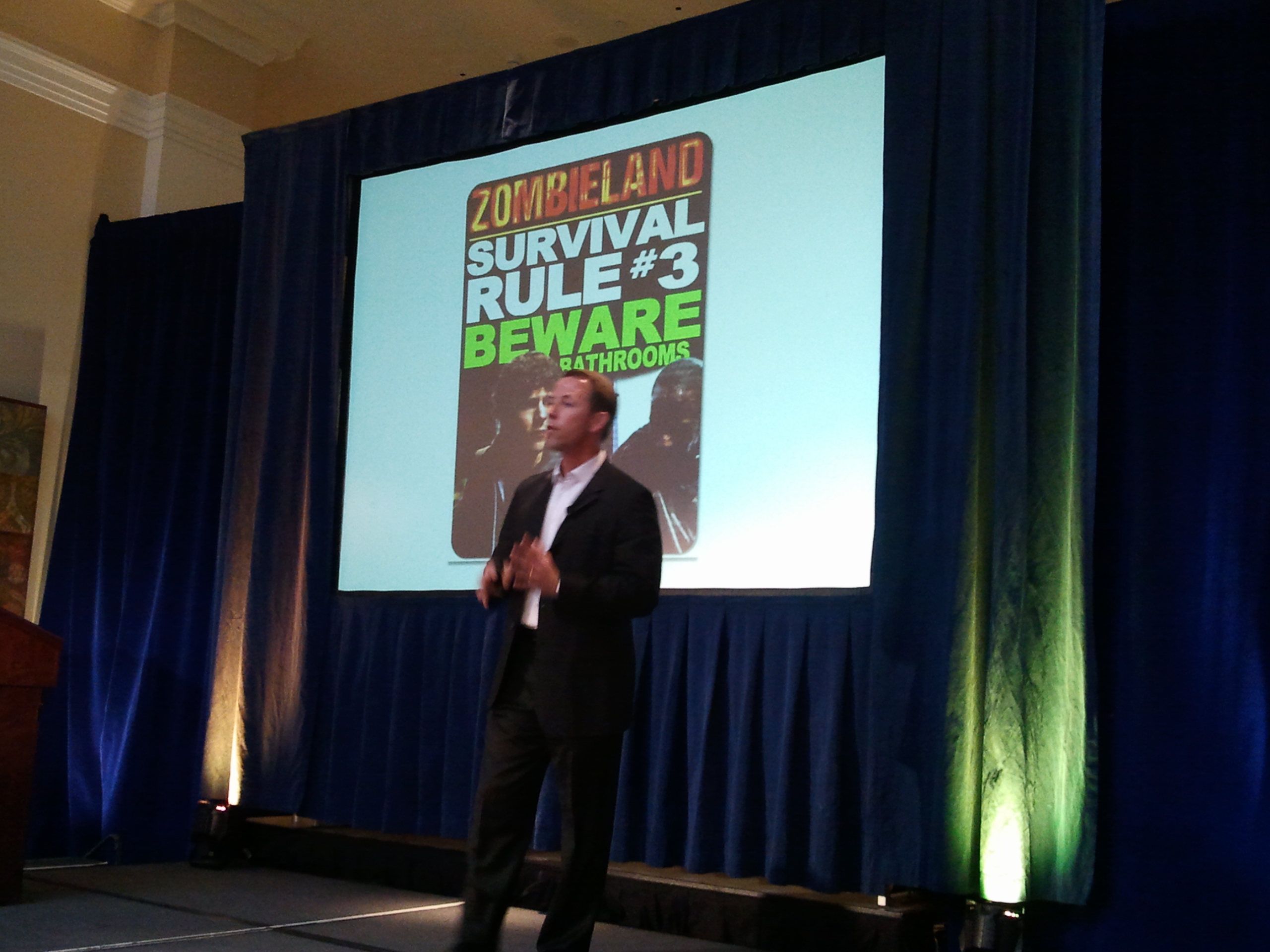
What do speechwriting and zombies have in common? A lot. At least according to Taylor Clark, a 20-year veteran of the U.S. Navy, who spoke about the rules of survival for speechwriting at a recent speechwriters conference.

He noted that his tips not only help with writing a speech but also work for surviving a zombie apocalypse.

The first rule is about cardio – you have to keep going and going, especially if you’re trying to outrun zombies. If you’re working on a speech, everything must be about the document.  As a speechwriter you should either be researching or writing. That means no checking emails and no watching cat videos on YouTube.

Rule #2 is all about the double tap. You shoot once, that’s fine. You shoot twice and that’s being thorough, which is needed with zombies. With speech writing, it’s all about accuracy. So check and recheck. Today’s speeches live on social media, and they live on the news. The speech must be accurate.

Writing a speech uses the same skills that are needed to survive a zombie attack. (Photo by Cynthia Price)

Writing a speech uses the same skills that are needed to survive a zombie attack. (Photo by Cynthia Price)

As a speechwriter you also can’t become too attached, which is rule #5. Becoming too attached is not only frustrating, but it can hurt your confidence. “I’ve worked so hard to dig deep and pull out the right words only to have them lined through and taken away,” Clark said. “You have to separate yourself emotionally from the words.”A final rule was to have a go-to weapon. With zombies it might be a chainsaw, a shotgun or a banjo. For speechwriting, Clark said his go-to choice is Evernote, which lets you take notes, sync files across devices, capture inspiration and share ideas.

“It’s a way to literally put anything in there and never run out,” Clark said. “And you always have the draft with you.”

Clark also discussed what he calls the “Trifecta of Speech Perfecta,” which includes paper, feet and mouth. “It’s like a weird paper, rock, scissors game,” he said.

Since the majority of speeches are on paper, you will have to print the speech repeatedly. For those who don’t like wasting paper and killing trees, Clark suggested giving a donation to the Arbor Foundation. Printing the speech is critical to ensure proper line breaks and spacing. And by printing it, you can stand and practice the speech, which leads to the feet of speech perfecta.

Speechwriters must get up from their desks and stand at a podium and recreate the speech. Clark has a podium in his office and stands at it to edit speeches.

Finally, he notes that the ear is neglected, which means as a speechwriter you must give the speech out loud and then edit it. “If it doesn’t sound right coming out of your mouth, it’s not going to sound right coming out of your boss’s mouth.”

Clark’s final rule focused on being ruthless and pushing past your comfort zone. He urged speechwriters to not just copy and paste from prior speeches. “You don’t want to become a zombie yourself.”

Readiness is Key to Crisis Management

Seventy-five percent of readiness in a crisis is making sure you have accurate contact information.

I learned this quickly working as a spokesperson for a major police department. I needed to be able to quickly reach colleagues within the city. I also need to reach out to other spokespersons whose organizations also might be involved in the situation. And I needed to reach out to reporters.

The key to any crisis situation is readiness.

It also helps to recognize that your response will be criticized by people who weren’t at the scene and that the media will quote people who were not involved so you need to get your information out – and quickly.

“Speed beats smart every time,” said James E. Lukaszewski, ABC, APR, Fellow PRSA, during a webinar on crisis management.

His recommendation is to brief continuously through frequent dispersals of 75 words rather than press releases, which he says only generate more questions and require approvals.

“Silence is the most toxic strategy you can choose,” Lukaszewski said. “You have to be able to communicate immediately.”

Are you ready?