Rework Your Network

Have you recently changed jobs or are you thinking about doing so? Then you should spend some time reworking your network.

I’m not suggesting that you abandon everyone within your network, but you may need to add some new people and switch the types of meetings you attend.

Connections: Be sure to add people to your network who can counsel you about the field in which you are working or can give you straightforward advice about how you are performing.

Publications: You should also reconsider the publications you read. It doesn’t mean you have to give them all up, but you need to spend time reading those that are relevant to your current job or the position you are striving to get. When I worked for the Federal Reserve Bank, I read The Wall Street Journal every day. I still read the occasional article online, but when I moved into law enforcement, I needed to focus on the latest trends in policing.

Conferences: When I moved from law enforcement communications to international development communications, I stopped attending conferences for public safety public information officers and began attending the InterAction Forum, which focused on organizations within the development space.

Professional Groups: You will also want to reach out to other professional groups on LinkedIn. My work for some time has included a focus on crisis communications so I am a member of a group with that focus. However, if you are changing sectors, you may want to change the groups to which you belong.

Don’t Call Me

Please don’t think I’m rude, but if you call me, I’m not likely to answer the phone unless I was expecting your call.

PhoneI’m not going to answer because often you are calling when I am in the middle of something, but there is no way for you to know that.

So rather than sounding irritated when I answer the phone, I simply don’t answer and let it go to voice mail. I find this quite helpful.

If you are a reporter, I want to hear your message so I can identify the information you require. I have even set my voice mail message to include my email address to make it easier for reporters to make their request.

Emails work better for me because if I am in a meeting and there is a break, I can quickly check my emails and usually respond. Otherwise, it might be another hour or two until I return to my desk, and the person who is calling might need something much more quickly.

If you are a salesperson, once I have listened to the message I can determine if I am interested in the product and schedule a convenient time for both of us to talk.

If you are relaying information, then once I hear the message, I have the information and I can finish the project that required the information.

What are your thoughts on telephone interruptions?

Bringing Trends to Life

Knowing about the next big trend is not enough.

Instead you need to look at the trends and how they converge with consumer behavior, technology and the business landscape.

DeeDee Gordon, president of Sterling Brands, shared how you can imagine a future you can act on today at a recent American Marketing Association meeting in Richmond, Va.

Gordon is a renowned consumer insight and trends expert who has been at the leading edge of trend research for more than 15 years. “I have a problem,” she told the audience. “I am a trends junkie. I love to bring them to life.”

One trend she identified is metromorphis, the future of how we live and play. “It’s a fancy way of saying urbanization,” she said.

With more people living in a crowded environment, there is an emphasis on how individuals can have access to clean, healthy air. (Slide from DeeDee Gordon presentation)

With more people living in a crowded environment, there is an emphasis on how individuals can have access to clean, healthy air. (Slide from DeeDee Gordon presentation)

With more people living in a crowded environment, for example, there is an emphasis on how individuals can have access to clean, healthy air.

Because trends often don’t feel tangible, Gordon said her company embarks on a vigorous process to identify the trends. That includes placing the trend against a set of criteria. Trends must percolate within the culture for three to five years and must happen in both suburbs and rural locations, she said.

To show a trend’s true value, she said, you have to contextualize it within a business environment.

Looking at the intersections of cultural and global trends, consumer insights, new technology and the business landscape, her company is able to find opportunity spaces, which she said leads to big ideas.

In studying urban wellness for a client, for example, her company identified several opportunities, including a refresher box, which is similar to a phone booth, but when a person enters it the filtered air is fortified with essential nutrients.

Gordon said trends are always better supported by business technology and consumer insights. She also stressed, “It’s important to learn from others and to collaborate. Think big but keep yourself grounded.”

5 Things to Do to Help Orient a New Employee

When a new employee joins your team, are you prepared to help them succeed? We all know the value of introducing the person to key people. That’s a good start, but don’t forget some other crucial ways to help orient a new employee.

Introductions. Don’t overwhelm the newest member of your team on the first day. Instead, let her get to know the immediate team. Take her out to lunch so she can get to know her colleagues in a relaxed setting. Later in the week and throughout the first month (depending on the size of your organization), introduce her to employees in other areas. This will allow her to connect names, faces and functions.

Meetings. Be sure the person has been sent the invitation for key standing meetings. A new employee will acclimate more quickly when he knows about projects, issues and deadlines.

Organization chart. Include the person’s title, email, phone number and high-level area of responsibility. Even better, include a photo and details about where the person’s office is located.

Publications. What publications should the new hire read? Save the last one or two issues so the person can read them in the first week or so. He will be able to familiarize himself with some of the industry issues.

Passwords. Ensure the person has passwords to any databases or online services that you use.


Working with an Editor

April Michelle Davis edits for a living. She reads lots of books and each one at least three times as part of her editing process.

She identified two types of editors – developmental and copy. A developmental editor focuses on themes, jargon and the big picture she explained at the Virginia Press Women (now Virginia Professional Communicators) spring conference.

A copy editor often is a free-lance editor. She focuses on spelling, style, capitalization and changing passive to active voice. In other words, all the things our English and journalism professors tried to teach us, and that we resisted.

“The author may not care about it, but they know they need it to be published,” she said.

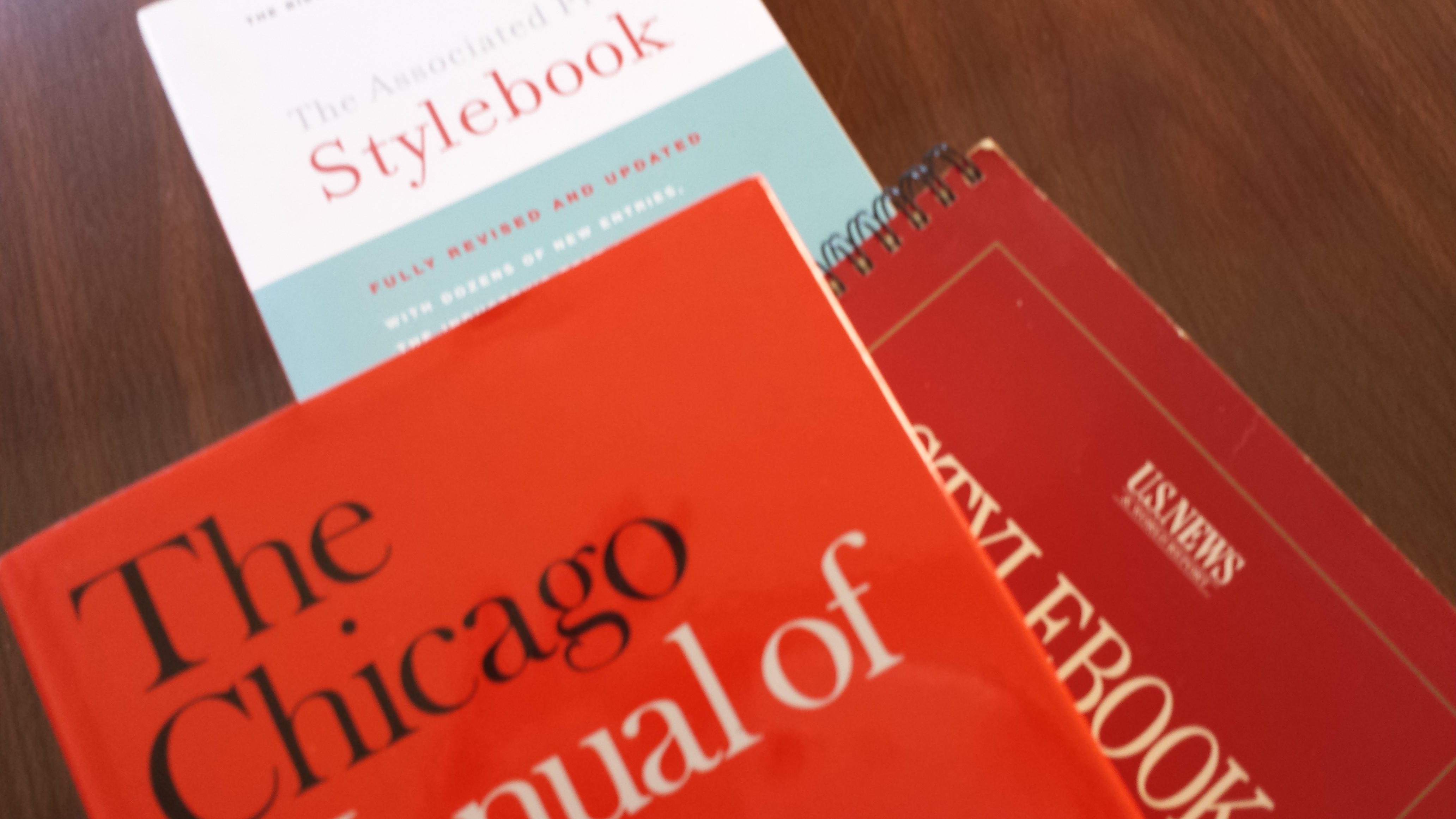
Style guides are important tools for editors. (Photo by Cynthia Price)

Style guides are important tools for editors. (Photo by Cynthia Price)

She uses many style guides, including the Chicago Manual of Style (16th edition is the current one) and Associated Press, but noted that a house style manual will override these.

As Davis reads the book, she’ll also insert style marks, which she said she can do more easily than the designer because she has read the book.

When she edits a book, she does so in track change mode and then locks the changes. The author can then review the changes and note any additional ones or ones that he doesn’t agree to. Keeping track changes locked ensures that the author will complete the process with her.

Davis said a good editor must have experience, be trustworthy and know about technology. “There are no tests to prove you are a qualified editor,” she said.

She gained her experience slowly over time. Payment for early jobs often came in the form of breakfast. As she continued to do a good job, she was able to start getting paid in dollars.

Over time, she gained the trust of authors. Each time she works with an author, she strives to understand what they mean. “I need to be careful to not misinterpret what they want,” she said. For example, if an author tells her to “go at it,” she will probe until she understands what the author’s expectations are for editing.

“You don’t want the relationship to be adversarial,” she said. “Communication is key.”

Davis also ensures that all of the systems she and the author use are compatible to ensure that editing changes are not lost.