Trends Driving PR Growth

Fundamental trends are driving the growth of public relations, says John Paluszek, APR, Fellow PRSA and chairman of the Global Alliance.

 He recently spoke to senior practitioners during a morning coffee before speaking to the Richmond PRSA.

 The three trends are

1)      Growing demand for PR services

2)      Providing a wide range of services

3)      Growing global demand

John Paluszek

John Paluszek discusses public relations trends with senior practitioners.

Paluszek, senior counsel with Ketchum, has counseled on corporate social responsibility and sustainability for severaldecades. He said that the demand for PR services continues to grow. “Almost all institutions now recognize the need for PR,” he says.

This is critical, he says, since PR professionals help to manage the interaction between the company and its stakeholder. 

PR once focused only on media relations, but today Paluszek says there is more specialization and a wider spectrum. Two areas that have implications from social media are issues management and crisis management. “Today it’s about how to get ahead of threats,” he says, “and what to do when the crisis hits.”

The messaging evolution has gone from delivering the message to what should the message be to a company asking what it should do.

The demand for PR services is happening all across the world. He cited MEPRA or the Middle East Public Relations Association as evidence of the need for PR services. His firm has six offices in China, which he said he could not have imagined 10 years ago.

“The world is changing and PR people are a part of it,” Paluszek says.
‘Uninteresting Life’ Leads to Many Novels for Owen

Author Howard Owen does not live an interesting life given that he’s about to publish his 10th book.

He cited a comment by writer Alice Munro, “If you live an interesting life you don’t have time to write.”

Howard Owen

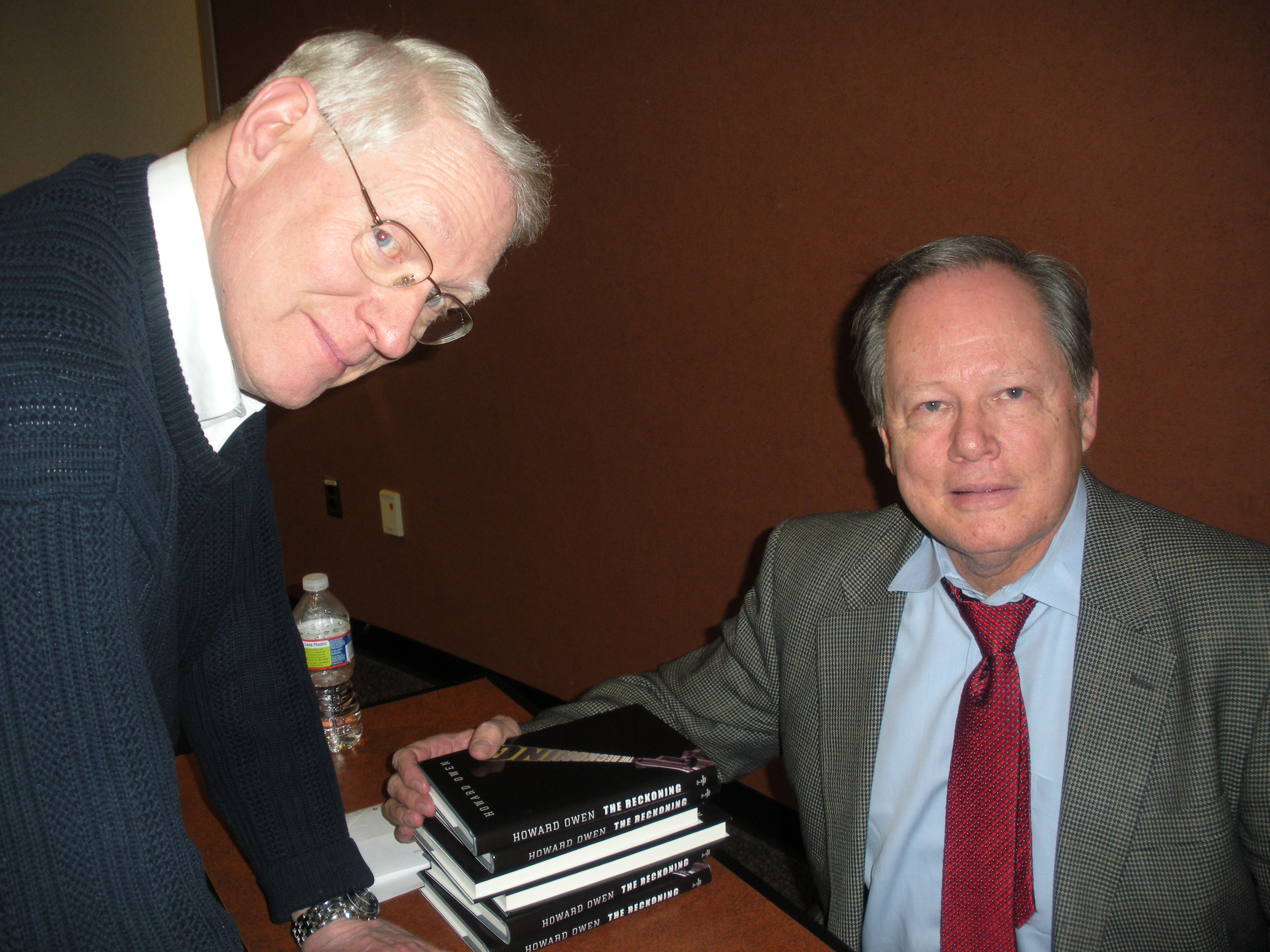
Howard Owen signs a book for John Ward.

He chuckled as he shared the quote and said he draws the details of his characters from others in real life. “There’s always someone out there I can draw from,” he said during a recent book talk. “There are psychopaths, thwarted lovers, ex-baseball players and guilty baby boomers.”

Although he was 13 when he said he would first be a writer, it wasn’t until he was 40 that Owen published his first book, Littlejohn. He cited laziness, fear and not having lived an interesting life as his excuses.

Writing, he said, takes discipline to do it every day. He also feared failing. “It’s much easier to have a pipe dream,” he said. “But at 40 I realized the worst thing would be to not try at all.”

So Owen began making up characters, settings and finally stories. He found, “You pick things up like a suit picks up lint.”

He doesn’t have a difficult time starting a book, but he said everything takes planning. He’s currently reading and signing his ninth book. His 10th is with his editor, and he’s writing the 11th.

When he’s not writing novels, Owen is business editor at the Freelance-Star in Fredericksburg, Va. He writes a daily blog and quipped, “Every day I floss and blog!”

He confessed that he’s “old school” having more respect for what shows up in print and is still adjusting to social media. “I think I’m the last write in America without a website.”

He acknowledged that he has to be present on social media platforms. “You have to be on Facebook or LinkedIn whether you want to write a book or overthrow a country.”

Ultimately for Owen it comes down to one thing: “All I want to do is write.”

Profiling Your Colleagues

Have you ever asked your colleagues how they like to work? What about asking them how they like to process information?

My team just did this, although we used a formal system called the Team Management Profile, which “reveals critical dynamics to enable the development of high performance in the workplace.”

My “ah-ha” moment in the meeting was that I have never asked my colleagues these questions — at any job. And yet, I know  there are different work styles because I find some easier to work with than others.

While not everyone can participate in TMP, everyone can ask their colleagues about their preferences.

My colleagues and I were asked to share three ways that we want to link with others. Mine are

  • Allow me to have processing/thinking time that is uninterrupted so I can stay in the flow/rhythm of my work (mornings)
  •  Stick to agendas and, if there is deviation, there needs to be a reason (additional action item, for example)
  •  Be punctual to meetings

 How do you like to work? More importantly, have you shared that with your colleagues?

Drive: What Really Motivates Us

What’s the best way to reward a great employee?

If you suggest a bonus or a day off, you may need to rethink your approach to motivating yourself and others – at least according to Daniel H. Pink, author of Drive: The Surprising Truth About What Motivates Us.

He describes external rewards as the carrot-and-stick approach. Such an approach may once have worked, but it won’t in today’s ever evolving landscape. Instead, he says the secret to high performance has three essentials:

1)       Autonomy: the desire to direct our own lives

2)      Mastery: the urge to get better and better at something that matters

3)      Purpose: the yearning to do what we do in the service of something larger than ourselves.

My blog is a perfect example of the essentials at work. There is no paycheck for publishing this blog. There is no carrot waiting for me. So why do it?

For one, I am mastering a new tool (or at least learning it). I can work on it when it suits me. I choose my topics. And it has a purpose – I’m able to share information with NFPW members who may not have the time or desire to research and distill on the topics that I cover. It’s part of my service to NFPW.

The book also includes a tool kit for taking the ideas in the book and putting them into action – in your professional life, in your child’s education, in your personal life.  

If you are intrigued, but just don’t think you can fit another book into your life, check out this video that neatly depicts it.

What’s Next in Social Media

Social media is about conversation not broadcasting.

It’s about geolocation.

It’s about privacy.

And online versus mobile.

It’s about measurement.

Those were the observations several months ago by Jon Newman of the Hodges Partnership as he talked about social media.

What’s he talking about today?

Growing communities, measuring success, multi channeling, mobile, the great platform shakeout.

One thing that hasn’t changed is that content remains king, and PR is the content driver. Without it, you aren’t going to be able to grow your communities online.

At the same time, social media is simply part of the conversation. “In a client meeting you expect to talk social media.”

When Jon asked at the January PRSA Richmond meeting how many people were actively using Twitter only about half the audience raised their hands. Less than a quarter were using geolocation sites, such as FourSquare. When asked about Facebook, every hand in the audience went up. 

“You can do everything on Facebook that you can do on a standalone website,” he noted.

Measuring Facebook success is about measure the fan base and fan engagement – what percent of the fan base is actively engaged? Are they posting a comment? Are they liking the status?

A successful social media strategy is about listening, customer service, advocacy and social commerce, said Sonali Shetty of Hodges Digital Strategies. The first step is establishing a community. Then, Sonali said, you have to cross promote, consistently brand and engage frequently.

And despite what some people say, “It does take money,” Sonali said. “It’s an ecosystem in which you surround your customers with your message.” 

To do that, you must develop a cohesive message and implement it across all devices. It’s about repurposing and recycling.

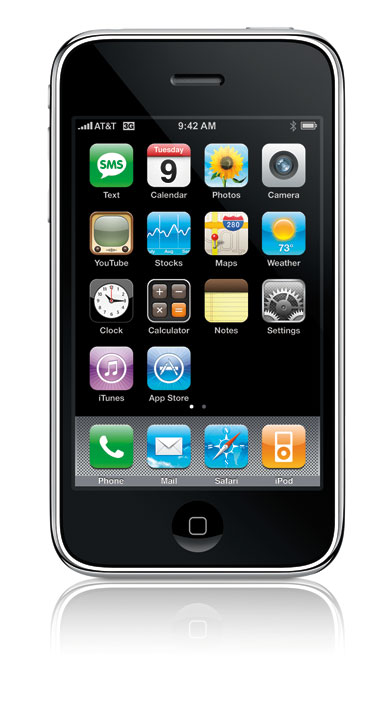
One of the hot topics was apps. Not surprising since the Apple store has sold its 10 billionth app. To have a successful app, Sonali said to prioritize the must-haves then add one or two bells or whistles. “You have to look for a reason for people to come back to your app every day,” she said.

Mobile will continue to get bigger. Overseas, people conduct most of their banking by cell phones. That hasn’t reached the United States at the same level yet. QR codes are growing in popularity. These codes allow individuals to use their smart phone as a scanner and obtain additional information about a product, brand or company. Some airlines make boarding passes available on mobile devices. Scan your smart phone and you’re boarding the plane. Starbucks lets you create a virtual card on a smart phone. Scan your phone and you’re walking out the door with your latte.

I wonder what we’ll be talking about a year from now….