Social Media One Year Later

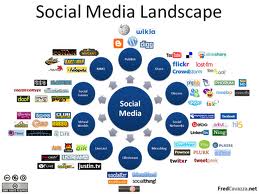
As I was putting together my presentation for Media Women of South Carolina, I updated the number of users on each of the social media sites I was going to discuss. I use social media every day and find the various platforms to be powerful communications tools. I had no idea just how powerful their reach is, though, until I saw the comparisons.

In April 2010, Facebook had 350 million active users worldwide. If Facebook were a country, it would have been the fourth largest country in the world. Today Facebook has 600 million active users worldwide. If Facebook were a country, it would be the third largest country in the world – behind China and India. The population of the United States is smaller now than Facebook’s population.

One year ago Twitter had 24 million users per month. A year later that number has soared to 190 million Twitter users per month.  That equates to about 65 million tweets a day and more than 800,000 search queries per day, according to Twitter.com – Quantcast Audience Profile.

YouTube has become the number two search engine behind Google. One year ago, people were uploading 20 hours of video to YouTube every minute. Today 35 hours of video are uploaded every minute.

If you’re looking for a job, consider that a year ago, LinkedIn had 50 million members in more than 200 countries. Today, it has 100 million members.

Do you have something to say? Then consider writing your own blog, but be aware, you aren’t alone. BlogPulse reports that 156 million blogs exist, including this one.

Are you communicating where you need to be?
Social Media Resource Recommendations

As part of my presentation for the Media Women of South Carolina’s Social Media Smarts seminar, I was asked to provide some resources to those interested in increasing their social media presence.

If you are not able to attend, here’s what I suggested:

  • Engage: The Complete Guide for Brands and Businesses to Build, Cultivate, and Measure Success in the New Web by Brian Solis, who is globally recognized as one of the most prominent thought leaders and published authors in new media. Engage thoroughly examines the social media landscape and how to effectively use social media to succeed in business one network and one tool at a time.
  • Made to Stick by Chip Heath and Dan Heath examines why certain ideas – ranging from urban legends to folk medical cures to business strategy myths – survive and prosper in the social marketplace of ideas. And let’s face it, whether you are writing on a social media platform or for a print publication you want the writing to stick.
  • Social Media Examiner logoSocialmediaexaminer.com is your guide to the social media jungle. It is a free online magazine designed to help businesses discover how to best use social media tools to find leads, increase sales and generate more brand awareness. It is ranked as one of the world’s Top 100 business blogs.
  • Lynda.com allows you to participate in tutorials on thousands of software subjects for a small fee. A one-month membership is $25 or you can sign up for several months or a year and access close to 1,000 courses 24/7.

What resources would you recommend?

Twitter Turns 5

Twitter turned 5 on Monday.

TwitterToday it has 200 million users and is a broadcast channel for major news events, including the plane in the Hudson River and the tsunami in Japan. It’s become a communications tool during political uprisings.

I confess, I am not a big Twitter user, but it has still impacted me, and for the very reasons that Twitter’s cofound Jack Dorsey said about Twitter in a Money CNN.com interview:

“The big thing I learned from Twitter are these concepts of immediacy, transparency, and approachability,” Dorsey says. “I think Twitter’s done a very good job for the communications industry.” 

When I’m communicating I write my headlines and subject lines of emails so that they are concise and that the meaning is clear. I think about what I would say if I had to tweet the article. If I can’t quickly identify the purpose of the piece, it needs to be rewritten.

Twitter may not be for everyone, but its lessons offer solid foundations for effective communications.

What’s Next in Social Media

Social media is about conversation not broadcasting.

It’s about geolocation.

It’s about privacy.

And online versus mobile.

It’s about measurement.

Those were the observations several months ago by Jon Newman of the Hodges Partnership as he talked about social media.

What’s he talking about today?

Growing communities, measuring success, multi channeling, mobile, the great platform shakeout.

One thing that hasn’t changed is that content remains king, and PR is the content driver. Without it, you aren’t going to be able to grow your communities online.

At the same time, social media is simply part of the conversation. “In a client meeting you expect to talk social media.”

When Jon asked at the January PRSA Richmond meeting how many people were actively using Twitter only about half the audience raised their hands. Less than a quarter were using geolocation sites, such as FourSquare. When asked about Facebook, every hand in the audience went up. 

“You can do everything on Facebook that you can do on a standalone website,” he noted.

Measuring Facebook success is about measure the fan base and fan engagement – what percent of the fan base is actively engaged? Are they posting a comment? Are they liking the status?

A successful social media strategy is about listening, customer service, advocacy and social commerce, said Sonali Shetty of Hodges Digital Strategies. The first step is establishing a community. Then, Sonali said, you have to cross promote, consistently brand and engage frequently.

And despite what some people say, “It does take money,” Sonali said. “It’s an ecosystem in which you surround your customers with your message.” 

To do that, you must develop a cohesive message and implement it across all devices. It’s about repurposing and recycling.

One of the hot topics was apps. Not surprising since the Apple store has sold its 10 billionth app. To have a successful app, Sonali said to prioritize the must-haves then add one or two bells or whistles. “You have to look for a reason for people to come back to your app every day,” she said.

Mobile will continue to get bigger. Overseas, people conduct most of their banking by cell phones. That hasn’t reached the United States at the same level yet. QR codes are growing in popularity. These codes allow individuals to use their smart phone as a scanner and obtain additional information about a product, brand or company. Some airlines make boarding passes available on mobile devices. Scan your smart phone and you’re boarding the plane. Starbucks lets you create a virtual card on a smart phone. Scan your phone and you’re walking out the door with your latte.

I wonder what we’ll be talking about a year from now….

Do You Know Quora?

I’d never heard of Quora until I attended a luncheon where social media was the topic. And the hot topic was Quora. The next day I saw several articles about it.

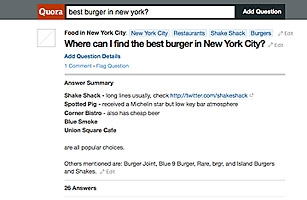
So what is it? Founded by two former Facebook bigwigs, it opened to the public in June 2010. The Q&A site isn’t yet a household name, but it’s fun (caveat: you can lose a lot of time on the site as I did today, but it was all for research!).

It is reminiscent of AskMe and other similar sites a decade or so ago. You post questions and answers on any topic and search for ones that have already been posted. You can follow other members (like Twitter). And you can vote if you like or don’t like an answer.  

As with Facebook, it seems to be popular because of the sense of community. And you can feel smart when you answer a question, or even post one.

Of course, you also might feel excluded when no one answers your question, which happens.

My logical first step was to read the answers to “How do I get started on Quora?” I learned –

  • Follow some topics that interest you.
  • Browse questions that interest you.
  • Add answers to questions you know about.
  • Improve question pages.
  • Find people you know who are already on Quora.

So for now I’m following some answers to questions about international travel, traveling smart and traveling to places that interest me.

Do you need to be here? Nope. But it’s like the trendy restaurant in town. While it’s hip, you want to get a table. So for now, I’m going to spend some time on Quora. I may even ask about the best new restaurants in my town.