Reasons to Attend NFPW Conference

As the director of the Education Fund for the National Federation of Press Women, I’ve been receiving applications from members who have never attended an NFPW national conference.

We’ve got one planned Sept. 20-22 in Scottsdale, AZ, and it’s the perfect opportunity to attend. NFPW will be celebrating its 75th anniversary.

These first-timers recognize a good thing. NFPW conferences have lots to offer:

Networking: When NFPW members meet, you’re meeting individuals who work for newspapers and magazines. Many work in public relations. Some are authors. Many are free-lance writers. Members are willing to share advice and their experience. They’ll help connect you.

I once needed to secure space at the National Press Club in Washington, D.C. No one at my office was having any luck. I called on Mary Jane Skala, who is now working in Nebraska. She went to school with the person with whom I needed to connect. The next thing I knew I had a program scheduled and media coming to the event.

Only a few months later, I needed the same thing, only this time in Denver. Again, an NFPW member came to my rescue. Ann Lockhart connected me with the right people, and I scheduled an event at the Denver Press Club.

Professional Development: The conference schedule is jam-packed with speakers covering public relations and marketing; writing books; journalism, digital media and social media, as well as how to balance life, work and play and boosting creativity. The speakers almost always are willing to stick around after their session and answer additional questions. The toughest part for me is choosing which session to go to. They are all so good. As soon as I receive my conference program, I highlight my top choices so I don’t get sidetracked by the silent auction, networking (see above) or exploring the city.

Personal enrichment: Another benefit of the conference is how good you will feel once you leave. You’re surrounded by smart, creative, energetic and driven individuals, who also like to have fun. You’ll come away with new friends, new colleagues and new experiences.

The early-bird deadline for this year’s conference is Aug. 27. For more details, visit the NFPW website.

Cash Mob Strikes Wichita

NFPW member Jill Miller is known for great ideas and providing businesses with what they need to thrive.

Jill Milller organized a Cash Mob in Wichita, KS.

She took that to the next level when she organized Wichita’s participation in international cash mob day. Cash Mobs are similar to Flash Mobs, but instead of dancing people go to predetermined businesses on a specific day and spend a little money to help support locally owned businesses.

Wichita joined 200 other cities around the world participating in the first International Cash Mob Day on March 24. Jill was inspired by stories she read about how small businesses were being impacted by Cash Mobs in other cities. “One night I asked my Facebook friends if they thought the Cash Mob would go over in Wichita,” she said. “The response was enthusiastic!”

At midnight she started a Facebook group and within 36 hours, more than 1,500 people were ready to go shopping at stores that were selected because they had been open less than one year, sell products for men and women, give back to the community and agreed to be mobbed.

Jill was tired of seeing local businesses “that were awesome” go out of business. After talking with a client about it, she was more encouraged to spearhead the effort. “I just had to go for it and do it,” she said.

She leveraged her social media network. “That really helped me pull it off,” Jill said.

Cash mobs were started by Buffalo, NY, blogger and engineer Chris Smith in 2011 to bring financial relief to small, struggling local businesses and to bring communities together. That is exactly what happened in Wichita March 24. “I found that people want to support local businesses but they aren’t sure what they should do,” Jill said. “And there is a lot of pent up demand to go out and buy stuff.”

That’s a good thing because Jill already is planning the next Cash Mob for April 21.

3 Reasons to Join NFPW

I sometimes use Yammer, the free private social network for companies, at work. It recently sent out an email touting reasons to use it. As I read the reasons, I realized they are the reasons to be a member of NFPW and your state affiliate. They include:

  1. Connect with colleagues
  2. Collaborate more effectively
  3. Share your knowledge

Connect with colleagues: Through NFPW you can find experts and tap into their knowledge. The key, of course, is reaching out to other members and getting to know them. During the 2011 conference we hosted a POWER Networking session where members had two minutes to share their professional stories. Members came away with information about each other and a stack of business cards for follow-up. We hope to do the same during the 2012 conference.

State affiliates also hold meetings and workshops. In Virginia we also have district meetings, which allow us to connect with a smaller group of members, providing opportunities for more in-depth conversations.

Collaborate more effectively: While Yammer was referring to online collaboration, NFPW also provides such opportunities. NFPW is active on Facebook and LinkedIn, which allow for quick and easy discussions. A recent discussion focused on whether bloggers should be considered journalists. We also share job openings and recently  members reached out to others asking for “likes” on their Facebook pages for their books or magazines. If someone is looking for information quickly, our social sharing sites are an ideal spot to get the information.

Share your knowledge: Again, Yammer was referencing sharing online through Yammer, but NFPW offers several ways to share knowledge. Members post on Facebook and LinkedIn. Members also share stories through a quarterly newsletter and the website. Not only are members sharing their expertise, they are being recognized for their contributions. During last year’s conference NFPW conference several members, including Ruth Brown of Nebraska Press Women and Jill Miller of Wichita Professional Communicators, shared their expertise during workshops.

What do you get from your membership and how can we leverage that with potential members?

Coaching Yourself to Career Success

If you want to achieve your ultimate dream, you’re most likely going to have to take something off your plate.

That is the advice of John Fulwider, a consultant, coach and connector, who spoke at the 2011 NFPW conference.

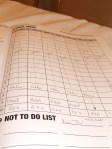
Coaching workook

To make a dream a reality, you need to make a "Not to Do List."

Using a workbook he had developed, he jogged participants through the steps to begin the fulfillment of their dreams. Participants had to write down their goals and make them SMART (specific, measurable, achievable, relevant and time bound), and they had to address the scoffers.

“Those are the people, who say – wrongly, of course, that you can’t possibly pull it off,” John told the group.

He challenged participants to identify their dream – what they are passionate about. For many in the room, it was a time to ponder and at least begin to identify the steps necessary to make the dream a reality. Often, that means identifying what one must give up to make it happen.

I’m working on a mystery manuscript. I put it on hold while I transitioned into a new job and served as president of NFPW. Now, I’m ready to pursue this dream. I’m not taking on new commitments, and I’ve identified time to write. I’m going to stop spending hours on the weekend lost in HGTV, but will instead write.

As part of the exercise, we also identified a personal board of advisors – those individuals who can help make the dream a reality. I’ll be reaching out to these people in the coming months. These advisors will help with editing, finding an agent and publicity. Most importantly, they’ll be there to help me over the hurdles and cheer me on.

Dreams don’t just happen, but John gave the participants a list of specific, measurable and achievable objectives to start work on immediately.  Now that I have my plan, it’s time for me to finish the manuscript and turn this dream into reality.

What will you stop doing to make your dream a reality?

Write It, Publish It!

Rainbow Rowell, author of the romantic comedy Attachments, one of Entertainment weekly’s top 10 “Best of Summer” reads, told an NFPW audience that she had been a journalist for so long it was hard for her to write beyond a few inches. Rowell is a lifestyle and pop culture columnist at The Omaha World-Herald.

"Attachments" by Rainbow Rowell“Writing something like a book is like wading into the ocean when you can’t see the bottom,” she said of her novel, which came in at 87,000 words.

But she waded in, cramming in writing whenever she could. She wrote on holidays and usually one day during the week (often Sundays). Rowell said she couldn’t simply write for an hour each day as many authors do.

“I can’t just dive in and out. I have to have blocks of time to write it. I have to get to a place where it can just come out of me.”

After completing the manuscript, she found an agent and two years after the book sold it was published.

Rowell says that finding an agent is the most difficult part of getting published. “Publishers don’t look at anything unless a literary agent gives it to them,” Rowell said. “They trust the literary agents to weed through the manuscripts.”

Rainbow Rowell

Rainbow Rowell shares publishing tips.

To find a literary agent, Rowell suggested looking through books that list agents. She also said that going to writers’ forums is a good way to learn about  others’ experiences with an agent.

Agents all have different rules for submissions, and Rowell said you need to follow them. “You have to give them exactly what they want,” she said. “They want to make it hard for you.” The agents receive so many submissions, this is a means to weed out the crap.

The best is when the agent asks you to send your manuscript. “Then you are in,” the author said.

A few additional tips she shared include:

  • Write only a one-page query letter.
  • Never call it a book. It’s a manuscript. “The publisher gives you a book,” Rowell said.
  • Start with your bottom choice for literary agent, saving your favorite agent for your final query. “Let other people reject you first so you can learn from them,” she said.
  • Don’t do any pitching to agents in the summertime. Rowell said, “They kick into gear after Labor Day.”