Check Your Facts Before Publishing

Have you read something on social media and immediately shared? Did you stop to think about whether it was accurate?

It’s a question, I honestly hadn’t given much thought to on my personal Facebook page, but now I’m pausing before I hit share.

At a recent media conference, Bill Schackner of the Pittsburgh Post-Gazette questioned, “Just because you can send it quickly, should you?”
(Source: ING)

(Source: ING)

Unfortunately, it seems as if that is exactly what many reporters are doing.

A new survey from Dutch company ING found that 45 percent of international journalists “publish as soon as possible and correct later,” while only 20 percent always do their due diligence before publishing.

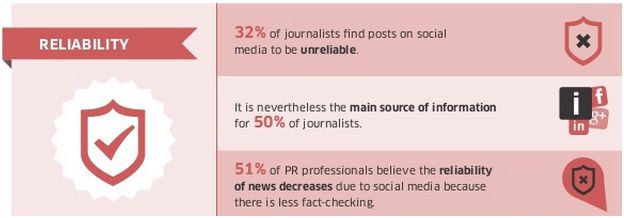
Additionally, the 2014 Study Impact of Social Media on News report, created for PR professionals and journalists, reported that one-third of journalists don’t consider social media posts a reliable source of information.

That doesn’t mean they don’t see the value of social media posts. Fifty percent said the majority of their news tips and facts come from social.

Scott Jaschick, editor and founder of Insider Higher Ed, said at the same media conference, “We now have unofficial sources of information. That really helps.”

I was encouraged, though, when he told the audience to lots of applause, “We’re old school journalists. We actually like to confirm facts.”

Maybe more journalists will return to the days of fact checking.

Covering News in the Digital Era

I transitioned from print journalism to public relations almost two decades ago. My reporting and writing skills have been critical to my success. I also like to think that because I was a reporter, I know what reporters are looking for.

The digital era, though, has changed the rules somewhat.

I remember when I wrote a story about children’s beauty pageants. I received not one but two (!) letters to the editor about the coverage. I also received several phone calls. That was unusual. For the most part, I wrote the story, it was published and, maybe, a friend or a colleague would comment about it.

Today feedback is semi instantaneous. Not only do readers share stories via social media, but news organizations know which stories are being read because of page view reports.

Reporters also are connecting differently. When I started in the business, I worked the phone. It was glued to my ear as I interviewed sources and scheduled face-to-face interview. Today, reporters do much of their reporting by email (that’s not to say they aren’t still meeting with sources) and they can find out about breaking news and potential sources through social media, particularly Twitter.

At the College Media Conference recently held in Washington, D.C., every reporter I met had a Twitter handle, and all but a few are active on it.

“Twitter is a quick way to reach people and find stories,” said Bill Schackner, higher education reporter for the Pittsburgh Post-Gazette.

To better engage with readers, newspapers are creating packages, both in print and online. Nick Anderson, the higher education reporter for the Washington Post, noted how a story on changes to the SAT included a quiz with SAT questions that readers could answer online – and many did.

Some publications also seek content from other sources to reuse on their site. Slate Magazine does this and its news editor Chad Lorenz said that PR practitioners should be aware of these publications and pitch stories to them.

The magazine also recognizes the importance of social media. “We use it to deliver content to new readers on their home turf,” said Chad Lorenz, news editor of Slate Magazine.

Not all readers are interested in the full story. “A share of my readers don’t even want the story,” said Schackner. “They just want the nugget.”

Whether you’re entering the world or reporting or you are pitching the reporters, it’s critical to understand how news is covered in the digital era.

Who You Gonna Call? Not a Reporter

At a recent conference where participants heard from about a dozen reporters, I heard a repeated refrain by the reporters – “Don’t call me.”

They all said their mailboxes were full and that they couldn’t keep up. One said he kept his phone muted.

Reporters prefer email or a tweet to a phone call. (Photo by Cynthia Price)

Reporters prefer email or a tweet to a phone call. (Photo by Cynthia Price)

The preferred method to reach reporters was email, followed closely by Twitter.

“Twitter is a quick way to reach people and find stories,” said Bill Schackner, higher education reporter for the Pittsburgh Post-Gazette.

Karen Travers, a correspondent for ABC News, said, “I never answer my phone. I’m never at my desk.” She most recently was the digital reporter covering the Obama White House, traveling across the United States and to nearly 20 foreign countries with the president.

“I am often impatient with phone calls,” said Richard Perez-Pena, the higher education reporter for the New York Times, during another session. “Emails should always be the default position.”

One reporter’s email signature has the notation, “Phone number available upon request.”

I don’t have an issue with the approach. In fact, I would like reporters to do the same. I’m seldom at my desk but my tablet or mobile is always with me. If the reporter sends me an email, I’ll see it long before I get back to my desk, and I can begin working on the request.

It doesn’t matter what tool we use to communicate. It does matter that we communicate.


Why Media Training Is Important


If you are involved in promoting your organization using key staff, you may want to consider media training for them.

Media training helps the person communicate effectively, minimizes risk and provides positive PR for the person giving the interview and the organization, according to Candace Smith, assistant vice president for media relations for George Washington University in Washington, D.C.

Media training also has benefits beyond the media interview. Such training improves presentations and builds confidence.

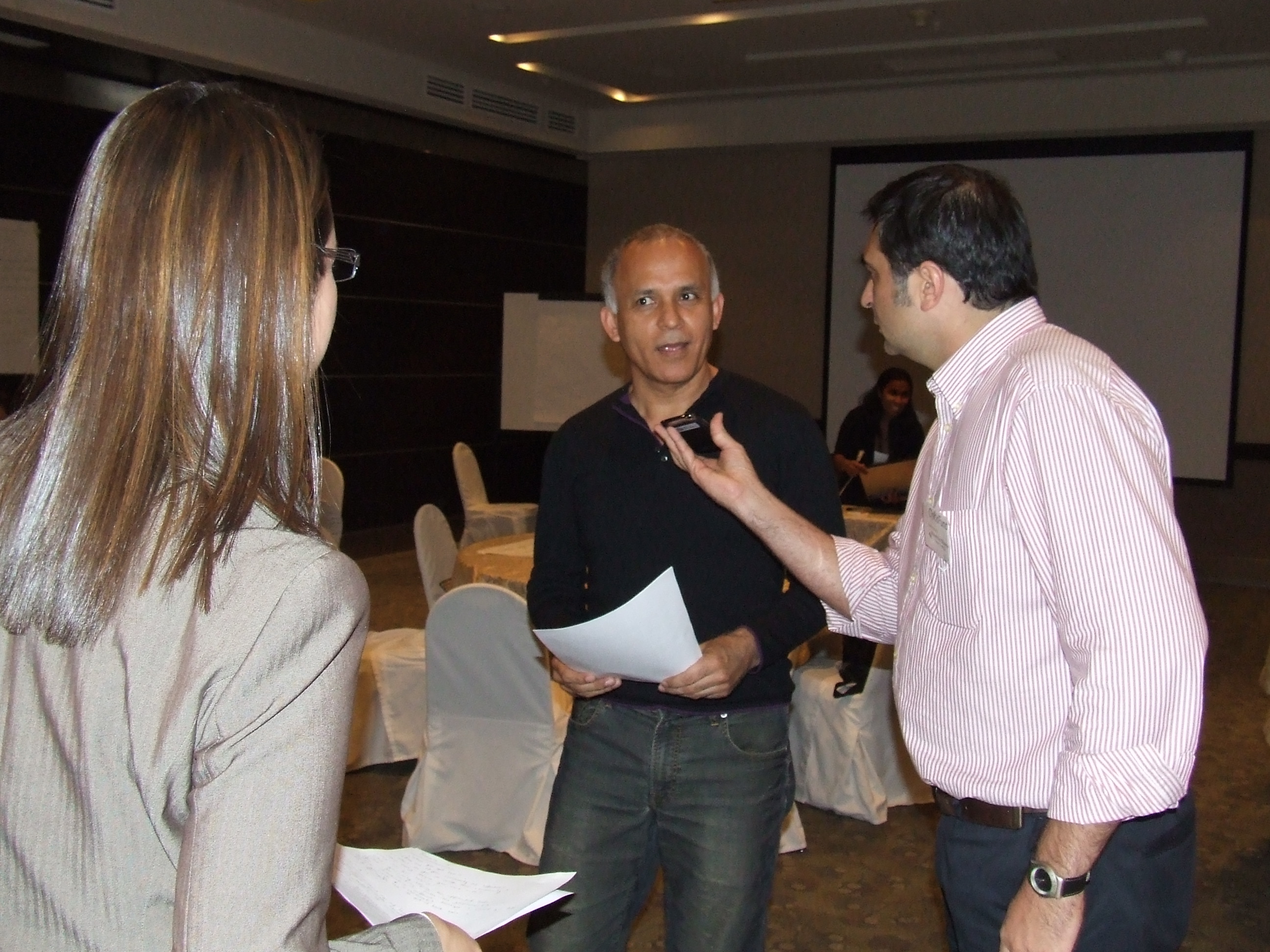
During a mock interview, a journalist uses a smartphone to conduct the interview. (Photo by Cynthia Price)

During a mock interview, a journalist uses a smartphone to conduct the interview. (Photo by Cynthia Price)

Those who haven’t had media training often make some common mistakes. One of the most common is assuming that a reporter has done his research. With today’s media cutbacks, reporters often are assigned the story only a short time before they go to interview the person. As the subject of an interview, it’s important for you to provide some background and context.

The flip side of this is individuals who think they should share everything they know, or a data dump. Most reporters have a limited time for the interview and even shorter time for the final interview. It’s important to know your key messages and focus on sharing those.

Those new to interviews also think they should answer every question a reporter asks. That’s the worst thing an individual can do, especially if the interview is antagonistic. Instead, it’s better to bridge back to an answer that you want the audience to hear.

If you have the opportunity to participate in media training – even if you don’t think you will ever have to give an interview – it may be worth your time.

Creating a Conference Follow Through List

Each year I attend at least one conference and a seminar or two. Like everyone else, I attend for the learning and the networking. It’s also time away from the office or whatever project on which I’m working. This allows my mind to roam and often leads to inspiration or reminders of things I need to do.

Capturing your action items from a conference in one place helps ensure follow through. (Photo by Cynthia Price)

Capturing your action items from a conference in one place helps ensure follow through. (Photo by Cynthia Price)

In years past, I would jot the idea or reminder down in the midst of my notes – whether I was handwriting them or typing them on my laptop or tablet. The problem with this is that I would return to reality and rarely returned to my notes unless I was specifically looking for something in them.

At a conference I just attended, we were provided an app to download from Guidebooks, which also included a To Do list. What a great idea! Every time I had an idea, wanted to remember to reach out to a fellow attendee, or had a specific task I wanted to do upon my return to the office, I added it to the list.

I confess that my list was a bit long by the end of the two full days, but I also already had checked off three items. Some of the items on the list involved seeking out specific people at the conference to whom I wanted to introduce myself. One involved following up with a speaker, and I was able to do that in a hallway conversation.

The rest of the items now are on one handy list for my return to the office. If I do just one item a day, I’ll knock out all of them in short order.

Why I never thought to make one list of action items instead of jotting the items down in the middle of my notes is beyond me. I’m just glad I had this app to inspire me.