Valuing Story Telling

During a recent planning and leadership meeting at work, we began the week focused on storytelling. Our facilitator that day, Judy Rosemarin told us that “the shortest distance between two people is a story.”

Since then I read in Inc. how storytelling can help entrepreneurs and in Fast Company how storytelling can grow a business. Although I’ve been telling stories my whole life, it was always in the context of telling someone else’s story. It’s what reporters and writers do. But this session was about telling stories as a leader or about your company.

I knew I was going to learn something when Judy said we should want our stories to be a “HUMAWAYTM.” It’s a term she trademarked, and it’s what its name implies. When a song sticks with you, you keep humming it. The same is true of a good story.

So how do you tell a good story? Several elements are needed, including:

  • Details
  • Dialogue
  • Momentum

One way, Judy said, is to act like a camera. “What can you show?” she challenged us in the room. The key is using words that create images in our minds.

She also urged us to listen with curiosity when we are interviewing or talking with others. “Dialogue is the key to rich, in the moment, feelings and experiences,” she said.
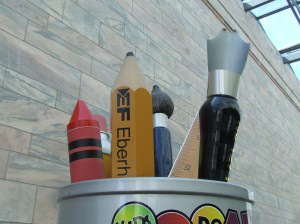
Writing and drawing utensils

Do you know how to tell a good story? (Photo by Cynthia Price)

To get to these stories, she said we must focus on the “why” and “how” and “what’s in it for me” questions, which are seldom answered.

A story should start in the present, jump to the past and springboard to the future.

Judy said the ability to tell a meaningful story is an essential leadership skill. “The sharing of stories connects us to each other, in deep and sustainable ways,” Judy said.

This is true not only for individuals, but also for organizations. “A true story,” Judy said, “is one that people remember; not your official communications, but real live stories.”

When you tell good stories, people will listen. They also will tell their own stories.

What is your story?

Consistency Key to Verbal Brand

Did you know that 96 percent of readers in a survey say poor grammar and misspelling affect their decision to hire a business?

Meghan Codd and Deanna Lorianni of Zuula Consulting shared the statistic during a presentation earlier this year.

Trader Joe's ad

Trader Joe’s verbal brand is fun and quirky and has an engaging personality as evidenced in Trader Joe’s Fearless Flyer.

They focused on verbal brand, which they described as the communications component of a company or professional’s overall brand identity.

These branded messages appear as emails, blogs, phone calls, networking events and resumes.

“Consistency really matters,” Meghan said.

The verbal brand consists of three parts:

  1. Brand purpose
  2. Brand story
  3. Brand voice

The brand purpose is the foundation. “It’s the unique value you are bringing,” Meghan said. “It’s what differentiates you.”

The brand story is the framework, or the themes that guide the company. It’s important not to confuse the marketplace with different messages, Deanna said.

Brand voice is about the tone, style of language key words and phrases that are used. They are the tools of communications.

One company whose verbal brand is consistent across message platforms, they said, is Trader Joe’s. “They are fun, quirky and have an engaging personality,” Meghan said.

Have you looked at your brand?

Cool Twitter Accounts to Follow

At a recent social media conference, we started talking about unique or cool Twitter sites. We weren’t talking about the ones that shared about life’s mundane events. Rather, these were ones that provided information in a unique way.

It’s amazing what can be shared in 140 characters – the maximum amount that a tweet is allowed to have.

Here are three that fascinated me:

  1. @cookbook: Maureen Evans is the author of the Eat Tweet cookbook. She tweets tiny recipes that serve 3-4. At first it’s a bit daunting but with the aid of the glossary she provides, it soon becomes simple. The New York Times called tweeted recipes quite possibly the “first great recipe innovation in 200 years.”
  2. @RealTimeWWII : This one features World War II tweets from 1940 and will continue for six years. Alwyn Collinson is an Oxford history graduate who tweets up to 40 times a day. He uses eyewitness accounts, photographs and video to make it feel as if you are there.
  3. @TVGuide: If you’re like me, you spend a lot of time channel surfing in search of your favorite show. I use TV Guide’s official page for TV news, scoops and live event coverage.

Do you have a favorite? If so, please share it so we can all enjoy it.

Time to Disconnect

I’m in a busy phase of my life right now, both professionally and personally. The result is I’m feeling unbalanced. Fortunately, I attended the Virginia Press Women spring conference this past weekend and attended a workshop by Christina Kunkle, a resilience coach – just what I needed.

Almost immediately, she talked about our need to disconnect. “There is too much emphasis on technology,” she said and went on to emphasize the need for a morning routine or practice.

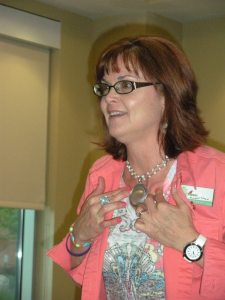
Christina Kunkle

Christina Kunkle encourages indivduals to be the CEO of Y.O.U. (Photo by Cynthia Price)

Ironically, I’d had a great routine for years – until I started using my smartphone as an alarm clock. With the smart phone, before I went to sleep I would check for last minute messages or play a quick game of Sudoku. First thing in the morning, after turning off the alarm, I would check my messages.

Chrstina’s words hit home. And, I’m not alone. Ben Silbermann, cofounder of Pinterest says in the latest issue of Better Homes and Gardens that he went low-tech and bought an alarm clock to break the habit of checking email righter before bed and first thing in the morning.

In the few days since the workshop, I continue to use my smartphone as an alarm clock but now I don’t look at the emails. I have returned to my morning ritual of journaling and making a list for me, which is another thing Christina emphasizes. “You need to be the CEO of Y.O.U.!”

With my list I note if it’s a workout day (seeing it in writing helps get me to the gym at day’s end), jot down evening commitments and identify one or two chores that might need to get done.

“We should start our day with ourselves at the top of the day,” Christina said.

By disconnecting, I actually feel more connected, or at least – grounded.