Coaching Yourself to Career Success

If you want to achieve your ultimate dream, you’re most likely going to have to take something off your plate.

That is the advice of John Fulwider, a consultant, coach and connector, who spoke at the 2011 NFPW conference.
Coaching workook

To make a dream a reality, you need to make a "Not to Do List."

Using a workbook he had developed, he jogged participants through the steps to begin the fulfillment of their dreams. Participants had to write down their goals and make them SMART (specific, measurable, achievable, relevant and time bound), and they had to address the scoffers.

“Those are the people, who say – wrongly, of course, that you can’t possibly pull it off,” John told the group.

He challenged participants to identify their dream – what they are passionate about. For many in the room, it was a time to ponder and at least begin to identify the steps necessary to make the dream a reality. Often, that means identifying what one must give up to make it happen.

I’m working on a mystery manuscript. I put it on hold while I transitioned into a new job and served as president of NFPW. Now, I’m ready to pursue this dream. I’m not taking on new commitments, and I’ve identified time to write. I’m going to stop spending hours on the weekend lost in HGTV, but will instead write.

As part of the exercise, we also identified a personal board of advisors – those individuals who can help make the dream a reality. I’ll be reaching out to these people in the coming months. These advisors will help with editing, finding an agent and publicity. Most importantly, they’ll be there to help me over the hurdles and cheer me on.

Dreams don’t just happen, but John gave the participants a list of specific, measurable and achievable objectives to start work on immediately.  Now that I have my plan, it’s time for me to finish the manuscript and turn this dream into reality.

What will you stop doing to make your dream a reality?

Write It, Publish It!

Rainbow Rowell, author of the romantic comedy Attachments, one of Entertainment weekly’s top 10 “Best of Summer” reads, told an NFPW audience that she had been a journalist for so long it was hard for her to write beyond a few inches. Rowell is a lifestyle and pop culture columnist at The Omaha World-Herald.

"Attachments" by Rainbow Rowell“Writing something like a book is like wading into the ocean when you can’t see the bottom,” she said of her novel, which came in at 87,000 words.

But she waded in, cramming in writing whenever she could. She wrote on holidays and usually one day during the week (often Sundays). Rowell said she couldn’t simply write for an hour each day as many authors do.

“I can’t just dive in and out. I have to have blocks of time to write it. I have to get to a place where it can just come out of me.”

After completing the manuscript, she found an agent and two years after the book sold it was published.

Rowell says that finding an agent is the most difficult part of getting published. “Publishers don’t look at anything unless a literary agent gives it to them,” Rowell said. “They trust the literary agents to weed through the manuscripts.”

Rainbow Rowell

Rainbow Rowell shares publishing tips.

To find a literary agent, Rowell suggested looking through books that list agents. She also said that going to writers’ forums is a good way to learn about  others’ experiences with an agent.

Agents all have different rules for submissions, and Rowell said you need to follow them. “You have to give them exactly what they want,” she said. “They want to make it hard for you.” The agents receive so many submissions, this is a means to weed out the crap.

The best is when the agent asks you to send your manuscript. “Then you are in,” the author said.

A few additional tips she shared include:

  • Write only a one-page query letter.
  • Never call it a book. It’s a manuscript. “The publisher gives you a book,” Rowell said.
  • Start with your bottom choice for literary agent, saving your favorite agent for your final query. “Let other people reject you first so you can learn from them,” she said.
  • Don’t do any pitching to agents in the summertime. Rowell said, “They kick into gear after Labor Day.”

Video 101

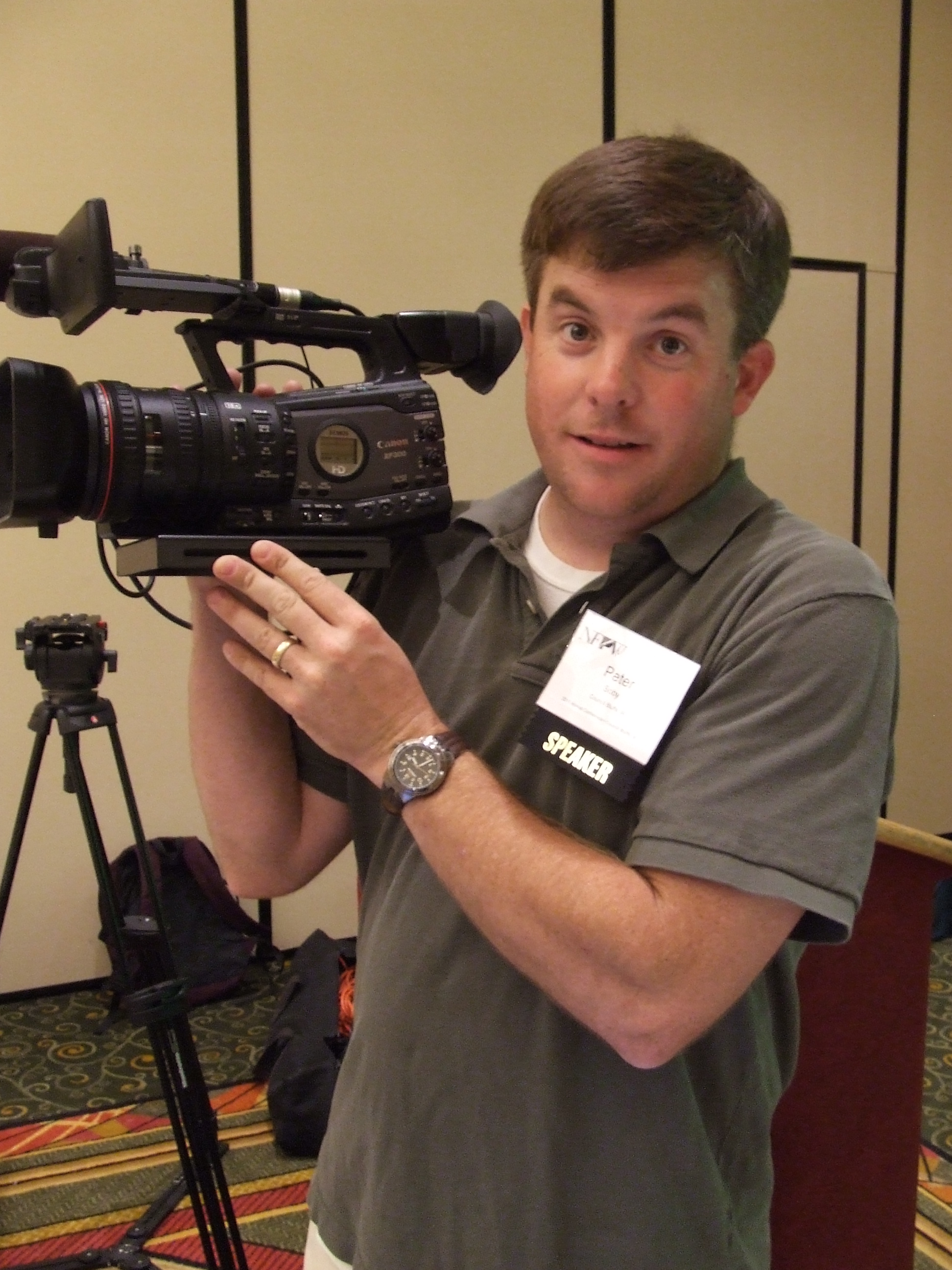
Peter Soby of Soby Vision is a storyteller.

Only his tools are not pen and paper but rather a Canon XF300. He shoots videos.

Peter Soby

Peter Soby explains how to shoot good video. (Photo by Cynthia Price)

And because we’re such a visual society now, Soby says learning how to shoot basic video is critical for those in the communications field. “YouTube has made video that is a little rough okay,” he added.

He offered several tips for shooting good video during a NFPW seminar:

1) Make yourself a tripod – lean up against something.

2) Be loose. If you’re too tight your muscles will shake.

3) Know how all your stuff works. Be able to set up quickly. Practice. He said he practices with a giant stuffed animal in a business shirt. He comes into the room and quickly sets up his equipment and begins shooting video. Once he could do it quickly, he knew he could do it in situations where the subject only had a short time for the interview.

4) Shoot sequence shots. “You shoot this way because our eyes are looking all over,” Soby said. “This will immediately make the video look better.” He noted that most people new to video shoot a lot of medium shots. Instead, shoot wide (to capture the entire scene), medium and tight (close up on the subject or on the action).

5) Use an external microphone because it will make the sound better.

After you shoot the video, what next? He recommends becoming familiar with the video editing software that comes with your computer, such as Windows Moviemaker or iMovie. For even better quality, you may want to buy a professional editing package.

Cynthia’s Communique Continues

Thank you!

Two years ago I started this blog. At the time I stated:

“This is a blog about communicating in today’s world. I became president of National Federation of Press Women in September 2009 and thought a blog would be a terrific platform for sharing ideas about communication, membership and anything else I might want to have a communique about… .”

I really did not know what to expect. I do know the first post felt weird when I hit the “publish” button. As a former newspaper reporter, it didn’t feel right sending it out into the world of the internet. Over time, though, I started receiving feedback in the form of comments on the blog, on Facebook and through email.

Stats for Cynthia Price Communique.I’ve kept to my self-imposed publishing schedule of every Wednesday and Sunday. I’ve often wondered what would happen if I switched days. Would I get more readers? Less? But blogging on Wednesdays and Sundays is now part of my routine, so I think it site stats best not to mess with it.

I try to cover a variety of topics related to communications, whether writing, PR, crisis management or social media. Into the mix I’ll share some leadership lessons and some author profiles. Since starting this blog, I’ve published 221 blogs. During  NFPW conferences and board meetings I blog more often.

WordPress reports that I’ve had more than 8,100 views since I began the blog. Is that good? I don’t know because I’ve broken my own advice, which is to measure it. I didn’t set any goals except to share information. I wasn’t focused on numbers. So now seems like a good time to set my first goal, which is to reach 10,000 views before the year is out.

I’ve also been challenged to find photos to illustrate the blog. I’m having fun as an amateur photographer finding the perfect illustration. Museums, parks and meetings are my favorite places to shoot photos for the blog. Some evenings, I experiment with objects from my desk.

Even though my term as NFPW president has ended, I am continuing the blog. I enjoy the connections I’ve made to members and bloggers, and you’ve told me that the topics are helpful. So as long as I am contributing to the conversation, I’ll keep blogging. I hope you’ll keep sending ideas and commenting and sharing.

Sound good?

Update Your Resume

When is the last time you updated your resume? If it’s been a while, now is the time to do so as September is Update Your Resume Month.

Some easy ways to update your resume include:

  • Add conferences, workshops and events you have attended. For those who attended the 2011 NFPW conference, include it on your resume.
  • Include awards, honors and certifications.
  • Include speaking engagements.

Don’t forget to consider the format and presenation of your resume. Susan Geary, a quadruple-certified resume writer, who has spoken to Virginia Press Women, recommends listing only one phone number on a resume. “Research surveys reveal the majority of people under the age of 30 only have a cell phone,” she said. “Older people still have landlines. So don’t give away your age bracket by listing two phone numbers. Just list the one you’re most likely to answer and check messages.”

Only use a Word doc to submit your resume. Not Works, WordPerfect, OpenOffice, or a PDF. Don’t use docx. For best
compatibility, save your document in MS Word 1997-2003 version. This way you can be sure the firm can open your resume.

Avoid a Skills Based/Functional Resume whenever possible. “They are out of date and recruiters dislike this style because they
raise suspicion as to ‘what are you hiding?’ ” Susan says.

If you are not working, show you’re currently doing something, as in volunteer work or taking classes.

When was the last time you updated your resume?