How Do You Spend Your Time?

One of the best pieces of time management I’ve ever heard is to do the most important thing first. I’ve also heard that you should complete the task that you dread the most. Often, they are one and the same.

For example, I thoroughly enjoy writing this blog. However, to succeed at it, I need to carve time to develop topics and research them. When I don’t do that, I’m left at day’s end realizing the clock is ticking, and I still haven’t written my blog.

Today is one such day. I spent a few hours developing ideas, and I’m really excited to work on those topics, which will come later this summer as they’re tied around specific dates or the upcoming NFPW conference. However, what I really needed to do today is write today’s blog. It’s now after 6 p.m., and it hit me that I should have written today’s blog first and then done research for additional topics.

The same holds true at work. Fortunately, I’m more successful in the office. I write down three things each morning that I must complete that day. I spend as much time as possible working on the first one. Then I invariably have a series of meetings. When I next have a chunk of time, I finish the first item before moving to the next one. I don’t always succeed in finishing all three, but then I simply put the one or two that do not get finished at the start of the next day’s list.

The items often involve planning and strategizing for some event, meeting or report that won’t even happen for a few weeks. Yet, I know that is where I need to spend my time.

The key is to remain focused on the most critical assignments. How do you spend your time?


Make Time Work for You

Last night at volleyball we were up by five points with two minutes left on the clock. Suddenly everyone was feeling the pressure, and we started rushing to serve and keep the lead.

And then it hit me. We have the lead. Slow down. Let time work for us. We didn’t run after the ball when the other team hit it out of bounds. We retrieved it, and passed it back to our server at a reasonable pace. More seconds ticked off the clock. We served. The ball came back. We used our three hits; we scored the point.

The ball came for the next serve. We watched as the ball slowly made its way to the server. Tick, tick, tick. Only a few seconds left. We served, they returned, the buzzer sounded announcing time was up, we returned the ball and scored. Game over.

I thought about that as I was driving home. All we needed to do to win the match was to stick with the plan and play our game. We didn’t need to rush.

I need to remember that in my life. I have a plan for what I need to achieve at work. I know what I need to do for my fitness, for my house, for my friends. I don’t need to rush. I need to work my plan. Sometimes that means slowing down.

Does time work for you or against you?

Learning New Words

When is the last time you learned a new word?

Thanks to a straight line storm that hit where I live, I learned the word “derecho.”

Like many in my region of the country, I learned a new one this past week thanks to the horrible storm known as a derecho. This storm is a widespread, long-lived wind storm that can produce destruction similar to that of tornadoes. The damage typically is directed in one direction along a relatively straight swath. As a result, the term ‘straight-line wind damage’ sometimes is used to describe derecho damage.

When I realized this word was new to me, I started thinking about how I learn new words. I used to love Reader’s Digest for its “Word Play,” which is a quiz that improves vocabulary. When I read a book in high school and college, I always took the time to look up words I didn’t know. Unfortunately, when I read now, I often skim over the word.

When did I get so lazy? The question hit me when I was in a shop and came upon a little book called 100 Words Every High School Graduate Should Know. Of course, I couldn’t resist purchasing it. I was familiar with most of the words, but discovered that a few of them I was using incorrectly. Yikes!

The book not only provided me with the definition but included examples of usage and history of the word. At the end of the book are exercises to improve vocabulary. Of course, one is to write down the words I don’t know and look them up. My favorite, though, is to create a list of words that I think people should know if they were to learn more about a topic that interests me. I thought I might apply that to my day job. Such a list would be beneficial to new employees.

What is the last new word you learned?


4th of July Perfect Day to Relax

Happy 4th of July!

Today is a federal holiday so most of us should not be working.

However, a recent Oseterman Research Survey commissioned by Neverfail indicates that 83 percent of us check email after work on a smartphone or mobile device and more than 66 percent of us bring a work-related device on vacation.

While it may be difficult to disconnect for a week, why not disconnect for a day – today?

Instead of checking emails, writing a report or catching up on work-related reading, spend today relaxing. Enjoy a picnic, watch the fireworks, catch a movie in an air-conditioned theater, read a book or simply watch the tomatoes grow.

The idea is to give yourself a break. Enjoy!


PR Still Ranks as Stressful Job

Last year I shared how PR executive came in number two on CareerCast’s most stressful list just behind commercial pilot. I’m not sure what has improved since then, but this year it’s down to number seven on the list.

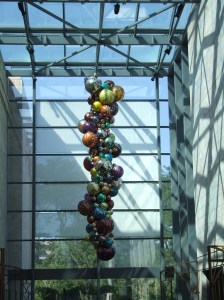
Glass sculpture

PR practitioners juggle lots of assignments, which leads to stress. (Photo by Cynthia Price)

PR executive was chosen because it is a “highly competitive field.” Of course, there is also the public speaking and interacting with members of the media, some of whom can be quite hostile. And don’t forget the deadlines.

CareerCast also ranked event coordinator as stressful, placing it at number six. The events I have planned have been stressful enough, but I’ve never had to do a major one that garnered national attention. Frankly, I would not want that stress.

Among the worst jobs are broadcaster and newspaper reporter, both of which face the same deadlines as PR staff. And reporters have the constant threat of layoffs as the media environment continues to shift. My colleagues in the profession could have told you this without the survey.

If this news depresses you, you might check out the list of best jobs, which includes software engineer, actuary and human resource manager.

Despite the stress, I’m sticking with the communications field. There is still too much to love about it, including being in the thick of things. What do you love about your job?