Small Goals Equal Big Success

Recently while in Ecuador some friends and I took the TeleferiQo, which is a gondola that takes you up the east side of Pichincha Volcano. When it deposits you, it still leaves plenty of hiking to do. The catch was that we were above 13,000 feet and oxygen was in short supply, and we were short of breath.
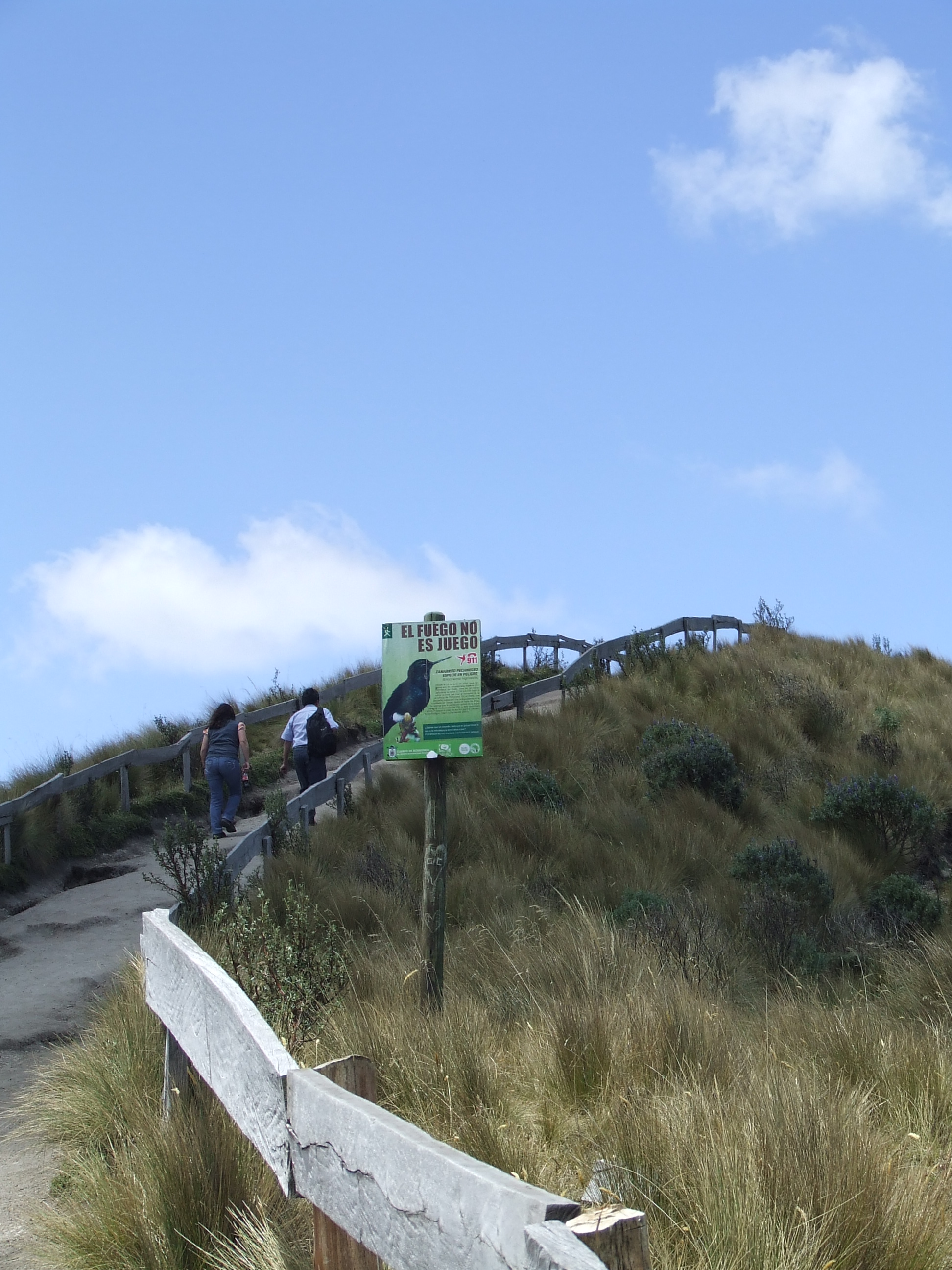
This sign was one of many small goals we set as we hiked.

This sign was one of many that we identified. Reaching it became a small goal.

We saw where we wanted to get to but the distance seemed great. Rather than giving up, we set some small goals. We decided we would at least walk to the first sign that talked about the altitude. At a minimum, we deserved to know how high from sea level we were. Then we decided to make it to the trash can.

We had a series of mini goals and as we reached each one, we gasped for oxygen and cheered ourselves. Before we knew it, we had reached our final goal. Success!

Reaching those small goals kept us going. Teresa M. Amabile and Steven J. Kramer address that idea in their book, The Progress Principle: Using Small Wins to Ignite Joy, Engagement, and Creativity at Work.” “Of all the things that can boost emotions, motivation, and perceptions during a workday, the single most important is making progress in meaningful work.”

It’s why professional organizers recommend cleaning out one drawer or one closet instead of tacking the entire room. Once you’ve experienced the success or organizing and decluttering one space, you’re ready to tackle the next one.

The same advice applies in my fitness efforts. I know how many days I should work out each week and month for my optimal fitness. Sometimes, though, I’m so worn out that the number overwhelms me. However, when I only focus on the next workout, I’m almost always able to complete it, and I feel terrific afterward. More importantly, I’m ready for the next one.

As long as I’m making progress – putting one step in front of the other – not only am I going places but I’m succeeding!

What are your small goals?

A Year of Gratitude

Sometimes focusing on a few details is better than looking at the whole picture.

That lesson can apply to so much in life, whether it’s the big project you have due at work, the house that needs a good spring cleaning or a photography project.

It’s one of the lessons I took away from my photo of the day project in 2012. There are many such project outs there. Some people look for letters in architecture. Some people photograph a menu each day. Mine was simple: 365 Days, 365 Photos.

I haven’t taken a photo since Dec. 31. It feels weird but I wanted to give myself a break. I suspect I’ll still be taking lots of photos but even if I don’t it’s okay because now images are captured in my mind.

I did learn much from my project, including:

  1. I still have lots to learn about photography. I worked hard to capture good images, but I didn’t always succeed. I sometimes ended up with some blurry photos. And you know what? That’s okay because life isn’t always clear.
  2. I definitely was more observant. I learned to look at the big picture – the sweeping vista of a vineyard in Tuscany, for example. I also looked at the details, such as the green olives on the trees that bordered the vineyard.
  3. I smiled more because I was more aware of my surroundings and the simple pleasures of life. I noticed the tiny details – the grace notes – of life.
  4. Even on the most challenging days, if I simply paused, there was much to be grateful for and this project helped me to remember that.

I’ve collected all the photos in a PowerPoint presentation. One slide, one day, one photo (although sometimes multiple photos). When I look through the photos, I realize that nature is a good thing, and I need to spend more time in it. I came to appreciate when the sun set and rose and the different phases of the moon. I was aware of the different cloud shapes.

I didn’t photograph my friends, but rather the experiences we were having, such as book club, dinner out, a walk, shopping.  It led to one of my realizations, which is that I’d rather have experiences than possessions.

Most importantly, I learned I have lots for which to be grateful.

Wasting Time Is a Good New Year’s Resolution

When I leave the office, I try to leave it behind. The problem for me, though, is I have just as many activities outside of work that keep my mind in overdrive. It’s always a challenge for me to totally disconnect.

Working out doesn’t do the trick. It does help me in solving problems. In fact, the other day I was on the treadmill and suddenly the idea I needed for a project popped into my mind. Still, I need to shut down and simply be.

People talk about the importance of not wasting time and always doing something constructive. I know people who travel and use all of the time in the air to catch up on correspondence, write emails, finish a report. I like to simply read a good book or stare at the cloud formations.

I think it’s important to enjoy life’s simple pleasures. It’s why in 2013 I photographed something that made me happy every day. I never missed a day. I came to really appreciate life’s simple joys. (More on this topic next week.)

I discovered that jigsaw puzzles are a great way to disconnect. (Photo by Cynthia Price)

I discovered that jigsaw puzzles are a great way to disconnect. (Photo by Cynthia Price)

I’ve discovered two ways this year that allow me to completely disconnect. The first one is bird watching. Nope, not the kind where you take your binoculars and you hike and keep a list of all the birds you see. Mine is really simple. Put a feeder or two outside a window. Sit in a comfy chair and kick back and watch the birds.

Yes, I sometimes make a mental note of the black-capped chickadee, the dozens of finches, the tufted titmouse or the cardinal. But for the most part, I simply enjoy watching them swoop in and dine. I like looking at their colors and unique markings. I like watching who is the aggressor, who waits his turn, who makes way for others. The next thing I know, an hour has passed.

During the holidays, I found a new pastime – jigsaw puzzles. Growing up I was never a big fan. I was an athlete and didn’t have time to sit still. But it was yucky weather and my sister had given me a 1,000-piece puzzle. Apparently, she thought I was ready for the big leagues.

I started with the border. And then I began filling in the picture, searching for that white piece with just a hint of green in the lower left corner. Hours later, I had made significant progress. More importantly, I had not thought about anything else.

At this time of year, as we all figure out our goals and resolutions, don’t forgot to figure out how you can waste time and find the joy in life.

Say ‘No’ to ‘Reply All’

Anyone who reads my blog knows how I struggle to tame my email. Lots of travel doesn’t help. In the past year, though, I’ve done a fairly good job of reigning in the emails.

One thing that doesn’t help is the “reply all” function. While it is important to send emails to groups of people, it does no one any good if you hit “reply all” to simply send a thank you or a short acknowledgement. Send it to the sender only, not the rest of us in the recipient list. All that you’ve done is clog inboxes.

Sometimes I wish the key could be removed. Or that it would at least come with a warning: “Are you sure you want to do this?” The answer should almost always be no.

Turns out I’m not alone in feeling this way about the function. Microsoft introduced a plug-in option on its Outlook program called NoReplyAll, which allows senders to prevent recipients from replying all to their messages. Sperry Software developed a program that actually asks the warning question, “Are you sure you want to reply to everyone?”

I don’t know if I’ll ever get the feature added at work, but I’m going to make an effort to never “reply all” unless everyone in the distribution truly needs to read my comments.

Professional Development Books Keep Me on Track

One of the ways I know if I’m on track is by checking the number of books I read each year, both for pleasure and for my profession. I don’t have a set number that I have to read, but I do know that if I’ve gone months without reading then I need to realign my priorities.

River

Professional development books help with one’s career journey. (Photo by Cynthia Price)

I decided to review the books I had read for my professional development, in part, because the stack that still needs to be read remains quite high. I did finish several and thought I’d pull them together in a list in case you have anyone you’re still shopping for. I included links to the original posts.

Most of try to do too many things at once. All that multi-tasking makes it difficult to focus. A great book about getting yourself set for the day is 18 Minutes. Written by Peter Bregman, it is based upon his weekly Harvard Business Review columns. Step 1 takes 5 minutes and is about setting the plan for the day. Bregman says that before turning on your computer, we should sit with a blank piece of paper and decide what will make this day highly successful. In Step 2, we refocus for one minute every hour. At the end of the day, we review for five minutes. It sounds simple. I’m fairly consistent with Steps 1 and 2. Step 3, not so much.

I’m an introvert, althoughI’ve learned to function in many settings as an extrovert. I even enjoy it. However, at the end of the day, I need to allow for quiet time, which is why at conferences I prefer to room alone and why I build time into the day for a peaceful walk in between meetings. These become my “restorative niches” as described in Quiet: The Power of Introverts in a World That Can’t Stop Talking by Susan Cain. It’s a great book for understanding the value of introverts.

In Marshall Goldsmith’s book, What Got You Here Won’t Get You There, he recommends making a list of the 25 people most responsible for your career. But he doesn’t stop there. He then wants us to write a thank you note “to confront the humbling fact that you have not achieved your success alone.”

Most of us need routines and order in our lives. If you’re like me, though, you struggle to do so. It’s about finding “the power of rhythm and routine” at work. That phrase comes from Cheryl Richardson in her book, The Art of Extreme Self Care. Creating routines “creates a sense of order that gives the mind a much-needed rest,” she writes. One of the best routines I’ve developed is printing my daily calendar for the next day before I leave the office at the end of the day. That way I already know if I have to pack a lunch or if I have an early meeting for which I must prepare. If that’s the case, I know to schedule my training session for a different day or only plan on a 30-minute morning workout. I also know what healthy snacks to pack.

Jason Womak, author of Your Best Just Got Better, warns that we are often forced to sacrifice quality for quantity. Because there is so much information to take in, he says, we’ve become a nation of skimmers. The downside of that, Womak says, is we miss essential details that could “help us improve our productivity, build better relationships and live more gratifying lives.” His book offers several suggestions, several of which I’ve implemented, including carrying a camera.

What books did you read this year that you would add to the list?