Inspiring Stories Lead to International Reporting Award

“If it bleeds, it leads” is a common refrain in journalism.

One journalist, though, became passionate about sharing inspiring stories about how people are making a difference. And that reporter, Christopher Dawson, recently was presented with InterAction’s award for Excellence in International Reporting.

Christopher Dawson is passionate about sharing inspiring stories about how peole are making a difference. (Photo by Cynthia Price)

Christopher Dawson is passionate about sharing inspiring stories about how people are making a difference. (Photo by Cynthia Price)

During a brief interview with me at InterAction’s 2013 conference, which gathered hundreds of organizations working in developing countries, Dawson talked about empowering journalism.

“Most news seems to be about how badly we can treat each other and about the failings of man,” he said. “To me, that was depressing.”

Fortunately, the company for which he worked – CNN – wanted to air more inspiring stories. The stories also proved popular with advertisers, which don’t want to connect with negative stories, Dawson said. “A sponsored series worked because it’s hopeful and newsworthy.”

Dawson became the lead producer for CNN’s Impact Your World in 2007. Throughout the next four years, he built the project into an award-winning cross-platform initiative for CNN, CNN International, HLN, CNN.com, CNN Mobile and CNN Radio. Impact Your World shares stories of great need and the inspiring examples of charities and volunteers making a difference.

He receives pitches from viewers about stories that inspire and encourage them. Dawson also looks carefully at the problems posed by disasters. “When reporting on a disaster, it’s important to go to the next step,” he said. “You want to find out who is responding and who is restoring the balance.”

Dawson, who also won the ShelterBox Global Media Award in 2011, values the impact of social media on the stories, too. Social media allows for actionable steps that viewers can take. “They are so hungry to participate in the good,” Dawson said. “The story continues beyond our broadcast.”

As for the recognition of his work, Dawson said, “My hope with such an award is that it would encourage more journalists to share these stories to empower and inspire their audiences.”
Checklist to Spring Clean Your Office

Spring is the time for cleaning and freshening up our environs, which means it’s a perfect time to clean your office. Here’s a short checklist to help you:

Dust: Start by removing everything from surfaces and thoroughly dusting. Don’t cheat and dust around items. You’ll be amazed by what is hiding underneath. As you put things back in place, you may find yourself tossing things you no longer need.

Vacuum: Thoroughly vacuum or mop the floors. If you can move furniture easily, this is the time to do so.

Declutter: Now it’s time to tackle the piles. Sort through them and toss what you no longer need. File anything you can. Whatever you do, do NOT create a miscellaneous folder. Even if a folder only has one sheet of paper in it, it will at least be labeled for future reference.

Order: Check your supplies. Do you need ink cartridges, paper, file folders? Make a list and get those ordered, if not for the year then at least for the next six months. It will be one less thing you have to remember to do.

Sort: Open your file drawers and determine if anything can be tossed. I have a rule that everything needs to fit within two file drawers. If both are full, I know it’s time to purge. I’m finding I have fewer file folders because of online documents.

Electronic sort: As part of your spring cleaning, take some time to clean your computer. Delete folders you don’t need anymore. Clean out your emails. Update your software.

There! You’re done with your spring cleaning and your office should be good to go until you start the piles again.

Writing Email Subject Lines

A successful email marketing campaign begins with a basic skill – writing effective subject lines.

The same can be said when you write an email to a colleague. I don’t know anyone who doesn’t complain about email overload so why not help your colleagues by writing clear, concise subject lines?

When you do this, you are ensuring that your email won’t be ignored or deleted.

Here are some things you can do to get your emails read:

Identify the content. If I require the person to take an action, I label my email with “ACTION” followed by what I am expecting the person to do. This provides an immediate framework for the receiver. Sometimes, I am sharing information that I think might be useful, but, it’s clearly not urgent. In that instance, I include, “FYI” and the topic in the subject line. This allows the receivers to filter the email to suit them.

Be concise. Nowadays, people are reading emails on smartphones and tablets. If the subject line is too long, they might move on to the next email with a subject line they can read in the entirety. Think of the subject line as if it were a headline. If you can say it in three words, don’t write it in five.

Act now. If the email I am sending requires a deadline, my subject line is simple, “DEADLINE: Tomorrow.” That way the receiver knows there is a deadline looming and when. If it is a tight deadline, the recipient is immediately made aware. If it’s a few days out, he or she can file it and respond at the appropriate time.

A good marketing email must have value. The same should hold true of emails sent to colleagues.

3 Tips to Avoid Distractions

I used to joke that if you wanted my dorm room, house or office to be spotless give me a deadline that I didn’t want to meet. In an effort to avoid meeting the deadline, I would do most anything, including cleaning anything and everything. Of course, eventually, I’d have to meet the deadline and I’d have even less time to do so, although I would have a neat space.

I now employ a few tricks to force myself to focus. I’m using one of them right now as I work on this blog.

1. Set a time limit. I’ve procrastinated all day writing this blog — and not because I didn’t want to but because I couldn’t figure out which topic I wanted to address. Finally, I picked one and employed this technique. I now have 45 minutes to write, edit and post the blog.

2. Play a CD. Sometimes when I can’t motivate myself to tackle a house project — whether it’s actually cleaning the house or cleaning out a closet — I’ll pick a CD and work until the CD finishes playing. I get to enjoy my music and often get lost in the tunes and before I know it the project is finished, and almost always before the CD has finished. If, by chance, I still have work to complete on the task, I am now motivated and will continue — usually with another CD. I also will listen to a few songs while I clean out e-mails. It makes the task much more enjoyable.

3. Promise yourself a reward. Sometimes the task is just not something you want to do. In that instance, I promise myself a treat, which ranges from a Starbucks to dinner out with friends depending on the challenge of the task.

How do you help yourself to focus?


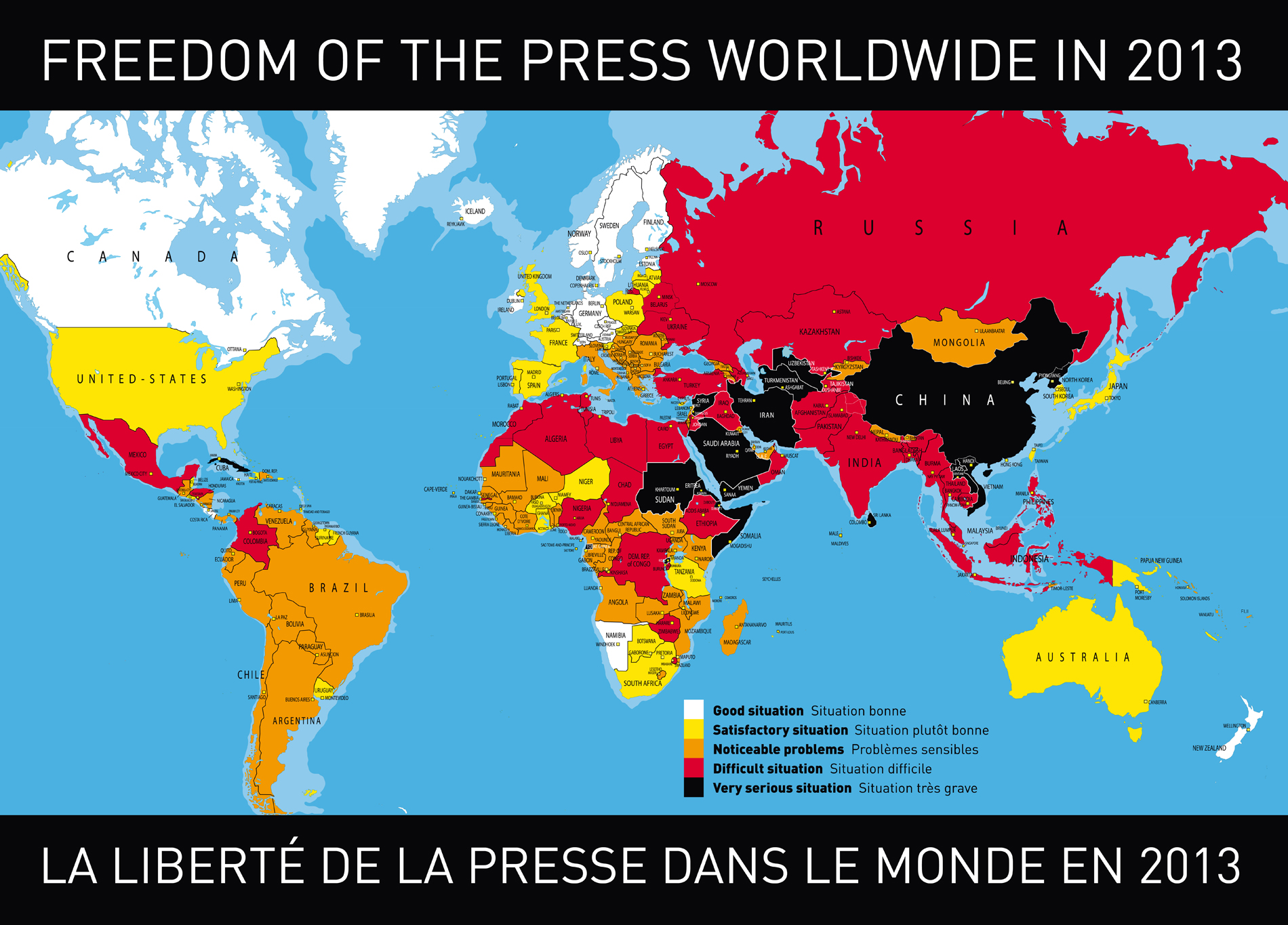
World Press Freedom Index Released

WebThe other day a report about media freedom crossed my desk, and I thought I would share some of the findings.

Finland, the Netherlands and Norway have distinguished themselves as countries that most respect media freedom. Those in the last three positions are dictatorial countries – Turkmenistan, North Korea and Eritrea.

The results are from the 2013 Reporters Without Borders World Press Free Index.

“The Press Freedom Index published by Reporters Without Borders does not take direct account of the kind of political system but it is clear that democracies provide better protection for the freedom to produce and circulate accurate news and information than countries where human rights are flouted,” Reporters Without Borders secretary-general Christophe Deloire said.