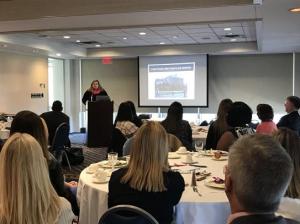
PowerPoint Presentations Require Planning, Practice

PRSA Hampton Roads

Presentations require preparation and practice. 

The Institute for Crisis Management tracked 801,620 crisis news stories during 2017, an increase of more than 25 percent from 2016.

That’s why when the Hampton Roads chapter of PRSA asked me to present on crisis communications, I knew I was going to have to do some research on the latest incidents. Plus, it had been about four years since I last presented on the topic, and I would need to rework some of the slides. In all, I spent about 15 hours preparing.

Based on the feedback and follow-up questions, I think it was worth it.

I share this because some people think they can simply whip up a PowerPoint and then present. To succeed, the prep time is critical. Here are some areas to consider:

Design

  • Decide what the look and feel of your slides will be.
  • Identify the photos, illustrations and artwork that you will use.
  • Consistently use font face and type size on all slides

Text

  • Keep words to a minimum on the slides.
  • Avoid full sentences.
  • Never read your slides.

Take Away

  • Always summarize your 2-3 key points.
  • Make the key points memorable so they will stick with your audience.

Audience

  • Know the composition of your audience and tailor your presentation accordingly.
  • Find out what they are expecting.
  • Always ensure that your presentation description matches what you present.

Practice

  • Know your slides.
  • Speak with confidence.
  • Don’t speak too quickly.

The first practice round I did with my colleagues, I realized I had too many slides, and that I was treating the presentation as if it was a full-day training session. I spent a few more hours on it. I cut slides, added case studies and identified key points. I did a second practice session, and knew I had the right presentation.

The effort put into a presentation pays off when you look at the audience and you see people taking notes, tweeting and nodding in agreement.


On the Path to Publication

Last summer I finally finished the first draft of my travel memoirs – a book I had no intention of writing. My focus had been on writing a mystery and joining the ranks of my favorite authors. Following a visit to my 50th state before I turned 50 – my own bucket list, if you will – friends and colleagues convinced me that my journey was worth chronicling.

What the heck, I figured. At a minimum, it would be one amazing journal of my visits to all 50 states. Now I’m in a second round of revisions and will be finished by late spring at which time I will begin shopping the manuscript around.

On my best days, I write furiously and happily. On my worst days, I’m filled with angst and doubt about my efforts.

20171014_105300

The path to publication is helped when following the advice from published authors. (Photo by Cynthia Price)

I’ve learned, I’m not alone. At the recent Mystery Palooza put on by the Sisters in Crime Central Chapter, several authors shared their journeys on the path to publication.All admitted to the same struggles. I wasn’t alone! Their stories encouraged me to keep plugging along. The authors who presented all had from two to 34 books to their name.

When asked about motivation, several responded about the importance of belonging to writers’ groups. I do, and they are right. Each time I attend a meeting I learn something. I also want to have something to share about my progress.

Frances Aylor, author of the Robbie Bradford financial thrillers, said. “I realized I was telling everyone I was writing a book, and it became a point of honor to finish it.” A few of my colleagues inquire every few weeks about my progress. I look forward to the day when I’m holding a copy of the book!

“Being around other writers motivates me,” author Mary Burton said. Every time I see her, she has encouraging words for me, and she has 34 books to her credit! Her next book, “Her Last Word,” debuts May 8.

Heather Weidner said, “It helps to have peers looking at (your work).” Her second book, “The Tulip Shirt Murders,” just came out.

When I shared my draft with my readers, I was apprehensive to get their feedback. What if they disliked it? Instead, they said, “Tell me more. I want more details.” They scribbled notes and suggestions throughout my draft, and I’m rewriting to deliver what they asked for.

I’m on the path to publication. I’ll let you know when the launch party is!

You’ve Got Mail – And More Mail

I don’t know anyone who doesn’t have a love/hate relationship with their inbox. I know I do. If I find a webinar about taming my inbox, you can be sure I signed up for it.

I recently did just that through the Career Mastery™ Kickstart 2018 event. Carson Tate, who offers a course in taming the inbox and is the author of “Work Simply: Embracing the Power of Your Personal Productivity Style” shared some tips.

While most of us are working to be more productive, part of our problem is poor allocation of time, Carson noted. Unfortunately, one size does not fit all. We each need to find the style that works for us.

IMG_2422

Carson Tate offers advice on how to tame our inbox. 

Carson encourages us to change our mindset about our inboxes. “You no longer work for your inbox, your inbox works for you,” she emphasized.

I was relieved when she said that the typical inbox should have no more than 50 emails in the inbox. Whew! That’s about where I am by week’s end. The first part of the week my inbox soars with emails. For a long time that frustrated me, but I know now that by week’s end the flow of emails ebbs. Midweek, I set time aside to review my emails for any important ones I may have overlooked. I delete those that require no action and offer no information. When Friday comes, I often walk out the door with 50 emails or fewer. Before the holidays I was down to 18.

It’s important to think about how you use your inbox. For me, it’s a giant to do list. Carson said there is nothing wrong with that, but for that to work, it’s important to move reference emails to a retrieval system. I’ll file emails into folders as needed. Other times, I file the attachment into a Word folder so I can retrieve it later.

She also encouraged individuals to stop starting the day with emails. “Your inbox is everyone else’s to do list for you,” she said.

I hadn’t thought about it that way. I now limit how often I check my inbox so I can work on the projects that are a priority. However, I will admit that I check it more frequently than is often recommended because I work with reporters on tight deadlines and need to be able to respond quickly.

By limiting how often I do check my emails, I am able to advance my goals.

The mail continues to arrive, but I’m processing it more efficiently.

What are your tips for taming your inbox?


5 Tips for a Creative Plan for Your Writing Life – Or Just Life

Working on your career is like working on your story. You need to ask yourself, “What is the ending for my 2018 story?”

Journey1Michelle Mercurio shared that advice during a James River Writers workshop. I found it so powerful I went home and spent a few hours journaling about it. Before long, I had three specific outcomes I wanted to see happen by the end of 2018. More importantly, the outcomes were more than words. I told a story with each of the outcomes, weaving in details and monthly plans. It’s going to be a beautiful journey.
The actual workshop was about scheduling, motivating and organizing one’s writing life, but I quickly found the advice applicable to so many areas. And yes, one of my 2018 outcomes is to have a book contract.

Here’s what else I learned:

A map is useful. Michelle urged the audience to define their buckets and then create an ideal calendar and map out how to fill the buckets.

Accountability matters. Karen A. Chase said when you regularly meet with groups you have to show up or people will ask why you didn’t attend. And when you show up, there are people asking about your progress. I’m finding that to be true with my book of travel essays. I’m making more progress the more I talk about it because people follow up and ask me how it is progressing.

Find your spot. We all need a place that inspires us. Or a place that helps us get unstuck. Or maybe a place that is simply a change of pace. I recently spent a long weekend in the Outer Banks writing. It wasn’t my house so I couldn’t be distracted by things I should do around my house. Instead I focused on my writing. It helped that the weather was lousy and I stayed indoors.

Organize. You can organize your notes and ideas by folders using dates or topics. Michelle prefers to use binders. Others organize electronically. Choose the system that works for you, and, if you need to, Kristina Hamlett said hire someone to help you organize.   

Say no. “We need to say no in order to say yes,” Kristina said. It’s important to make time for writing. That might mean turning down invitations.

With all this planning and organizing, you would think you would be set to write (or whatever your goal is), but avoid the pitfall of overscheduling and making so many lists that you aren’t writing.

“It’s safer to plan than it is to do, but choose writing,” Michelle said.

Books to Grow Your Career

I’m sure by now you realize how much I enjoy reading. I love a good novel, especially a mystery. I also read a lot as related to my career and future success.

A recent Business Insider article about how to keep up with the evolving business landscape noted that reading a lot will keep you open to change. The author wrote, “Leaders who read can get into continuous learning loops that allow them be more empathetic and collaborative, rather than commanding and controlling.”

Ron Friedman, an award-winning social psychologist who specializes in human motivation, said one of our psychological needs is to feel competent.

“When we are exposed to new ideas and fresh perspectives that is when we feel ourselves growing,” he said during a webinar with the Career Mastery™ Kickstart 2018 event.

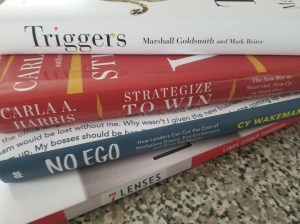
BooksOne suggestion he had for doing this is to give each person on your team a reading budget to purchase a book once a month or quarter. I don’t have a budget to do this but I do share titles with my colleagues and others in my network. I also participate in an informal women and leadership reading group where I am exposed to new ideas or different ways of approaching a concept.

Here are four that are on my list:

Triggers by Marshall Goldsmith He examines the environmental and psychological triggers that can derail us at work and in life and shows how we can overcome the trigger points in our lives, and enact meaningful and lasting change.

Strategize to Win by Carla A. Harris She gives readers the tools they need to get started; get “unstuck” from bad situations; redirect momentum; and position themselves to manage their careers no matter the environment. Here’s a video of her on the topic.

7 Lenses by Linda Fisher Thornton She describes 7 dimensions of “ethical responsibility” that together give us the whole picture of ethical leadership in a global society and provides a powerful framework for ethical decision-making and action.

No Ego by Cy Wakeman Ego-driven behaviors are the #1 source of drama in workplaces today, and it’s costing organizations billions annually. She provides a modern leadership philosophy that provides simple tools and techniques to eliminate drama from our organizations, deliver up employees who say yes to what’s next, and cultivate accountability, not engagement, to drive big business results.

If you have read any of these, would you share your thoughts in the comment field? And if you have other suggestions, we’d love to hear them.