Blog Comments: Good or Bad?

Editor’s Note: I recently attended WordCamp Richmond, which was all about blogging using WordPress. I learned a lot, felt overwhelmed at times and was inspired to write several blogs. This is the second one. Part 1 focused on whether to create a blog and Part 3 will talk about communities and blogging.

One of the best parts of blogging is when someone writes a comment after I post a blog. The comment lets me know that I said something that resonated. My goal is to get to the point where there is a long comment stream because it means that the conversation is continuing.

When it comes to comments on blogs, there are three considerations.

  1. Should I respond to comments? “Yes! It’s building relationships,” says Bradley Robb, who spoke at WordCamp Richmond
    recently.
  2. Should I allow comments? Yes, if you want to steer the conversation.
  3. Can I delete comments I don’t like? Yikes!

If someone posts that they liked the blog, I sometimes acknowledge the kinds words. I know I should do it every time. Sometimes, I get distracted, but really, it’s a compliment, and you should always acknowledge a compliment.

I have my blog set up that I must approve the comment in advance. Only once did I not allow a comment and that’s when someone made a wild claim that I could not substantiate and I feared it could lead to a libel issue.

One time, I made a grammatical mistake in my blog post. A reader sent me a comment. How embarrassing! I quickly revised the blog, and I allowed the comment to remain. I want my readers to know that their comments are appreciated.

Comments are a great way to keep the conversation going. At WordCamp Richmond Frank Fitzpatrick of Henrico County Schools (Va.) shared how students in his school district studied multicultural versions of Cinderella and then commented on blog posts about the topic. Students are taught early about internet safety. Commenting on blogs was a means for  students to pull their thoughts together and share with others, Frank said.

When won’t I allow a comment? As I already noted, if the comment could lead to legal troubles, is offensive or is off topic. After all, this is a community of professional communicators, and I think everyone expects a level of professionalism.

Going forward, I hope to hear from more of you on the blog through comments. For those who are consistent posters, thank you! Your comments mean the world to me.

Blogging 101

Editor’s Note: I recently attended WordCamp Richmond, which was all about blogging using WordPress. I learned a lot, felt overwhelmed at times and was inspired to write several blogs. This is the first one. Part 2 will focus on blog comments and Part 3 will talk about communities and blogging.

When colleagues learn I have a blog, they often say to me, “I need to start one.” My next question to them is why?

Don’t get me wrong, a blog is a great communications tool. However, if you don’t have a communications plan or a purpose for writing the blog, your blog is going to go into cyberspace and nothing will happen.

So why should you have a blog? During a recent WordCamp in Richmond, Va., Bradley Robb, a digital producer with INM United offered four reasons to blog, including:

  1. Building Community
  2. Establishing authority: “If you’re the one with the mic people obviously assume you know what you are talking about,” he notes.
  3. Building fresh content
  4. Engaging directly with clients, customers or peers

Once you’ve decided that a blog is an appropriate communications tool for you or your client, you will want to establish an editorial calendar. I post on Wednesdays and Sundays so my calendar has all the Wednesdays and Sundays listed. I then go through and note possible topics. For example, I knew I would be attending WordCamp Richmond so I marked the dates closest to the camp as topics related to the camp.

In September I always note that I will have three to four posts around the National Federation of Press Women conference. January is a good month to have a post around resolutions related to communications.

An editorial calendar Bradley says “is a great way to make sure your blog doesn’t die.” Since establishing my schedule and calendar, I have never missed a post. A calendar forces consistency for me. When I run low on ideas, I have to spend some time researching so that I don’t come up short on a day that I post. A calendar also leads to new ideas. I met a student the other week for breakfast after he asked for advice about communications in the non-profit field. He tweeted about it, and it inspired a post on a day when I had not yet decided what to write about.

The final benefit of an editorial calendar is that it forces consistency. Thanks to my calendar I have never missed posting on a Wednesday or Sunday. My readers have come to expect twice weekly posts. I don’t want to disappoint.

When you’re ready to blog, don’t forget to create your editorial calendar. Whether you post once a week or once a month, it will help you with your content.

Are you ready to blog?

Cynthia’s Communique Continues

Thank you!

Two years ago I started this blog. At the time I stated:

“This is a blog about communicating in today’s world. I became president of National Federation of Press Women in September 2009 and thought a blog would be a terrific platform for sharing ideas about communication, membership and anything else I might want to have a communique about… .”

I really did not know what to expect. I do know the first post felt weird when I hit the “publish” button. As a former newspaper reporter, it didn’t feel right sending it out into the world of the internet. Over time, though, I started receiving feedback in the form of comments on the blog, on Facebook and through email.

Stats for Cynthia Price Communique.I’ve kept to my self-imposed publishing schedule of every Wednesday and Sunday. I’ve often wondered what would happen if I switched days. Would I get more readers? Less? But blogging on Wednesdays and Sundays is now part of my routine, so I think it site stats best not to mess with it.

I try to cover a variety of topics related to communications, whether writing, PR, crisis management or social media. Into the mix I’ll share some leadership lessons and some author profiles. Since starting this blog, I’ve published 221 blogs. During  NFPW conferences and board meetings I blog more often.

WordPress reports that I’ve had more than 8,100 views since I began the blog. Is that good? I don’t know because I’ve broken my own advice, which is to measure it. I didn’t set any goals except to share information. I wasn’t focused on numbers. So now seems like a good time to set my first goal, which is to reach 10,000 views before the year is out.

I’ve also been challenged to find photos to illustrate the blog. I’m having fun as an amateur photographer finding the perfect illustration. Museums, parks and meetings are my favorite places to shoot photos for the blog. Some evenings, I experiment with objects from my desk.

Even though my term as NFPW president has ended, I am continuing the blog. I enjoy the connections I’ve made to members and bloggers, and you’ve told me that the topics are helpful. So as long as I am contributing to the conversation, I’ll keep blogging. I hope you’ll keep sending ideas and commenting and sharing.

Sound good?

Social Media and Disasters

This past week I experienced a 5.8 magnitude earthquake and Hurricane Irene. In both instances, I immediately went to Facebook and Twitter to see what was happening.

Twitter birdWith the earthquake, I discovered it was felt up and down the East Coast but that I was not far from the epicenter. I was able to quickly connect with friends who wanted to know if I was okay. I learned that there were no injuries but there was property damage at the center.

I’m not alone in finding information out about disasters through social media. According to two new surveys conducted by the American Red Cross, Americans are relying more and more on social media, mobile technology and online news outlets to learn about ongoing disasters, seek help and share information about their well-being after emergencies.

Facebook icon“Social media is becoming an integral part of disaster response,” says Wendy Harman, director of social strategy for the American Red Cross.

Key findings include:

  • Followed by television and local radio, the internet is the third most popular way for people to gather emergency information with 18 percent of both the general and the online population specifically using Facebook for that purpose.
  • Nearly a fourth (24 percent) of the general population and a third (31 percent) of the online population would use social media to let loved ones know they are safe.
  • Four of five (80 percent) of the general and 69 percent of the online populations surveyed believe that national emergency response organizations should regularly monitor social media sites in order to respond promptly.

In the aftermath of Tuesday’s earthquake the Federal Emergency Management Agency urged people to incorporate social media elements into their natural disaster and emergency-preparedness plans.

FEMA Administrator Craig Fugate told reporters that Tuesday’s earthquake demonstrated an over-reliance on cell phones during an emergency.

Mobile networks were overburdened in the immediate aftermath of the quake as people tried to reach friends and family. Cell phone texting, however, remain unaffected and became a popular and reliable alternative.

Twitter Feeds — Good or Bad?

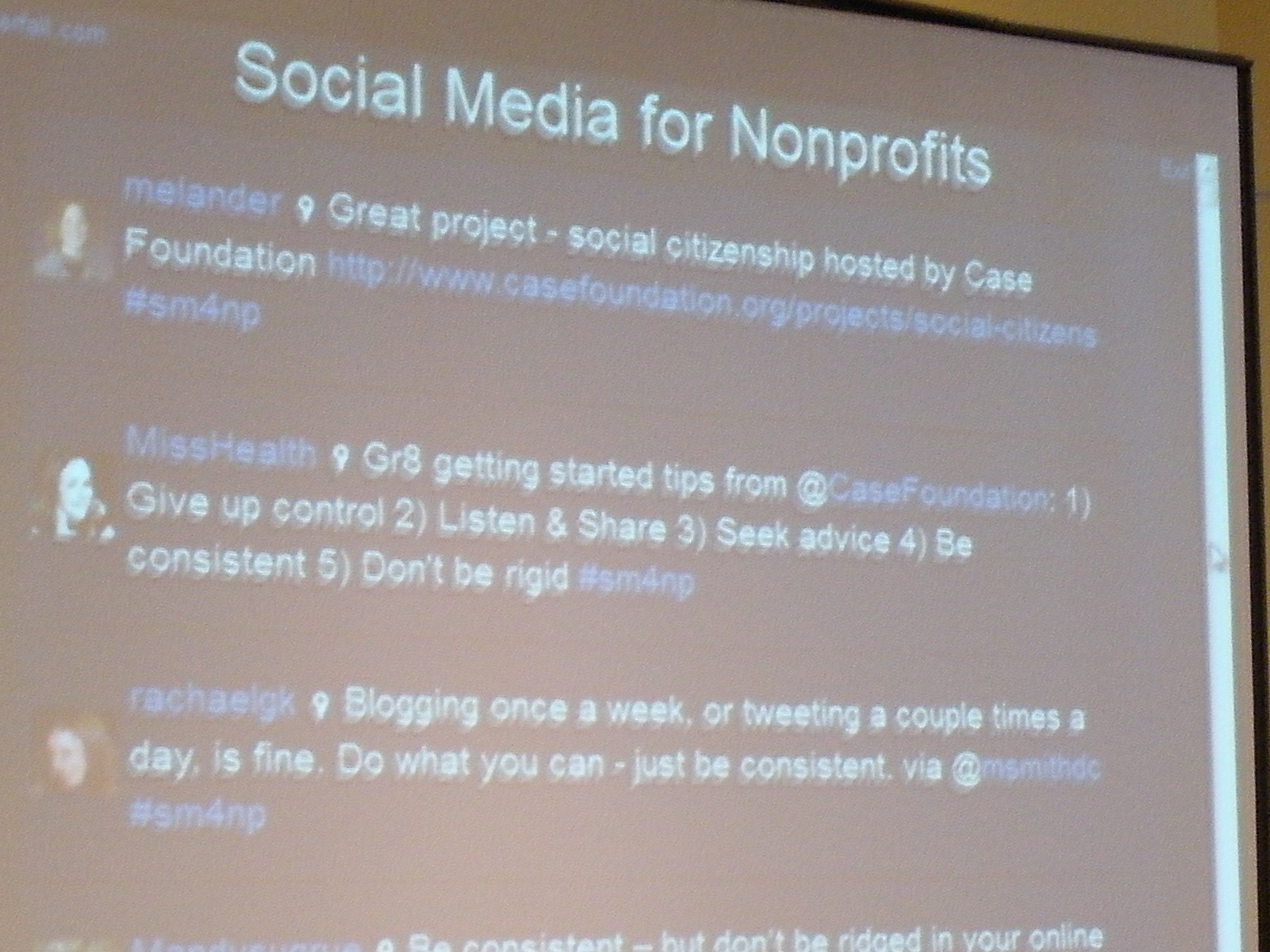
More than two years ago, I participated in a social media conference during which there was a live Twitter feed. As a speaker, I found it a bit distracting because there was so much chatter from the audience around the Twitter stream. The audience members were newbies.

Twitter feeds keep audiences engaged during conferences.

Twitter feeds provide real-time information during a conference.

Today, I don’t think twice about a Twitter feed when I’m speaking. In fact, I find it useful after I speak to go back and see what
audience members tweeted. I can see if my messages hit home or if I need to further refine portions of the talk.

As an audience member, I find the Twitter stream helpful. At a recent social media conference the speaker’s words generated an idea I wanted to capture. As I typed on my netbook, I realized I had lost the thread of the conversation. Not to worry, I just had to look up at the screen with the Twitter feed to see what key points I missed.

Twitter feeds also are great to keep the room engaged and present. And in between speakers it’s a good way to start a conversation with a colleague. At the social media conference you would expect strong engagement. What was particularly helpful was if a speaker quoted someone or referenced a book or movie but didn’t have all of the details. Invariably, someone in the
audience found the information and either tweeted it or tweeted the link so that everyone else could follow-up.

The National Federation of Press Women is gearing up for its annual conference, and we’re considering a Twitter feed – most likely for the social media seminars. A recent LinkedIn post generated many comments. Response has been mostly favorable with a few worried about the distraction of it. On the other hand, many members have not experienced a seminar with a Twitter feed
so this may be a good way to provide that exposure.

What do you think about Twitter feeds during a seminar?