5 Steps to Jump Start Your Career in 2019

I spent part of my winter break thinking about all aspects of my career. Although I’ve worked in communications for many years, the landscape continues to change. I want to stay current. I also aspire to be a published author and career coach.

20171128_105427

Photo by Cynthia Price

Here are 5 things you can do to further your career journey:

Pay membership dues. Before you pay your membership dues, consider each organization and whether you are benefiting. Will you learn something new? Will you network with individuals from whom you can learn and with who you can share information?

Take a course (or two). Learning about new platforms, the latest apps and different management styles is important. Webinars, seminars, conferences and classes all provide learning opportunities. I signed up for a daylong seminar on starting my own business. I won’t be ready to do so for a few years, but at least I’ll know what I should be doing when I am ready to make the leap.

Network. We all know the value of networking but too often we think of it only in the context of a group setting. I try to have at least two networking lunches a month. One is with a colleague within my organization. I like learning about someone else’s position. An added bonus is that because I work in communications, I almost always also get a nugget for a story. I also network with someone monthly outside of my organization. It allows me to see how other companies and sectors operate.

Enter an awards competition. Each year I look to see if I have anything to enter in a communications contest. My colleague and I review our body of work. I’m reminded of some good work. I’m also reminded of some work I could have done better. And I get ideas for other projects. It’s a great process to prepare myself for the coming year.

Update your resume and LinkedIn profile. It’s important to do this yearly to ensure everything is up-to-date. Note key projects you worked on in the past year and double check keywords. Reach out to your references, updating them on your career and finding out on what they have focused.

Are you ready to jump start your career?


Jump Start Your Career in 2018

I spent part of my winter break thinking about all aspects of my career. Although I’ve worked in communications for many years, the landscape continues to change. I want to stay current. I also aspire to be a published author and career coach.

chess pieces

What  moves are you making to ensure career success? (Photo by Cynthia Price)

Here are 5 things I did to set my priorities and make changes to my career journey:

Paid my membership dues. Before I paid the dues, I considered each organization and whether I was benefiting. I elected not to renew one of my memberships because while the programming was strong it was geared toward individuals at a different place in their careers. Another group has been super encouraging, and I even received a handwritten note from one of the members encouraging me to stretch even further. I renewed that one.

Take a course (or two). I suspect I will always be a lifelong learner. Learning about new platforms, the latest apps and different management styles is important. I’m always looking for webinars, seminars, conferences and classes. I’ve signed up for a WordPress certificate course. I know the basics for my blog, but I’d like to improve my website and find out what I don’t know. For fun – and maybe to help with my mystery writing – I decided to take a course on the “FBI in Movies.” If nothing else, I think I will get to watch some good movies. Anyone for “The Untouchables?”

Network. We all know the value of networking but too often we think of it only in the context of a group setting. I try to have at least two networking lunches a month. One is with a colleague within my organization. I like learning about someone else’s position. An added bonus is that because I work in communications, I almost always also get a nugget for a story. I also network with someone monthly outside of my organization. It allows me to see how other companies and sectors operate.

Entered an awards competition. Each year I look to see if I have anything to enter in a communications contest. My colleague and I review our body of work. I’m reminded of some good work. I’m also reminded of some work I could have done better. And I get ideas for other projects. It’s a great process to prepare myself for the coming year.

Updated my resume and LinkedIn profile. It’s important to do this yearly to ensure everything is up-to-date. I note key projects I worked on in the past year and double check keywords. I also reached out to my references, updating them on my career and to find out what they had been focused on.

Are you ready to jump start your career?

5 Tips I Picked up at the JRW Conference

My dear, late friend Emyl Jenkins was known for sprinkling her fairy dust over many writers.

Once again, she did it when I attended the James River Writers Conference. Her delightful husband Bob attended to award the Emyl Jenkins Sexton award, which recognizes individuals who continue her legacy of inspiring a love of writing and writing education in Virginia. He talked about how she spent so much time helping other writers, she sometimes needed to be reminded to follow her own advice: “Put the seat of your pants on the seat of the chair and write.”

That’s what I’ve done for the past two years, and have a first draft of a manuscript of travel essays. I decided to attend the JRW conference to learn more about fine-tuning the book, the publishing process and finding an agent.

I learned how much more I need to do, and what I was doing right. Here are some of the tips:

Attend a conference. This is the obvious one, but I found myself hesitating to register for the JRW conference. It was worth every penny and giving up a weekend of writing.

20171015_135912

Great advice on a tote bag. (Photo by Cynthia Price)

I worried. Do I belong here? Is my writing good enough? Turns out almost every writer has those thoughts. Mystery writer Maggie King shared a great tip, “At a conference, I pick one person and I talk with them.” She says she usually makes a new friend or discovers a fan. Either way, she said, “You’ve done your good deed for the day.”

Identify beta readers. These are individuals who, early on, read your manuscript and point out plot holes, poor dialogue and inconsistencies among other things. I did that with the travel essays, and I’m now reworking the material.

Write a strong query letter. This is your chance to sell an agent on you and your manuscript. You want the letter to be authentic and polished.

Most writers aren’t going to have the success that David Baldacci did with his first query letter. He shared the story during a luncheon Q&A.

He said he wrote in his letter, “I guarantee if you read the first page, you will read through until the last page.” He figured they’d read the manuscript just to prove him wrong. Fortunately, he was spot on, and he now has 34 novels to his credit.

Agent Cherise Fisher said a query letter reveals the author’s knowledge of herself and that’s important to her. “I am looking for a partner in bringing this book into the world.”

Power of Cmty

Maggie King, Joanna S. Lee, Maya Smart and Angele McQuade talked about the power of community during the James River Writers 2017 conference. Shawna Christos moderated.  (Photo by Cynthia Price)

Join a community of writers. These can be face-to-face or online. Maya Payne Smart says she gets more out of in-person writing communities. “You see (the writers) are real people. There is something to putting a face to the stories you hear,” she said. “It’s important to have people cheering for you.”

Joanna S. Lee said it’s okay to join online and then simply “lurk” until you are ready to contribute.

One benefit of an online community is the flexibility. “Not all of us can be in person within the community whether because of work or obligations,” said Angele McQuade.

Just write. The one piece of advice I heard repeatedly is what Emyl always told me — you need to write. McQuade said, “You need to recognize when you are having too much fun within the writing community and aren’t writing.”


Productivity tips from the experts

For the past several evenings, I have been watching way too many videos, but it’s okay. They are an investment in myself. I recently blogged about the importance of investing in yourself, and one of the things I recommended was finding free webinars.

Capture_PeakWorkPerformanceThe Peak Work Performance Summit is a series of video talks with some of the top productivity names in the industry. It’s a wealth of “research-based insights and actionable tips for elevating your performance,” according to the email I received from Ron Friedman, author of “The Best Place to Work,” and organizer of the Summit. Unfortunately, the videos are no longer available for free, but you can purchase access.
Here are just a few of the takeaways I had –

Gretchen Rubin on Changing Your Habits noted, “Nothing is more exhausting than the task that is never started.” After watching her session, I wrote the introduction for a book idea I have. I’d been talking about writing the introduction for three months. I also developed a writing schedule. She also suggested developing some fun habits, including running down stairs because it’s energizing. I did it at work, and people commented on how much energy I had!

Christine Carter, who wrote, “The Sweet Spot: How to Find Your Groove at Home and Work,” talked about the “better than nothing workout.” Her point is that more is not necessarily better, especially if you don’t even start. I’m on a Fitbit quest, but there are days that 10,000 steps seem daunting. After listening to Carter, I gave myself permission to just walk 2,500 steps that day. Once I started, I was good. That day, I reached 7,700 steps. I was short a bit, but at least I moved.

Greg McKeown spoke about “the undisciplined pursuit of more.” The antidote, he said, “is the disciplined pursuit of less but better.” For example, when an opportunity presents itself, is it a great opportunity, or a just a good opportunity?

I have always been a list maker, and in the last few years, I’ve become even more intense about my lists. I feel vindicated now thanks to David Allen who said, “Don’t use your head as an office.” He said that writing things helps us stay clear and focused. He is the author of “Getting Things Done: The Art of Stress-free Productivity.”

One of the ways, I have developed my skills is by volunteering through groups to which I belong. Dorie Clark, author of “Reinventing You,” recommended doing just that — volunteering in areas of interest where you want to take your career. “It can help you pivot,” she noted. She also recommended creating a networking plan and being strategic about who to spend time with and who you want to learn from.

Carrie Wilkerson, who wrote the “Barefoot Executive,” recommended picking one person and intentionally following them through the year, whether you invest with them or not. Currently, I personally pay a monthly fee to be part of an inner circle in which I get tips on earning positive media coverage. You could also follow a person’s blog or buy their book. The key, Wilkerson said, is to listen and not try to be on all the lists (of course, that’s easier said than done after participating in this summit!)

An underlying theme was the importance of developing and implementing routines. Doing so makes execution as effortless as possible, McKeown said. Turns out our mothers were right to line up our clothes for the week.

My takeaways were many, and I’ve put them on a master list so I don’t lose sight of them. Some of the items are action items, and I’ve assigned due dates to ensure that I follow through. Mostly though, I came away inspired.

Modern Rolodex

As a reporter, sources were key to my success. In public relations, it’s all about networking. Either way, business cards are the lifeblood of communicators.

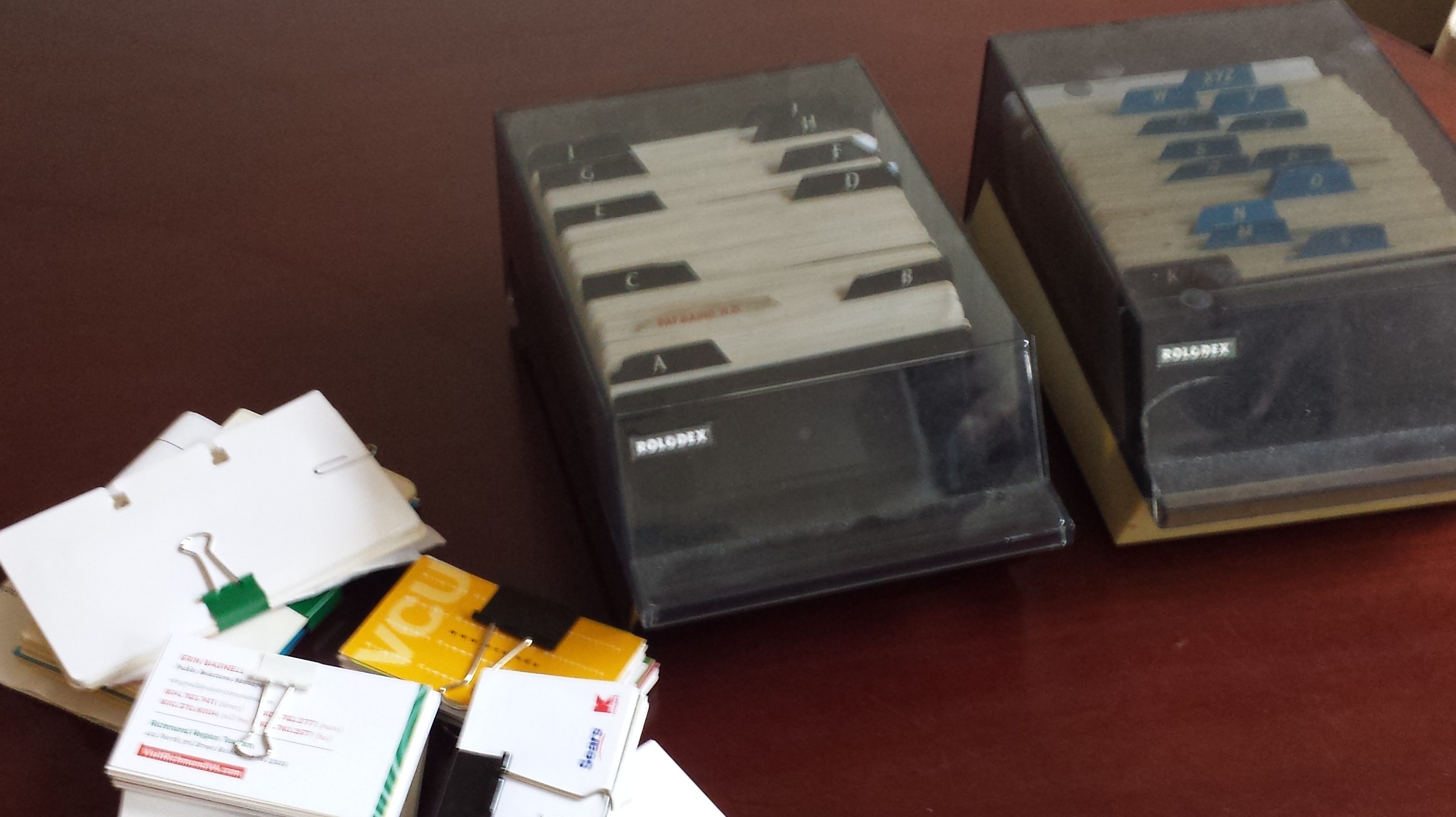
20141029_112515I miss the days of my big round Rolodex. I could spin it and find anyone at my fingertips.

Yes, I know I can store and search for contacts using electronic contacts or LinkedIn. For me, though, there is a difference – I can no longer see the business card. Sometimes I forget the person’s name, but I can clearly recall the logo or image on the business card.

One of my contacts has his image artfully drawn on it. I can forget his name, but I don’t forget the card. Or I’ll recall that you work at Ohio State University, but, again, I can’t remember your name. I spin the Rolodex and suddenly I see the Ohio State logo. I’ve found you.

So without the Rolodex, I’ve struggled. Until recently. That’s when I heard Jill Chappell say, “I get paid for my Rolodex, so it is really important that I know who these people are.”

She calls herself a professional stalker, but in actuality she books interviews for Wolf Blitzer on CNN.

When she files a person’s name and details, she puts a key word under the company name. That key word helps her remember what she needs to know about a person. If she has met a doctor who treated Ebola, she puts the word Ebola in the company name. When she searches for Ebola, the doctor’s name appears. She includes other critical details, including company name, in the notes section.

I’ve totally embraced this idea. Everyone I met at a recent conference is now listed in my contacts under the same company name – that of the conference.

Thanks for a genius idea Jill!