Defining Your Organization’s News Values

News values are the building blocks of a story.

The news values that we learned in journalism school include: timeliness, proximity, impact, prominence, bizarreness, conflict and currency (issues in the spotlight).

But did you ever stop to think about news values as related to your organization? For the past month, my organization has been conducting global communications training. As an international organization focused on child development in developing countries, we identified additional news values that included curiosity, understanding, engagement, innovation and positive
outcomes.

  • Curiosity: We work in 31 countries, some of which have changed names throughout the years. Others are so far away or so small that our supporters may know little about them. But because we work there, they want to know more about the countries – from the work we do to what the climate is like to the languages spoken to the food that is eaten.
  • Understanding: We defined this as walking in someone else’s shoes. This might include describing a typical day for a child in a developing country, for example.
  • Engagement: We want all of our stories to engage with our readers by either providing them with relevant information or encouraging our supporters to act in some way, whether it is making a donation, posting the information to their social media platforms or advocating.
  • Innovation: Changing a child’s life requires innovative approaches. One of our news values is sharing those innovative approaches. An example is a booking ceremony in Kenya. Traditionally, girls were “booked” for marriage at a very young age. Our approach was to work within the society’s culture and instead have the girls booked for education before marriage. This provides them with a better future.
  • Positive outcomes: We recognize that it’s not enough to share what we are doing but that in addition to sharing the solutions, we must share the results. In other words, we must measure and evaluate to determine the effectiveness of the programs.

As a first step to identifying our news values we brainstormed about what is unique about our work. From there, we developed our list.

What are the news values of your organization?

Coaching Yourself to Career Success

If you want to achieve your ultimate dream, you’re most likely going to have to take something off your plate.

That is the advice of John Fulwider, a consultant, coach and connector, who spoke at the 2011 NFPW conference.

Coaching workook

To make a dream a reality, you need to make a "Not to Do List."

Using a workbook he had developed, he jogged participants through the steps to begin the fulfillment of their dreams. Participants had to write down their goals and make them SMART (specific, measurable, achievable, relevant and time bound), and they had to address the scoffers.

“Those are the people, who say – wrongly, of course, that you can’t possibly pull it off,” John told the group.

He challenged participants to identify their dream – what they are passionate about. For many in the room, it was a time to ponder and at least begin to identify the steps necessary to make the dream a reality. Often, that means identifying what one must give up to make it happen.

I’m working on a mystery manuscript. I put it on hold while I transitioned into a new job and served as president of NFPW. Now, I’m ready to pursue this dream. I’m not taking on new commitments, and I’ve identified time to write. I’m going to stop spending hours on the weekend lost in HGTV, but will instead write.

As part of the exercise, we also identified a personal board of advisors – those individuals who can help make the dream a reality. I’ll be reaching out to these people in the coming months. These advisors will help with editing, finding an agent and publicity. Most importantly, they’ll be there to help me over the hurdles and cheer me on.

Dreams don’t just happen, but John gave the participants a list of specific, measurable and achievable objectives to start work on immediately.  Now that I have my plan, it’s time for me to finish the manuscript and turn this dream into reality.

What will you stop doing to make your dream a reality?

Write It, Publish It!

Rainbow Rowell, author of the romantic comedy Attachments, one of Entertainment weekly’s top 10 “Best of Summer” reads, told an NFPW audience that she had been a journalist for so long it was hard for her to write beyond a few inches. Rowell is a lifestyle and pop culture columnist at The Omaha World-Herald.

"Attachments" by Rainbow Rowell“Writing something like a book is like wading into the ocean when you can’t see the bottom,” she said of her novel, which came in at 87,000 words.

But she waded in, cramming in writing whenever she could. She wrote on holidays and usually one day during the week (often Sundays). Rowell said she couldn’t simply write for an hour each day as many authors do.

“I can’t just dive in and out. I have to have blocks of time to write it. I have to get to a place where it can just come out of me.”

After completing the manuscript, she found an agent and two years after the book sold it was published.

Rowell says that finding an agent is the most difficult part of getting published. “Publishers don’t look at anything unless a literary agent gives it to them,” Rowell said. “They trust the literary agents to weed through the manuscripts.”

Rainbow Rowell

Rainbow Rowell shares publishing tips.

To find a literary agent, Rowell suggested looking through books that list agents. She also said that going to writers’ forums is a good way to learn about  others’ experiences with an agent.

Agents all have different rules for submissions, and Rowell said you need to follow them. “You have to give them exactly what they want,” she said. “They want to make it hard for you.” The agents receive so many submissions, this is a means to weed out the crap.

The best is when the agent asks you to send your manuscript. “Then you are in,” the author said.

A few additional tips she shared include:

  • Write only a one-page query letter.
  • Never call it a book. It’s a manuscript. “The publisher gives you a book,” Rowell said.
  • Start with your bottom choice for literary agent, saving your favorite agent for your final query. “Let other people reject you first so you can learn from them,” she said.
  • Don’t do any pitching to agents in the summertime. Rowell said, “They kick into gear after Labor Day.”

Video 101

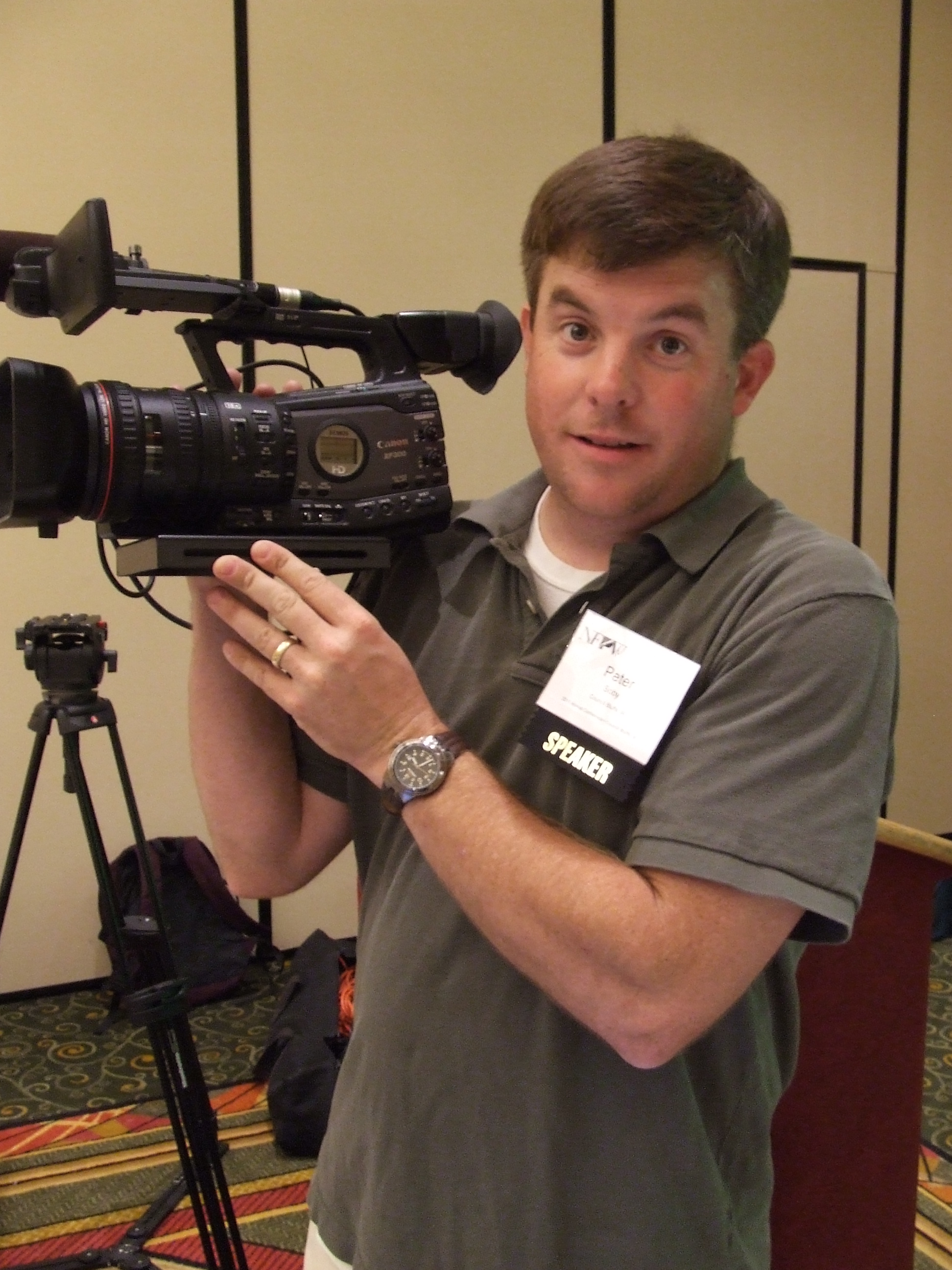
Peter Soby of Soby Vision is a storyteller.

Only his tools are not pen and paper but rather a Canon XF300. He shoots videos.

Peter Soby

Peter Soby explains how to shoot good video. (Photo by Cynthia Price)

And because we’re such a visual society now, Soby says learning how to shoot basic video is critical for those in the communications field. “YouTube has made video that is a little rough okay,” he added.

He offered several tips for shooting good video during a NFPW seminar:

1) Make yourself a tripod – lean up against something.

2) Be loose. If you’re too tight your muscles will shake.

3) Know how all your stuff works. Be able to set up quickly. Practice. He said he practices with a giant stuffed animal in a business shirt. He comes into the room and quickly sets up his equipment and begins shooting video. Once he could do it quickly, he knew he could do it in situations where the subject only had a short time for the interview.

4) Shoot sequence shots. “You shoot this way because our eyes are looking all over,” Soby said. “This will immediately make the video look better.” He noted that most people new to video shoot a lot of medium shots. Instead, shoot wide (to capture the entire scene), medium and tight (close up on the subject or on the action).

5) Use an external microphone because it will make the sound better.

After you shoot the video, what next? He recommends becoming familiar with the video editing software that comes with your computer, such as Windows Moviemaker or iMovie. For even better quality, you may want to buy a professional editing package.