VPC Blazes New Trail

When I was president of NFPW, the one thing I said I wouldn’t address was a name change. I wanted to focus on SNAP!, or sustainability, networking and professional development. And that’s what I did.

However, when my affiliate Virginia Press Women discussed a name change, I was all for it. VPW was founded in 1958 as an organization for female newspaper editors and writers. In 1973, membership was opened to men.

For too many years, I’ve had individuals (mostly men) say to me, “Oh, that’s that women’s group.” I don’t think they were being derogatory, but that’s how they defined it, and, unfortunately, it often meant they didn’t think as highly of it because they didn’t think it was inclusive.

For the longest time, such comments didn’t bother me much, especially given that women still only earn 77 percent of what men do, according to the White House. Keeping the name was a way to further emphasize the need for parity.

However, when I made the transition from newspaper reporter to PR practitioner, I often felt as if I didn’t truly belong to VPW because I was no longer “press.” In recent years, I’ve had many potential members tell me the same thing. They didn’t think they could join because they worked for a PR firm, were a solo practitioner, wrote a blog or a book, or coordinated events.

Yet one of the things VPW has been so good at is joining all types of communicators and helping individuals transition from journalism to PR or from writer or coordinator to manager or director. The amount of knowledge within the organization is astonishing. More importantly, the members are so willing to share their experience and expertise with others. I’ve learned so much from my peers in this organization.

That’s why when the board proposed a name change, I jumped to support it. Of course, I had plenty to say about the name change having gone through one with an organization for which I worked. And many of our members debated it one rainy Saturday afternoon, exploring all options.

The board took on the challenge and on April 5, members voted to change the name of Virginia Press Women to Virginia Professional Communicators.

No matter what we call ourselves, though, our members – be they journalists, PR practitioners, novelists, men or women – will continue to trail blazes. That’s a group that I want to belong to!
Time to Disconnect

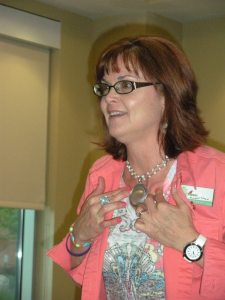
I’m in a busy phase of my life right now, both professionally and personally. The result is I’m feeling unbalanced. Fortunately, I attended the Virginia Press Women spring conference this past weekend and attended a workshop by Christina Kunkle, a resilience coach – just what I needed.

Almost immediately, she talked about our need to disconnect. “There is too much emphasis on technology,” she said and went on to emphasize the need for a morning routine or practice.

Christina Kunkle

Christina Kunkle encourages indivduals to be the CEO of Y.O.U. (Photo by Cynthia Price)

Ironically, I’d had a great routine for years – until I started using my smartphone as an alarm clock. With the smart phone, before I went to sleep I would check for last minute messages or play a quick game of Sudoku. First thing in the morning, after turning off the alarm, I would check my messages.

Chrstina’s words hit home. And, I’m not alone. Ben Silbermann, cofounder of Pinterest says in the latest issue of Better Homes and Gardens that he went low-tech and bought an alarm clock to break the habit of checking email righter before bed and first thing in the morning.

In the few days since the workshop, I continue to use my smartphone as an alarm clock but now I don’t look at the emails. I have returned to my morning ritual of journaling and making a list for me, which is another thing Christina emphasizes. “You need to be the CEO of Y.O.U.!”

With my list I note if it’s a workout day (seeing it in writing helps get me to the gym at day’s end), jot down evening commitments and identify one or two chores that might need to get done.

“We should start our day with ourselves at the top of the day,” Christina said.

By disconnecting, I actually feel more connected, or at least – grounded.

Journalism is an Ideal Stepping Stone for Career

Charles Darwin said those most responsive to change would survive. In today’s changing workplace, individuals must change to be relevant and visible.

Pam Stallsmith of Virginia Press Women shared her journey from long-time newspaper reporter to communications consultant for the Federal Reserve Bank of Richmond during a workshop at the 2010 NFPW Conference.

“I went from a noisy newsroom to a quiet office,” Pam says. “The first thing I realized is that I can’t use a newsroom voice.”

The biggest change for her was that journalism is reactive with lots of short-term deadlines. But “corporate communications is strategic and proactive,” she says.

She’s also learning more technology and has worked on several multimedia projects. “Interactivity is everywhere,” she notes.

Pam exemplifies why journalism is an ideal stepping stone for a career in journalism, says Lynn Hazan, who founded Lynn Hazan & Associates, which provides recruiting services for clients.

Some of the skills journalists bring to the table and, therefore, are skills that journalists should highlight when transitioning into communications, are –

  • Interview skills
  • Ability to make and see connections
  • Writing – taking the complex and making it easily understood
  • Ability to talk to many types of people
  • Creativity
  • Inquisitiveness
  • Deadline oriented
  • Multitasking
  • Critical thinking.

Editors/Freelancers Face Off

Notice to freelancers – editors don’t want much from you. Here’s what they want –

1)      Good copy

2)      Clean copy

3)      On-time copy

4)      Someone who follows instructions.

That’s what editors shared during a session of Virginia Press Women’s spring conference in Roanoke.

Dan Smith, editor of Valley Business Front, and former editor of Blue Ridge Business Journal, also urges writers to write in their own voice. “Hang on to it,” he says. “It makes you a better writer.”

“The editor’s role is to give the writers as much room, support and guidance,” says Keith Ferrell, freelance writer and former editor of Omni magazine.

Freelance writer Deborah Huso says she wants editors who return phone calls and emails. “There needs to be basic courtesy and good communication,” she notes.

She also urges writers to have a contract before proceeding with any writing. “You do not work for a magazine, you work for the editor,” she says. “If a new editor comes in don’t assume the old contract is valid.”

Digital media has changed the freelance landscape. Deborah says writers should get paid for all the uses of their articles. “Don’t be afraid to negotiate, especially if you’ve been in the business for a long time,” Deborah says.

Neither Dan or Keith disagreed with Deborah’s perspectives. Dan says, “Talk to other writers for the publication and find out about their experiences” before you start writing for a new publication.

“We work with our writers to accommodate their requests,” Dan adds. “We want to be on the writer’s side.”

They all agreed on one point – if you’re going to be a freelance writer, you have a to be a business person first and a writer second.

Blue Ridge Parkway Celebrates 75 Years

More people visit the Blue Ridge Parkway than visit the Great Smokey Mountains, Grand Canyon and Yellowstone combined.

Phil Francis, superintendent of the Blue Ridge Parkway, shared insights into the Parkway during Virginia Press Women’s spring conference in Roanoke, April 23. The Parkway, which is celebrating its 75th anniversary, is a half-day’s drive for almost half of the U.S. population.

The Parkway, Francis told VPW, is more than its scenic overlooks. “It’s the places to sleep, eat and the adjacent communities.”

With that in mind, he wanted to involve everyone and “have a big party” for the 75th. The Blue Ridge Parkway Travel Association is leading the effort. As part of the celebration, symposiums are being held to honor the past but also contemplate the future.

As with any good PR event, the Parkway set three goals.

1)      Connect with communities

2)      Stewardship: protecting the Parkway and preserving it for future generations

3)      Financial sustainability.

Francis noted that the visitor experience is the Parkway and their visits to the communities along the Parkway.

But he is concerned that only 11 percent of park visitors are young people.  Also troubling is that 80 percent of visibility has been lost in his lifetime.

Yet the Parkway has much to offer. It has more species of trees than all of Europe. Its biodiversity is great. It has 250 pull-ins to enjoy the Parkway. It’s a designated landscape in that every single mile of it was designed, Francis said.

VPW members had many suggestions to enhance the Parkway as a destination, but Francis noted that the Parkway has two limitations – capacity and process.  Fortunately, it also has Friends of the Blue Ridge Parkway, the Blue Ridge Foundation and an anniversary website.