Aliza Sherman thrives in the digital age, but also knows to value self

Aliza Sherman is a speaker, author and web pioneer who has championed women in tech since the 1990s. Newsweek named her one of the “Top People Who Matter Most on the Internet” in 1995. In 2009, Fast Company called her one of the “Most Powerful Women in Technology.”

And while she thrives in the digital age, she recognizes that it also poses some problems.

During the recent NFPW conference she discussed “The Future of Communications in Our Ultra Connected Social Media World.”

Aliza Sherman questions whether 140 characters is enough to be heard. (Photo by Cynthia Price)

Aliza Sherman questions whether 140 characters is enough to be heard. (Photo by Cynthia Price)

“The internet has transformed every way we communicate,” she said. “There are so many layers of complexity.”

Not only do we struggle with consuming all of the information (about 6,000 tweets are tweeted every second), we also have to respond to it (does anyone have an empty inbox?) and determine if the research is accurate.

“As communicators we have to learn to cut through the noise,” Sherman said.

Because we don’t, we are losing our ability to focus. And the noise, she said, stifles our creativity. Some of us obsess over the like button. Some limit their communications to 140 characters (myself included @PriceCynthia).

“Social media has changed our information consumption habits because it has changed our brains,” Sherman said.

The result is that we fight FOMO (Fear of Missing Out) and NoMoPhobia (not having a mobile).

Sherman said, “Smarter and more mindful use of technology can transform bad habits into better ones.”

She recommended a few apps to help with attention, focus, productivity and creativity, including:

  • Rescue Time tracks time spent on applications and websites, giving you an accurate picture of your day.
  • Coffitivity plays the ambient sounds of a morning coffee shop or the ambient tones of a university café. You can also upgrade to get ambient sounds from Paris or a Brazilian coffeeshop.
  • Humin manages your contacts and helps you sift through the data.
  • Calm allows you to discover the power of meditation and take a mental break.

Sometimes, though, the best app is no app.

“Give yourself permission to disconnect,” Sherman said. “It all comes down to value. Value yourself. Value your loved ones. Value your life. The future of communications is value.”

Pie Champion Has All the Ingredients for Success

Who would have thought biscuits would have anything to do with a career, but they do.

Just ask Francine Bryson, a national pie champion, mom, homemaker and self-proclaimed redneck. Her award-winning desserts have won the hearts of bakers everywhere when she appeared on CBS’s “The American Baking Competition.”

Francine Bryson remains true to herself and excels on the baking circuit. (Photo by Cynthia Price)

Francine Bryson remains true to herself and excels on the baking circuit. (Photo by Cynthia Price)

I recently heard her speak, and she demonstrated to the audience how to make biscuits. Many of the step involved in making biscuits also relate to creating a successful career.

The first lesson is to follow your passion. For Francine that’s baking. As a 4-year-old she made a lemon meringue pie. “I’m not sayin’ you could eat it,” she told the audience. Over time, though, she developed her skills and now knows that if it “comes out of an oven,” she can make it.

When it comes to ingredients, Francine said she uses self-rising flour.  “This lets you skip baking powder and baking soda,” she said. “Who has time for all the extra ingredients?”

Another way to look at that is to make sure you have the right ingredients. In the case of work, do you have all of the information that you need to create a PR plan or the elements to write a great story?

Once she had the right ingredients, she put a whisk in the flour to lighten it up. “Sometimes you just need to give it attention,” she said.

That’s good advice, especially, if I apply it to a project. For a project to succeed, I need to give it the appropriate attention.

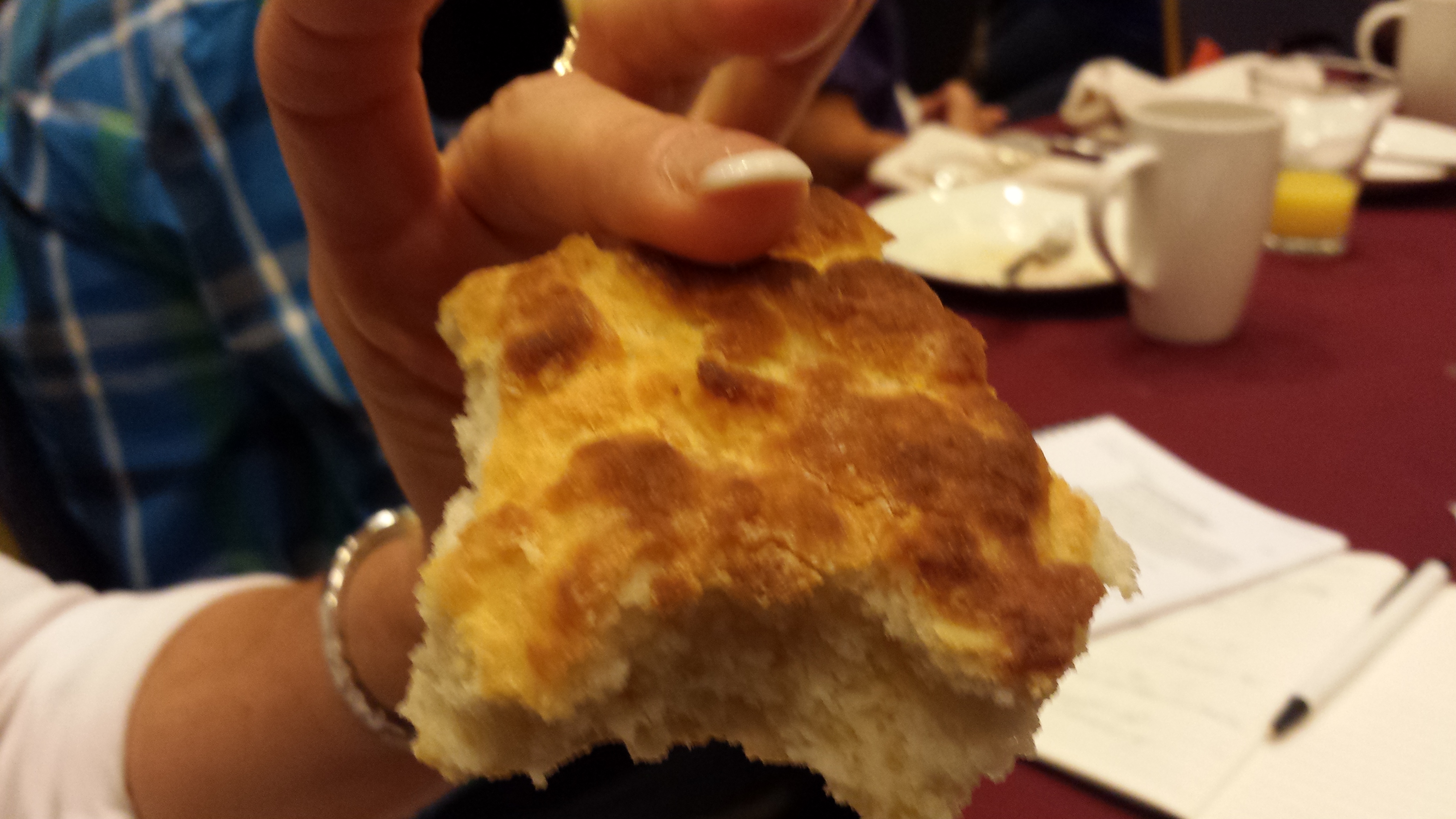
20140905_091907As Francine mixed the ingredients for biscuits, she emphasized, “Don’t overwork the batter,” adding, “Let the ingredients become friends.”

I realized that sometimes when I’m working on a project, I make it too complex. Listening to Francine I realized I should not overwork or overthink a problem.

As she gently mixed the batter, I thought about challenges I have had at work, and how sometimes I overthink them and fret about them instead of simply quickly addressing them. The advice also holds for making friends with colleagues, even those with whom you don’t directly interact on a daily basis. You never know when you might need to mix in additional knowledge.

Her final advice was to take time to play in the kitchen because “it’s cheaper than therapy.” I admit that I enjoy whipping up a storm in the kitchen to unwind. But even if you don’t like to cook, the point is to make sure you have fun in life.

Now that’s a recipe for success.

7 Ways to Help a Reporter

When Terry Cole began her reporting career, she covered the water commission. She admitted, “I didn’t get it.”

She was fortunate, though, because the commissioner spent time with her explaining about water and how the water commission worked. His taking the time to do that helped ensure the accuracy of her reporting.

Today she is the Communications Practice Director for Jacobs Engineering with more than 25 years of experience implementing strategic communications programs. Along the way, she’s learned some ways to help other reporters, which she shared during the 2014 NFPW conference in Greenville, S.C.

  1. Find the sizzle in the technical stories. If it’s too technical, audiences won’t be interested, which means reporters won’t be interested.
  2. Avoid jargon. This goes without saying.
  3. Break down the challenging concepts. Taking the time to do this leads to more accurate and interesting stories.
  4. Provide a list of acronyms. These are also good to share internally so there is no confusion.
  5. Think of visuals. Cole noted that sometimes spending time with a photographer or videographer to get the right shot may be your only opportunity to tell your story, so use the time wisely.
  6. Don’t let people start from a place of panic. Most companies have a reason for the processes they have in place, Cole said. Too often, though, when a reporter asks a question about the process, people panic. “You have a reason for doing what you do,” Cole said. “Take the time to explain.”
  7. Provide media training. She wasn’t referring to media training for executives, but rather to those on the front line. At a minimum, the training will prevent them from saying, “I can’t talk to the media.”

And if all of those techniques fail, Cole reminded the audience that most of us now have resources at our disposal for telling our stories.

A company website and social media platforms immediately come to mind, but she also encouraged the use of community events. For example, Spartanburg, S.C., has held a Paddle Fest the past three years as a way to help connect the community to its reservoirs and increase the stewardship of water resources.

Doing What It Takes to Pay the Mortgage

Tiffany Ervin calls herself the “queen of self promotion.”

She has to be if she is going to pay the mortgage.

She has cobbled together a series of positions to do just that. She has worked as a morning radio show host, a keynote speaker, a sideline reporter, a TV host and even a commercial spokesperson. She also owns a clothing boutique.

Those positions came from her passions – speaking and giving back.

As a preacher’s kid, Tiffany listened to her dad in the pulpit and came to understand how to use words to move people. She also was active with the Miss America organization where she learned the value of community service and further enhanced her public speaking skills.

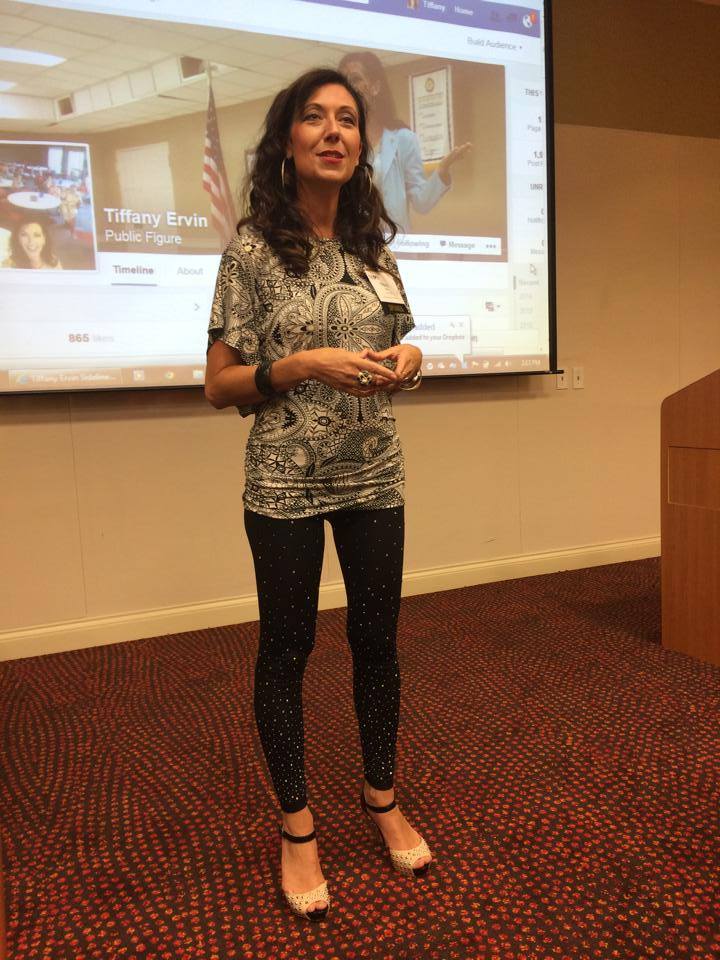
Tiffany Ervin speaks to NFPW members at the 2014 conference. (Photo by Cynthia Price)

Tiffany Ervin speaks to NFPW members at the 2014 conference. (Photo by Cynthia Price)

She followed a fairly traditional path except that instead of working in broadcast journalism she went into public relations and marketing. She oversaw marketing for a hospital. During that time she worked for three CEOs in four years. Tiffany decided it was time for a change.

That’s when she began co-hosting a morning radio show. Next thing she knew, she was doing an infomercial for South Carolina. Other jobs presented themselves, and she became involved with Rotary, which also helped grow her public speaking. She now offers talks called “Breakfast with Tiffany.”

She told an NFPW audience at its recent conference in Greenville, S.C., that “to be a freelancer you have to be constantly evolving and reinventing yourself.”

Part of succeeding, Tiffany stressed, is to find your passion. For her it’s public speaking and giving back. “I’ve had so many great mentors,” she said. “I want to do that for someone else.”

Along the way, she has learned that sometimes she has to make difficult decisions. “You have got to be doing things that give you forward progress,” she said. For her that meant giving up a radio show that required a long commute that cut into other opportunities.

Once you know what you want to do, Tiffany encouraged audience members to network and use social media, both of which involve building relationships.

“Social media is an opportunity to network with people who may be looking for you, and you didn’t even know it,” she said.

Tiffany uses social media to share short clips from her speeches. “It’s great for when someone wants a sample of my work,” she said.

Facebook is good for demonstrating the breadth of what she offers. She finds Twitter helpful for meeting people in the long-term.

At the end of the day, when she has finished all of her jobs, she also knows she has paid the mortgage.

Make Your Case to Attend a Conference

Do you want to discover the spirit of innovation and inspiration at the 2014 NFPW Communications Conference?

The conference promises professional development and plenty of networking opportunities, both of which are important for your career.

When deciding whether to attend a conference, which often involves making the case to attend to your boss (or helping yourself decide to make the investment in yourself), consider these areas: program, networking, fees and recharging.

Is the conference program jam-packed with workshops that will have some benefit for you, your team and your organization?

The 2014 NFPW conference will focus on three areas:

  • Develop Your Digital Impact
  • Create Innovative Communications
  • Modernize Your Professional Profile

Within those areas are topics such as Leveraging the Right Digital Tools to Tell Your Story; Are You A Social Media Wallflower?; Why Local Is Still Important; and How To Stand Out In Your Genre. I already know I’m going to have a difficult time choosing which workshops to attend.

Next consider the networking opportunities, which enable you to establish connections with outstanding communicators. At least year’s conference, I learned about a member who was in the book publishing business. I contacted her because my company needed a book publisher, and hers was able to meet our needs. My colleagues were impressed that I could find someone so quickly.

When I applied for a recent job, I reached out to members I had met who worked in higher education. I received lots of great tips to help me as I prepared for my interviews.

We all like to save money. If you register for the conference by Aug. 8 you will save $50 off the conference registration. If it’s your first time attending a conference, you can apply for a first-timer grant, which will cover the cost of registration. Most conferences have an early-bird rate.

CaptureThose reasons should satisfy your employer as you state your case to attend.

Another great reason to attend is that you can recharge and recalibrate. Taking a break from the office is important to health and productivity. I always return re-energized because I meet others who face similar challenges and frustrations. Even if we don’t solve the problem, we feel better discussing it, but most often I come back with ideas to implement.

NFPW conferences also give you a break. If you have a few vacation days, it’s worth it to sign up for a pre-tour of post tour. The conference organizers know their state and provide you with wonderful glimpses into their world.

Of course, you can turn that into a working vacation. This year’s conference organizers are introducing “Media Marketplace,” a unique news-gathering exchange that brings the stories to freelancers and travel writers.

With all these reasons to attend conference, what are you waiting for? Register now!